Guides
What OSHA and FDA rules mean for vending machine labeling and placement
Vending routes answer to two federal rulebooks: FDA calorie disclosure at the machine and OSHA standards for servicing, wiring and placement.
What to take away
- The FDA calorie disclosure duty attaches at 20 or more vending machines and must be readable before the customer pays.
- Packaged food needs a Nutrition Facts panel, an ingredient statement and allergen declarations no matter how small the route is.
- OSHA 1910.147 covers any service task that exposes a hand to a spring auger, a drive motor or a live circuit. Stocking through a closed door does not.
- Electrical findings cluster around three habitsdamaged cords kept in service, extension cords used as permanent wiring, and missing ground pins.
- Placement limits come from exit route rules, ADA reach ranges and the fire marshal, not from a federal vending law.
- About half the states run their own OSHA program, and several of them write stricter standards than the federal text.
Which federal rules actually reach a vending machine
No federal agency regulates vending machines as a category. The rules arrive sideways, through the food, the worker and the wiring.
The FDA reaches the machine because it sells food. A vended bag of chips is a sale of food under the Federal Food, Drug, and Cosmetic Act, so it carries the same labeling duties as grocery shelf stock.
OSHA reaches the machine because someone has to service it. A route driver is an employee, and a machine with a live compressor or a charged spring motor is that employee's workplace.
The ADA reaches the machine through the building. Reach ranges and clear floor space apply when the host is a public accommodation or a government office.
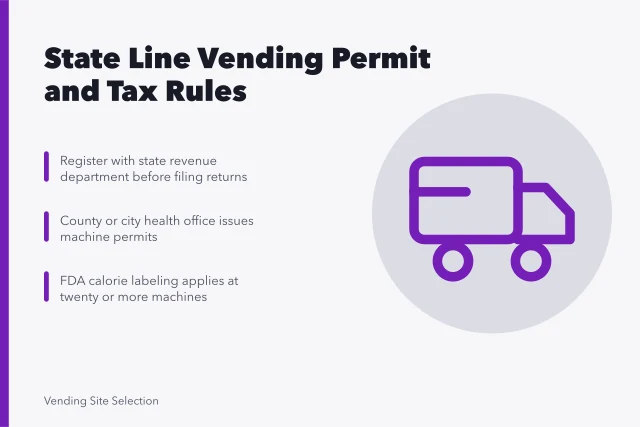
State and local health departments reach it through the food permit. Vend perishable food and you should expect a plan review and periodic inspection. A licensing and compliance guide covers the registration side; this article covers labeling and placement.
There is no federal vending machine license. Operators stack obligations instead: food labeling, worker safety, electrical code, tax registration and host contracts.
Route size changes which duties apply. A five machine route and a five hundred machine route do not face the same FDA obligations, and the threshold is written into the rule.
FDA vending machine labeling and calorie disclosure duties
Packaged food labeling is the base layer. Nutrition labeling, ingredient statements and allergen declarations belong on the package itself, and they follow the product, not the route.
The calorie disclosure rule adds a duty at the point of sale. A customer must be able to read calorie information before paying, not after.
That means a calorie declaration on the front of the machine, on a sign beside it, or on the package where the buyer can read it at the glass.
The duty attaches to operators who own or operate 20 or more vending machines. Under that count, the federal calorie duty generally does not attach, but the packaged food rules still do.
Count carefully if you sit near the line, and keep the count in writing. A route that grew through two acquisitions can cross 20 without anyone deciding to.
A sticker inside the coin return is not a disclosure. A laminated card at eye level on the machine face is. If the corner is dim, the sign has to work in that light.
Some items fall outside the calorie rule, including certain foods sold in very small quantities. Do not guess at the boundary. Read the rule text and, when the answer matters, ask the FDA or counsel.
Micro markets sit closer to a retail store than to a machine, and the labeling expectations follow that resemblance. Treat the self checkout kiosk as a point of sale.
The FDA's Nutrition, Food Labeling, and Critical Foods | FDA page is the starting point for the packaged food side.
| Item | FDA duty | Who it hits |
|---|---|---|
| Packaged snacks and drinks | Nutrition Facts, ingredients, allergens | All sellers, any route size |
| Calorie disclosure at machine | Calorie declaration visible before purchase | Operators with 20 or more machines |
| Perishable food | Food safety and labeling rules, local permit | Operators selling refrigerated or hot food |
| Micro market kiosks | Point of sale labeling expectations | Operators running unattended stores |
OSHA lockout/tagout for vending machine servicing
Stocking means opening the door and loading product. Servicing means repair, cleaning of internal parts, or any task where a guard comes off and a mechanism is exposed.
When servicing can release stored energy, OSHA lockout/tagout under 1910.147 - The control of hazardous energy (lockout/tagout). | Occupational Safety and Health Administration applies.
Stored energy in a vending machine is not only electricity. It is also the tension in a spring loaded auger and the pressure in a refrigeration circuit. A jammed spiral that snaps free with a hand inside is the case the standard exists for.
The standard requires a written energy control program, machine specific procedures, training for authorized and affected employees, and periodic inspection of the procedures themselves.
The sequence is short. Notify affected workers. Shut down. Isolate. Lock and tag. Release stored energy. Then verify zero energy.
Verification is the step routes skip. After locking out, try the normal start control. If the machine runs, the isolation failed and the lock is decoration.
For most routes the program looks like this:
- List every machine model and its energy sources, springs and refrigerant included.
- Write one procedure per model family.
- Buy lockout devices, tags and a hasp that fit the plugs and disconnects you actually own.
- Train authorized technicians on the procedure and train route staff to recognize the hazard and stay out.
- Inspect the procedures at least annually and fix what the inspection finds.
A driver who only stocks product is an affected employee, not an authorized one. Affected employees need awareness training, not the full procedure, and confusing the two roles is a common citation.
A preventive maintenance checklist should name the lockout step for every task that opens a mechanism. A checklist that says "clear jam" without "isolate power first" is teaching the wrong habit.
The standard carries a narrow exception for cord and plug connected equipment under the exclusive control of the worker. It does not cover a machine a customer can reach, and it does not cover a panel that stays energized after the plug is pulled.
Electrical safety and equipment use standards for installations
Most machines run on 120 volt branch circuits, with larger units on 208 or 240 volt feeds. Installation falls under OSHA 1910.303, which covers approval of equipment, guarding of live parts and working space around equipment.
Working space matters more than operators expect. A machine pushed tight against a wall or a stack of cases blocks the room a technician needs. A missing back panel is a defect under the same standard, not a cosmetic issue.
Equipment in use falls under 1910.334 - Use of equipment. | Occupational Safety and Health Administration, which covers flexible cords, portable equipment and the condition of tools in service.
Three field habits cause most electrical findings:
- A damaged cord or plug kept in service because the machine still runs.
- An extension cord run across a walkway to reach a machine with no nearby receptacle.
- A junction box left open after a repair.
Grounding is the other recurring issue. A missing ground pin, or an adapter that defeats the ground, is a shock hazard for customers and staff. Pull the machine from service until it is corrected.
Local electrical code applies on top. Most states adopt a version of the National Electrical Code, and a city inspector can require more than OSHA does. OSHA 1910.303 is the workplace floor, not the whole code.
Settle the electrical question before the machine arrives. Ask the host whether the receptacle is on a dedicated circuit, whether it is grounded, and who pays for a new one. A sop checklist for daily operations should carry a cord and plug inspection on every visit.
Workplace placement limits and hazard communication
No federal rule sets a required distance between a vending machine and a door. Placement limits stack from several sources instead.
OSHA requires adequate exit routes and clear aisles. A machine in a corridor can narrow the path below what the walking and working surfaces rules allow, and in a plant that is the host employer's citation.
In practice the host tells you to move it, and the host is right.
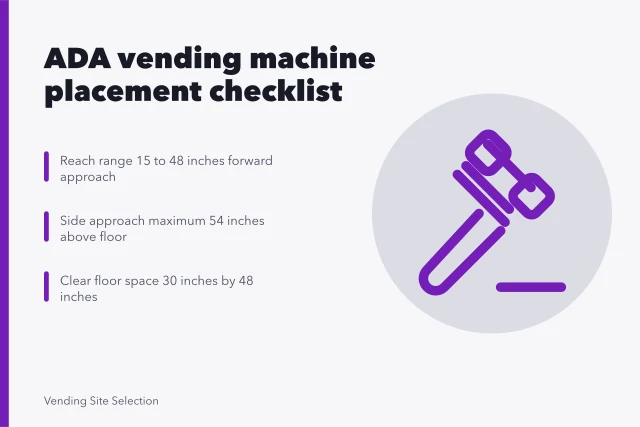
ADA guidelines set reach ranges and clear floor space for operable parts. In a public accommodation, the coin slot, bill acceptor and product door need to be reachable from a wheelchair, with clear floor space in front.
Fire codes add their own limits. Machines are sometimes restricted in stairwells, near fire doors and inside exit enclosures, and the authority there is the fire marshal, not OSHA.
Hazard communication is the piece routes forget. Employees who work with hazardous chemicals need access to safety data sheets and labels, and vending service involves cleaners, sanitizers and refrigerants.
A cleaner in an unlabeled spray bottle is a labeling violation. Secondary containers need labels unless the person who filled them uses them immediately. Keep a binder or a digital folder of safety data sheets for every chemical on the van.
Refrigerant handling adds a layer outside OSHA. Technicians who service refrigeration circuits face EPA certification requirements, so confirm who on the team holds the certification before scheduling compressor work. Machine specific repair steps belong in the manufacturer's service documentation and with a certified technician, not in a route binder.
Walk each location three times before you commit: as a customer in a wheelchair, as a worker with a hand truck, and as a fire inspector. Each walk finds a different limit. A compliance checklist for new owners can carry the placement questions so they get asked before the machine is dropped.
The OSHA poster and employer obligations for route staff
Every covered employer must display the federal OSHA poster, "It's the Law," where employees can see it. For a vending company that means the warehouse or office where staff report, not a host's break room.
The poster requirement is small. The obligations behind it are not. Route staff lift cases, drive between sites, work in refrigerated spaces and handle equipment in public areas.
Employers must record certain work related injuries and illnesses on OSHA logs, subject to size and industry exemptions. Vending is not automatically exempt, so a company past ten employees should know its recording status rather than assume it.
Training is the other core duty. New route staff need safe lifting, safe driving, electrical awareness and the company's lockout procedures before they work alone. Refresher training belongs on a calendar, not on a crisis.
The van is a workplace too. Secure dollies, stack product so it cannot shift, and keep the cab clear. A badly loaded van creates hazards that follow the driver all day.
Keep training records, inspection records and lockout procedure reviews in one folder per year. When an inspector asks, a folder answers faster than a memory.
A repair and security guide is a good place to align security tasks with the safety tasks that touch the same machines. The two overlap more than most operators admit.
State Plans and where they change the federal baseline
Federal OSHA sets the floor, but it does not run the program everywhere. OSHA State Plans are state run programs approved by federal OSHA that must be at least as effective as the federal one.
About half the states run a State Plan, and some cover state and local government workers as well. California, Washington, Arizona, New York and Illinois are in that group. Texas, Florida and Georgia are federal OSHA states for private employers.
The practical effect is that a State Plan can adopt a stricter standard, a different inspection priority or a different penalty structure. California runs its own standards and its own citation practices, so a procedure written for a federal state may not satisfy it.
For a multi state route, write the program to the strictest state you operate in and apply it everywhere. That costs a little more training and paperwork, and it avoids rewriting procedures every time the route crosses a border.
The OSHA State Plans | Occupational Safety and Health Administration page lists which states run their own programs and what each covers. Check it before assuming the federal text is the whole story in a new market.
State Plans also change how complaints move. In a State Plan state, a complaint goes to the state agency, and response times differ. Know which agency has jurisdiction before one lands.
A compliance checklist for labeling and placement
Adapt this to your route size and your states. It is written for the operator who wants the answer before the inspector arrives.
- Count your machines and record the total against the 20 machine threshold for calorie disclosure.
- Confirm every machine under the calorie rule has a declaration readable before purchase.
- Verify packaged food carries Nutrition Facts, ingredient and allergen labeling.
- Check that calorie signs are legible in the actual light at each location.
- Write a machine specific lockout procedure for every model family in the fleet.
- Stock lockout devices and tags that fit your plugs and disconnects, and train authorized technicians.
- Train route staff as affected employees on energy control awareness.
- Inspect cords, plugs and grounding on every visit and pull defective machines from service.
- Confirm working space and guarding around each machine, back panels included.
- Review placement for aisle width, exit routes, ADA reach range and clear floor space.
- Keep safety data sheets for every chemical on the van and label secondary containers.
- Display the OSHA poster at the company workplace and keep training and inspection records.
- Identify which states you operate in run a State Plan and apply the strictest rule.
Run it quarterly, and run the placement items again whenever a host moves a machine. A move is an installation, and nobody treats it like one.
Common questions
Does the FDA calorie rule apply to a small vending route?
The calorie disclosure duty generally attaches at 20 or more vending machines. Below that, the packaged food labeling rules still apply to everything you sell.
Is lockout/tagout required for clearing a jam?
If clearing the jam puts a hand near a spring, an auger or a live electrical part, the energy control procedure applies. Stocking product through a closed door normally does not.
Can a route driver do electrical repairs?
Only if trained and authorized, and only under the company's energy control and electrical safety procedures. Untrained staff should pull the machine from service and report it.
Do State Plans change vending rules?
They can be stricter than federal OSHA and they run their own inspections. Write your program to the strictest state you operate in.
Where does ADA fit into placement?
Public accommodations must keep operable parts within reach range with clear floor space in front. Check the location before the machine is installed, not after.