Guides
Bilingual vending machine labelling requirements in Canada
Bilingual vending machine labels Canada: federal and Quebec rules for vending operators. Learn what to submit and what happens if you skip French label requirements.
What to take away
- Bilingual labels are required for most prepackaged foods sold in vending machines under the federal Food and Drugs Act and its Food and Drug Regulations.
- The Consumer Packaging and Labelling Act and its Regulations add the bilingual net quantity declaration and the dealer's name and principal place of business.
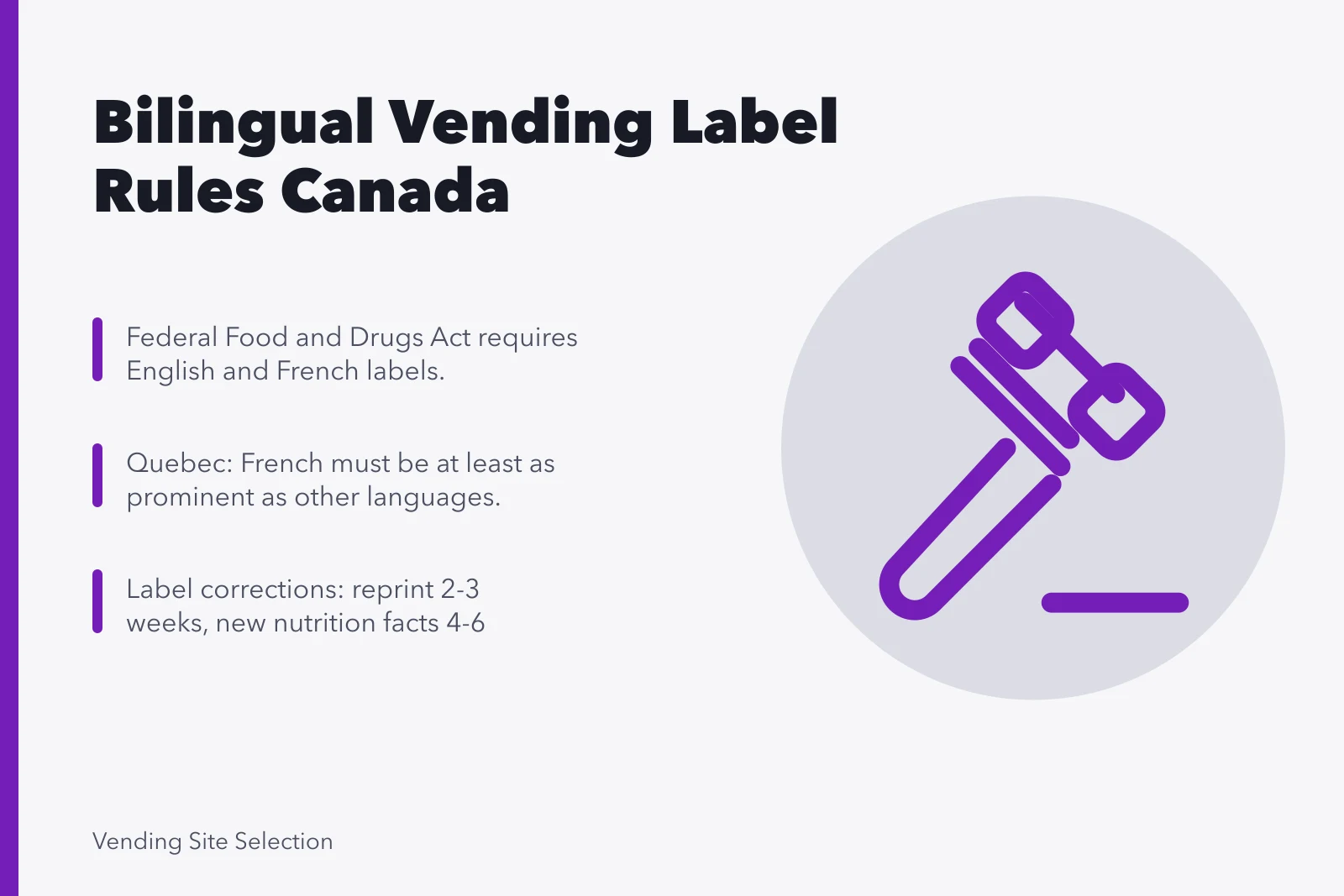
- Quebec's Charter of the French Language and its Regulation respecting the language of commerce and business require French on the product inscription, with French at least as prominent as any other language.
- Municipal bylaws and private placement agreements can require extra signage on or near the machine, but they cannot lower the federal or Quebec label standard.
- Non-compliance can lead to product seizure or an order to remove the machine from service.
Vending operators in Canada must treat label language as a legal condition, not a design choice.
Who has jurisdiction
Federal rules cover any prepackaged food sold in Canada, including food sold from a vending machine. The Food and Drugs Act and its Food and Drug Regulations set the label's content, and the Consumer Packaging and Labelling Act and its Regulations add the net quantity declaration and the dealer's name and principal place of business. Federal law requires the information on the label to appear in both English and French. See the Food and Drugs Act for the exact text.
Labeling is separate from business licences, but operators also need permits. For permit and licence details across Canada, see Vending machine licences in Canada.
Label rules by jurisdiction
Federal
- Rule source
- Food and Drugs Act
- Bilingual labels
- Required
- French prominence
- Not specified
- Machine display
- Not specified
- Promotional material
- Not specified
Quebec
- Rule source
- Charter of French Language
- Bilingual labels
- Required
- French prominence
- At least as prominent
- Machine display
- French required
- Promotional material
- French required
Municipal/Private
- Rule source
- Local sign rules
- Bilingual labels
- Cannot lower standard
- French prominence
- Cannot lower standard
- Machine display
- Contact sticker possible
- Promotional material
- Placement agreement rules
Quebec adds a separate layer. Section 51 of the Charter of the French Language requires every inscription on a product, on its container or wrapping, and on any document supplied with it, including directions for use, to be drafted in French. The Regulation respecting the language of commerce and business sets out how that rule applies to labels, packaging and commercial documents, and section 58 governs the signs and advertising visible on or around the machine, where French must be markedly predominant. The Office québécois de la langue française enforces both.
Municipal governments can add sign rules for public vending locations, such as requiring a business licence number or a contact sticker on the machine. Private building owners can add their own conditions in a placement agreement, for example a rule that all product labels be visible before purchase. Private rules cannot lower the federal or provincial labelling standard.
Rule source
- Federal
- Food and Drugs Act, Food and Drug Regulations
- Provincial (Quebec)
- Charter of the French Language
- Municipal
- City bylaws
- Private
- Placement agreement with location owner
What it controls
- Federal
- Bilingual labels on most prepackaged foods
- Provincial (Quebec)
- French prominence, product and machine display
- Municipal
- Business licence numbers, contact stickers on machine
- Private
- Visibility, product restrictions, machine signage
What triggers a label review
Adding a new snack or drink to a vending machine triggers a label review if the product was manufactured outside Canada or labels were designed for a single-language market. Changing a supplier, reformulating a product, or moving a machine into Quebec also triggers review.
A consumer complaint about an allergen or missing French text can bring an inspector to the location. Routine inspections by the Canadian Food Inspection Agency, or by Quebec's Office québécois de la langue française, can also start a review without a specific complaint.
Federal labelling rules apply to every vending machine in the country, and Quebec's language rules apply once the machine is placed in Quebec. For operators who also collect GST or HST on vending sales, see GST and vending machine sales.
What to submit for a vending label file
Keep a label file for each product line. The file should include:
Vending label file checklist
- Principal display panel in English and French
- Ingredient list and allergens in both languages
- Nutrition facts table and metric net quantity
- Canadian dealer or importer name and address
- French translation certificate or proof of review
- The English and French versions of the product's common name.
- The bilingual net quantity declaration.
- The ingredient list and the allergen declarations, in both languages.
- The nutrition facts table, plus the durable life date, storage instructions and lot code where the product requires them.
- The dealer's name and principal place of business.
There is no federal label registration form to file for a vending product. The Canadian Food Inspection Agency checks labels when it inspects rather than approving them in advance, and Quebec's language office reviews French wording the same way, so the label file is your own record and the proof you hand over when an inspector asks.
Provincial and municipal permit offices are listed on the federal Permits and licences page.
How long label corrections take
Label corrections take time because most vending operators rely on the product manufacturer or a label printer. A simple bilingual label reprint usually takes 2 to 3 weeks from approval to delivery. If a product needs a new nutrition facts table, the manufacturer may need 4 to 6 weeks.
Label correction timeline
- Approval to deliveryBilingual label reprint 2–3 weeks
- Manufacturer lead timeNew nutrition facts table 4–6 weeks
- Inspector deadlineCompliance in 15–30 days
- Fastest pathPull product until corrected label arrives
An inspector may set a compliance deadline of 15 to 30 days, which means the fastest path is often to pull the product from the machine until the corrected label arrives. For a comparison with how the same rules are enforced outside Canada, see US vending label enforcement.
What happens if you skip it
Skipping a bilingual label is not a paperwork error. If a Canadian Food Inspection Agency inspector finds a non-compliant food product, the agency can seize it and order it removed from sale.
In Quebec, the Office québécois de la langue française can issue a notice requiring the machine be taken out of service until the French label is corrected.
Repeated violations can escalate from a compliance notice to prosecution under the Charter of the French Language or federal food labelling provisions.
Operators who run routes across the border may also need to review Cross-border vending.