Guides
A vending machine sop checklist built for real conditions
A daily vending SOP: the load-out, the fixed order inside each visit, the end-of-day close, and the weekly checks that stop a route drifting.
What to take away
- The order inside a visit is the SOP. Counting before loading is the step that produces every number you use later.
- Close the day per machine, not per vehicle. One route total tells you something is wrong and nothing about where.
- Write the decision line downwhat a driver settles alone, and what comes back to you.
- Keep the daily list to one screen. Longer checks belong in the weekly review.
- A machine down past your stated response time is a phone call to the host, not a note on the glass.
Start of day: the load-out
- Read yesterday's exceptionsopen faults, skipped sites, machines short against sales.
- Pull the par list for every machine on today's run.
- Load to par per selection, checking date codes as you load.
- Load the shortest-dated stock for the machines you will revisit soonest.
- Carry spares of the fastest movers and the parts that fix your two most common faults.
- Count the coin float and record it before the vehicle moves.
- Confirm access windows and which sites require sign-in or an escort.
- Check fuel and confirm the load will not force a return to storage mid-route.
At each machine, in this order
- Note arrival time and any wait before access.
- Look before openingclean, lit, undamaged, approach clear.
- Count what remains in each selection.
- Note every selection that was empty.
- Pull expired or damaged stock and record the reason against the selection.
- Record the temperature on refrigerated machines.
- Load to par and record what went in.
- Collect cash and record the amount at the machine.
- Test a vend, and a card transaction where a reader fault was reported.
- Wipe the front and clear the coin return.
- Note departure time and the next scheduled visit.
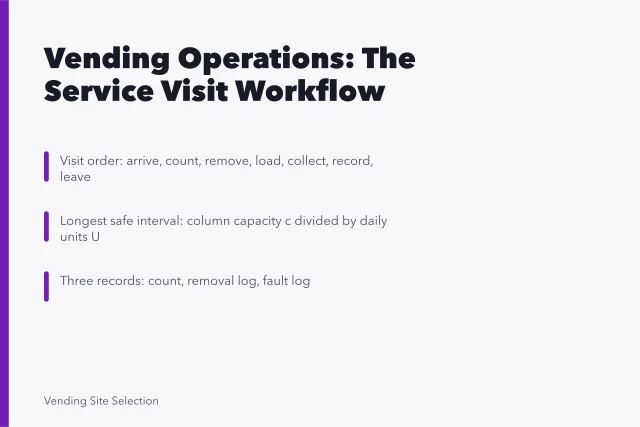
Counting before loading is the step people drop when the day runs late. It is also the only step that makes the cycle's data usable. If you are behind, skip the wipe down, not the count.
Fixed order at each machine
- Note arrival time and wait
- Look before opening
- Count remaining stock
- Note empty selections
- Pull expired or damaged stock
- Record refrigerated temperature
- Load to par and record
- Collect cash, test vend, wipe, note departure
End of day: the close
- Reconcile cash collected against recorded totals, machine by machine.
- Bank or secure cash by your written procedure, not at your convenience.
- Enter counts, removals and faults for every site visited.
- List skipped sites with the reason and reschedule them.
- Flag any machine where cash and sales disagree, and any machine that sold out.
- Restock the vehicle for tomorrow or note what to order.
A vehicle-level total cannot be investigated. You know a number is wrong and not which machine, which visit or which driver produced it. Machine-level reconciliation is what makes the discrepancy a question with an answer.
End-of-day close
- Reconcile cash machine by machine
- Bank or secure cash by procedure
- Enter counts, removals, faults
- List skipped sites with reasons
- Flag cash-sales disagreements
- Restock vehicle or note orders
Weekly review
- Review sell-outs by machine and adjust pars or visit intervals.
- Review the removal log by reason and act on whichever cause dominates.
- Check open faults against how long they have been open and your service commitment.
- Order against measured consumption rather than a standing order.
- Look at any site where visit time has grown, and find out why.
- Call any host whose machine has been out of service, before they call you.
The parts of the SOP that are not steps
Three rules belong in the document because they decide what happens when the checklist runs out.
The first is the decision line. A driver settles small reversible things alone. Price, agreement terms and host relationships come back to the owner. Write the line down, because an unwritten one always turns out to have been somewhere else.
The second is what to do when the machine and the record disagree. Do not resolve it at the site. Record both figures, finish the route, investigate the same week.
The third is host communication. When a machine will be down past your stated response time, that is a call. A note left on the glass is how a host learns their machine is broken from a customer instead of from you.
Two checks that only happen at the machine
The clear approach is one. Hosts stack boxes in front of equipment without meaning anything by it. Machines in a place of public accommodation fall under the U.S. Department of Justice: 2010 ADA Standards for Accessible Design. Move the obstruction and tell the site contact rather than assuming they will notice.
The temperature record is the other. Your state or county health department sets what is required, in what form, and what happens after a site loses power. The U.S. Food and Drug Administration: State Retail and Food Service Codes and Regulations directory names the agency to ask.
Sales, purchases and removals also need documenting. The Internal Revenue Service: What kind of records should I keep? guidance expects a business to hold those records.
Fault entries that someone else can act on
A fault entry needs five things: which machine, which component, what you observed, what you did, and whether it is still open. "Machine is playing up" is not a record. It is a note that forces the next person to start over.
Two entries from the same component in a month is a pattern, not bad luck. That is the point where a swap-or-fix decision gets made rather than deferred.
Keeping the SOP alive
A procedure in a folder is a procedure nobody follows. Put the per-machine list where the work happens, on the inside of the service door or on the screen the driver already opens, and keep it to one screen.
Then revise it after anything it failed to catch. A fault that went unreported, a discrepancy nobody investigated, a host who heard about an outage from a customer: each is a missing line, and adding it is how the document earns its place.
Feed the results into the route schedule and the operations framework. Revisit the document when you take machines into a new area whose sites work differently.
If you are still placing your first machines, write version one now, while the route fits on a page. Align it with your product and par decisions so the two documents agree.
Common questions
Is a checklist patronizing for an experienced driver?
The list is not there to teach the sequence. It exists so the record survives a bad day, when the steps that produce data are the first to go. Experienced drivers object to length, not to the idea, which is an argument for keeping it short.
Paper or an app?
Whichever gets completed at the machine rather than in the vehicle afterward. Recall degrades within minutes, and a form filled in at the end of a route is a reconstruction.
Who owns a discrepancy between cash and sales?
The owner, not the driver. The driver records both figures and finishes the route. Investigation happens the same week, away from the site, where the machine log and the collection record can be compared without an audience.
How often should the SOP itself be reviewed?
After every failure it did not catch, and otherwise quarterly. A document reviewed on a calendar drifts out of step with the route. A document updated after each miss stays honest.