Guides
ADA compliance for vending machines, a checklist for American operators
Vending machines in public buildings must meet ADA reach range, clear floor space and signage rules under Title III. Here is the working checklist.
What to take away
- Title III of the ADA applies to your machine whenever it stands inside a place of public accommodation: a hospital lobby, a county building, a transit station, a university hallway.
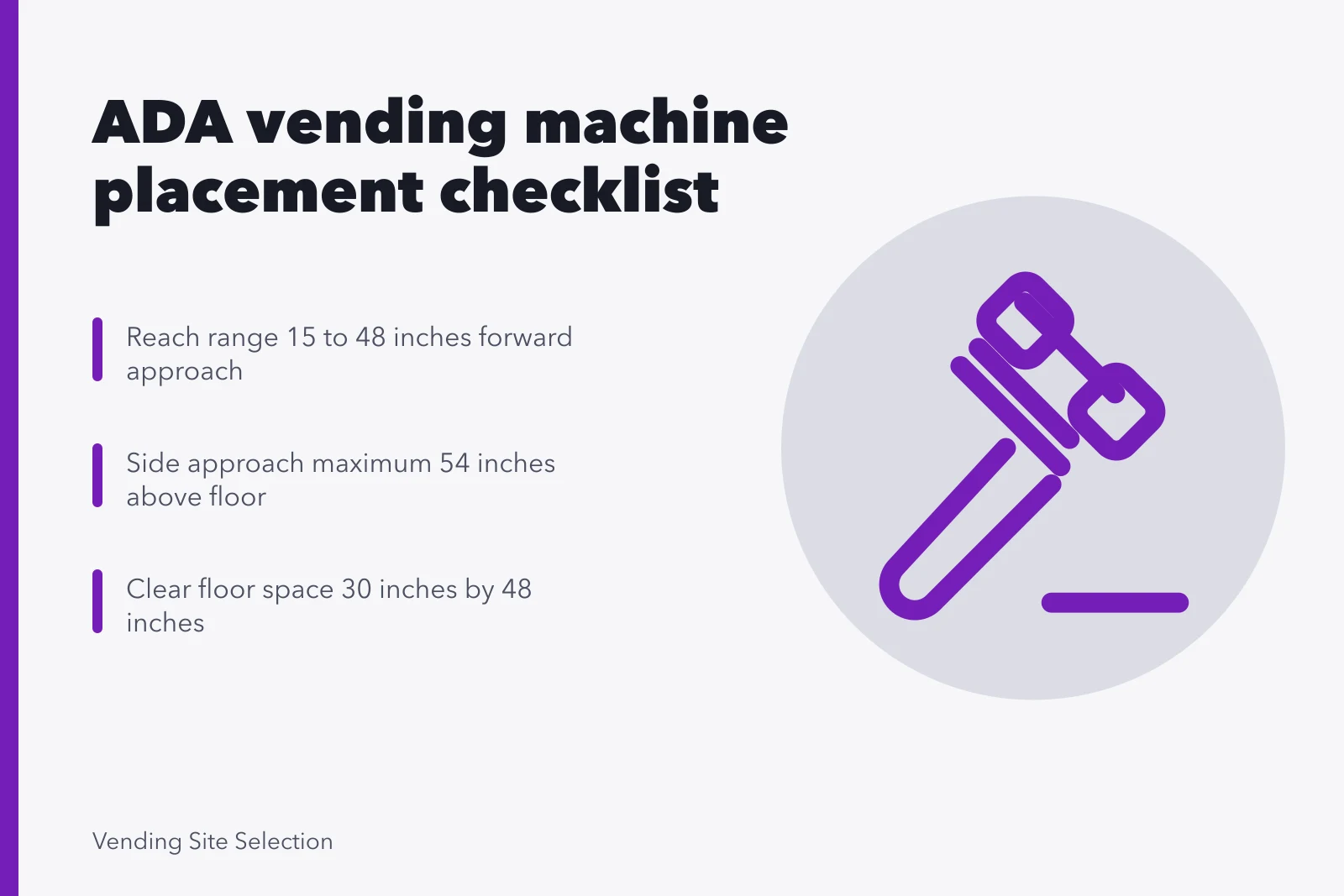
- The 2010 ADA Standards for Accessible Design set two numbersreach range 15 to 48 inches for a forward approach and up to 54 inches for a side approach, plus clear floor space of 30 inches by 48 inches at the machine face.
- Clear floor space at the machine face must connect to an accessible route with no step, locked door or planter in the way.
- A machine installed before March 15, 2012 in an unaltered building may still be judged against the 1991 standards. Any alteration or replacement pulls it into the 2010 rules.
- The host owns the duty. Your placement agreement decides who pays when the approach is blocked or a complaint is filed.
What Title III requires where a vending machine stands
Title III bans disability discrimination in places of public accommodation. Your machine sits inside one of those places, so its placement is covered even though the host owns the building.
The duty covers the aisle you block, the counter you replace and the height of the button a customer has to press. A person who uses a wheelchair must be able to approach, pay and retrieve a product without asking for help.
Read the regulation itself when a host asks who is responsible: Americans with Disabilities Act Title III Regulations | ADA.gov.
Self-service does not exempt the machine. If a customer cannot reach the card reader, the site has an accessibility problem and your equipment is the evidence.
States add their own enforcement on top of the federal floor. California, New York, Illinois and Washington all run accessibility programs, and a state complaint can arrive before any federal one does.
Reach range and clear floor space under the 2010 standards
Two measurements decide whether a placement passes: reach range and clear floor space. Take a tape measure to the site rather than trusting the host's floor plan.
Reach Range and Clear Floor Space
Forward approach
- High reach limit
- 48 inches
- Low reach limit
- 15 inches
- Clear floor space
- 30 in x 48 in
- Obstruction rule
- No obstruction below 27 in
- Typical failure
- Card reader mounted too high
Side approach
- High reach limit
- 54 inches
- Low reach limit
- 15 inches
- Clear floor space
- 30 in x 48 in
- Obstruction rule
- Knee clearance not required
- Typical failure
- Machine boxed in by a planter
Reach range for an unobstructed forward approach runs from 15 inches to 48 inches above the finished floor. A side approach, or a machine set into a recess, raises the maximum to 54 inches.
Coin slots, bill validators, card readers, keypads and the product delivery door all have to fall inside that band. The exact figures are published in the 2010 ADA Standards for Accessible Design | ADA.gov.
Clear floor space is the second measurement. It has to be level, clear of obstacles and on an accessible route. A machine against a wall with a trash can beside it fails on this point alone.
Reach range and clear floor space
Forward approach
- High reach limit
- 48 inches
- Low reach limit
- 15 inches
- Clear floor space
- 30 in x 48 in
- Obstruction rule
- No obstruction below 27 in
- Typical failure
- Card reader mounted too high
Side approach
- High reach limit
- 54 inches
- Low reach limit
- 15 inches
- Clear floor space
- 30 in x 48 in
- Obstruction rule
- Knee clearance not required
- Typical failure
- Machine boxed in by a planter
The route matters as much as the footprint. If the only path to your machine runs up a step or through a locked door, the site fails even when the machine itself measures correctly.
Screening for that before you sign is cheaper than retrofitting after. The site selection and location guide covers how to check the approach on a first walkthrough.
Machines installed before March 2012
The 1991 ADA design standards still matter for existing placements. Many long hospital and transit contracts were written around those rules. If your machine has sat in the same corridor since 2008 and nothing around it has changed, the host may argue the older standard applies.
Pull the text before you concede anything: ADA Standards for Accessible Design Title III Regulation 28 CFR Part 36 (1991) | ADA.gov.
Assume the 2010 standards govern anyway. A replacement machine, a remodeled lobby or a new lease generally pulls the installation into the current rules. The 1991 standards are a defense for untouched placements, not a permanent exemption.
The baseline for both eras sits on one page: ADA Standards for Accessible Design | ADA.gov. When a facilities manager disputes a measurement, the published standard settles it faster than a phone call.
A placement checklist you can run with a tape measure
Walk the site before the machine is bolted down. Measure, photograph, and keep the file with the placement agreement.
Vending Machine Placement Checklist
- Measure high and low reach points
- Confirm 15-48 in forward or 54 in side
- Verify 30 in x 48 in clear floor space
- Trace clear floor space to accessible route
- Check floor is level, no threshold strip
- Move planters, stanchions, trash bins, signage
- Photograph finished placement with tape measure
Run the sequence in order.
A placement checklist
- Measure high reach. With the machine set where it will stand, find the highest operable part: coin slot, card reader, keypad, bill validator or product door. It must sit at or below 48 inches for a forward approach and at or below 54 inches for a side approach.
- Measure low reach. Find the lowest operable part on the same face. It must sit at or above 15 inches above the finished floor.
- Measure clear floor space. Lay the tape at the machine face and confirm 30 inches by 48 inches. Nothing else, including a bin, a planter or a host sign, may sit inside it.
- Verify the route. Walk in from the public entrance as a customer would. Note any step, locked door, chained gate or furniture another tenant has moved into the aisle.
- Photograph the placement. Shoot the machine face, each reach point with the tape in frame, and the full route from the entrance. Date every image.
- File the record. Keep measurements, photographs and any host sign-off in one folder with the placement agreement.
A short clause in the placement agreement naming the host as responsible for the approach prevents most disputes.
Retrofits are usually small money. A lower card reader bracket or a relocated bill validator is typically a parts-and-labor job in the $150 to $500 range per machine.
A raised base or platform typically runs $400 to $1,200, set by floor type, machine weight and who does the work. Either fix costs less than answering one complaint. Budget for a retrofit on every older account instead of assuming the first install was right.
Signage, instructions and communication duties
Signage is where operators get caught. Instructions have to be readable by someone with low vision, and small text on a dark panel fails that test in practice.
Where a customer cannot use the machine independently, the host may owe an effective communication duty under Title III. That can mean staff assistance, a second accessible machine, or a posted way to request help. The duty belongs to the public accommodation, but your machine triggers it.
The fixes are ordinary. High-contrast labels, large type, and a phone number or help point near the machine. If the machine is the only food or drink option overnight in a hospital or transit facility, the host carries a stronger obligation to keep a usable path to it.
Keep a written log of every measurement, photograph and retrofit. If a complaint arrives, that log is your record of good-faith compliance and it carries weight with the host's legal team. New accounts should fold this into a broader compliance checklist for new owners so nothing is missed at handover.
Contract risks when a site fails a complaint
A complaint names the host, but the fallout reaches your contract. Know these risks by name before you sign.
Contract Risks When a Site Fails
- 1Lease termination
- 2Indemnity claims
- 3Lost commissions
- 4Retrofit costs
Push for a clause that assigns the accessible route and clear floor space to the host, and cap your indemnity. It can read: "Host shall keep the accessible route to the machine and the clear floor space at its face free of obstruction at all times, at the host's expense."
The real cost of insuring a vending machine business is worth pricing against those risks.
Accessibility sits alongside the rest of your paperwork: sales tax registration with your state Department of Revenue, local health permits for food and drink machines, and FDA vending machine labeling rules. Operators who want one view of what it takes to operate legally should treat accessibility as one line in that file, not a separate project.
When to call the ADA Information Line
The ADA Information Line is a free federal service that answers accessibility questions, including questions about machine placement and reach range. Call before you install, not after a complaint.
Use it when the site is unusual: a recessed alcove, a sloped floor, a historic building, a bank of several machines side by side, or a host insisting on a placement you think fails. Ask for the answer in writing and keep the note with the placement file.
The line answers at 800-514-0301, with TTY at 800-514-0383, on weekdays from 9:30 a.m. to 5:30 p.m. Eastern Time, except federal holidays. Hours and contact options are on the official page: ADA Information Line | ADA.gov.
The line does not issue formal rulings or approve designs, so treat what you hear as direction, not a guarantee.
For anything with real money attached, pair the call with a local accessibility consultant and your own counsel. A short paid review of a hospital or transit placement costs less than defending a complaint, and it tells the host you take the duty seriously.
Common questions
Does the ADA apply to a vending machine in a private office break room?
Usually not, because a private office is not a place of public accommodation. The duty attaches once the public or a broad group of people can enter the space, which covers most government, hospital and transit sites.
What is the maximum reach height for a vending machine?
48 inches for a forward approach and 54 inches for a side approach, measured to the operable parts such as the coin slot, card reader and keypad. The low limit is 15 inches either way.
How much clear floor space does a vending machine need?
30 inches by 48 inches at the machine face, positioned for a forward or parallel approach and connected to an accessible route. Keep bins, planters and signage out of it.
Can an old machine in an older building stay where it is?
Sometimes. A pre-2012 installation in an unaltered building may still be judged against the 1991 standards, but any alteration, replacement or new lease brings it under the 2010 rules.
Who pays if a host site fails an accessibility complaint?
It depends on the contract. Broad indemnity and repair clauses often push the cost onto the operator, so negotiate who maintains the accessible route and clear floor space before you install.