Guides
A preventive maintenance checklist for vending machines, by interval
Vending preventive maintenance checklist organized by interval: what to check every visit, every month, every quarter and every year, and what to log.
What to take away
- Preventive maintenance is mostly cleaning. The components that fail most are the ones that get dirtiest.
- Sort the work by interval, not by component, or it will not fit into a service round.
- Log what was done and when, per machine. That log is what makes repair or replace a calculation.
- Isolate power before working inside a machine, and never move one alone.
Every visit
- Clean the bill validator path with the manufacturer's recommended method.
- Run a test vend and, where a reader is fitted, a test card transaction.
- Check the coin return and clear anything lodged in it.
- Look at the delivery bin and flap for damage or obstruction.
- Check the door seal closes cleanly and the lock engages.
- Wipe the front glass and keypad, and check every price label is legible.
- Look at the condenser area for visible dust build up.
- Confirm the machine's fault contact details are present and current.
- Check the approach to the machine is clear.
Nine items, most of them seconds. The validator clean repays the effort most often: a validator rejecting notes cuts sales without ever registering as a fault.
Every month
- Clean the condenser coils properly rather than glancing at them. Restricted airflow is the usual first step toward a refrigeration failure.
- Check the evaporator and drain for blockage or ice build up.
- Inspect the coin mechanism path and clean it.
- Check spiral and shelf alignment against the product actually loaded, since most dispensing failures are a loading mismatch rather than a mechanical fault.
- Test the refrigeration recovery after the door has been open, and record the temperature.
- Check the power cord and plug for damage, and that no temporary extension has appeared.
- Check the machine is still level and stable on its feet.
Every quarter
- Review the machine's fault history and look for a component failing repeatedly.
- Check that spare parts for this machine type are still available from your supplier.
- Update firmware or software on payment and telemetry hardware where the vendor provides it.
- Review the price labels against the current price list, which drift apart faster than anyone expects.
- Check keys and locks, and change any lock whose key has been lost or copied.
- Inspect the machine's exterior for damage that has been accumulating unnoticed.
Every year
- Have refrigeration serviced by someone qualified, on the manufacturer's schedule.
- Review the machine's total repair cost against what the site returns, and decide whether it stays.
- Check the installation against the site as it is now, since buildings change around machines.
- Confirm the approach and clear floor space still meet the requirements in the U.S. Department of Justice: 2010 ADA Standards for Accessible Design where the machine is in a place of public accommodation.
- Reconcile the maintenance log against expenses recorded, since repair and maintenance costs are part of what the Internal Revenue Service: What kind of records should I keep? guidance expects a business to document.
Working safely inside the machine
Two rules, and they are not negotiable because the consequences are not proportionate.
Isolate power before working inside, and keep it isolated while you work. The principles for controlling hazardous energy during servicing are set out in the Occupational Safety and Health Administration: Control of Hazardous Energy (Lockout/Tagout) standard. Whether it applies to your operation is a question for OSHA or your state plan before you employ anyone.
Never move a machine alone. They are heavy, top heavy, and the injuries from a tip are severe. Plan the route through the building first, use the right equipment, and decline a move that cannot be done safely whatever the site would prefer.
The log
One line per machine per intervention: date, what was done, what was found, parts used, and whether anything is outstanding.
That log does three jobs. It shows preventive work is actually happening, which a schedule alone does not.
It reveals a component failing repeatedly, the signal a machine is near the end of its useful life at that site. It also turns the repair or replace decision from a memory of the last failure into a comparison of accumulated cost against what the site returns.
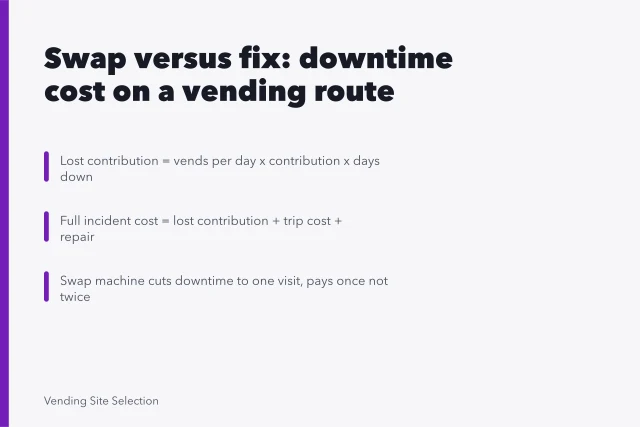
Keep it per machine rather than per visit, because the question you will eventually ask is about a machine, not about a day. That is also what makes the downtime and repair cost arithmetic possible when you decide whether a site is worth another machine.
Fitting it into a route
The everyday list has to be short enough to survive a busy day. If it grows, it will be skipped silently, and a skipped checklist marked complete is worse than none.
Attach the monthly and quarterly work to specific machines on specific runs rather than to a general intention. A route where every machine has a named month for its coil clean gets its coils cleaned. One where it happens when there is time does not.
Build this rhythm while the route is small. Retrofitting it onto twenty machines is much harder than starting with three, which is an argument for setting it up while you are still placing your first machines.
Two more items fit the same rhythm. Keep temperature records in the form your state or county health department requires. The licensing obligations attached to your machines are easier to keep current alongside maintenance than separately.
Loading practice matters too, since several dispensing faults are really product and column mismatches. For prevention that fails, the full repair and security picture covers what to do.
Common questions
How often should refrigeration be professionally serviced?
Follow the manufacturer's schedule for that model, and treat monthly coil cleaning as your own job in between. A machine in a dusty environment such as a workshop or a plant needs the cleaning more often than the schedule assumes.
Is it worth maintaining an old machine or just running it to failure?
Running to failure means the failure happens at the worst moment, at a site, in front of a host. Even on an old machine the everyday cleaning is worth doing, because it is minutes. What changes with age is the threshold for a large repair, which the log will tell you.
What should I do if a machine keeps developing the same fault?
Stop treating each occurrence separately. Three repairs to the same component is a component or a machine problem, and the next decision is whether to replace the part with a new one rather than another refurbished one, or to replace the machine at that site.