Guides
Vending site selection after the anchor tenant leaves: traffic signals and a repitch meeting
How vending operators decide whether a host site survives an anchor tenant leaving, with four-week sales signals, a five-step repitch meeting, and a managed exit.
What to take away
- A lost anchor tenant is a site selection problem, not a salvage problem. Decide within 30 days whether the stop stays on the route.
- Re-pitch with records90 days of sales, cost per route stop, and a shorter term with a written exit clause.
- Keep machines only where the property's own residents or staff still buy. Visitor traffic rarely returns on the schedule landlords promise.
- Earning vending referrals from the property manager and neighboring tenants often replaces lost volume faster than cold calling.
- Test 2027 vending demand trends before buying equipment sized for a location that may not recover.
Diagnose the traffic loss before you touch the contract
Anchor tenants leave for reasons the landlord already knows. A grocery store closes after a merger. A call center shifts to remote work. A warehouse moves across town. Your placement agreement survives, but the traffic that justified it does not.
Read that agreement the way you would read any commercial lease: term, exclusivity, notice period, and who pays for power and repairs.
Then measure. Pull weekly unit sales per machine, transaction counts, and the days that fell first. A weekday-only drop points at staff. A drop across every day points at the property itself.
One slow month is normal. Four straight weeks below the level that covers your route cost is a decision point.
Slow Month vs Dead Site
Slow month
- Foot traffic
- Normal
- Sales
- Hold
- Neighbor tenants
- Stay
- Route cost
- Below gross profit
Dead site
- Foot traffic
- Falls 4 straight weeks
- Sales
- Fall with traffic
- Neighbor tenants
- Two or more give notice
- Route cost
- Exceeds gross profit
Signals that separate a slow month from a dead site
Slow month or dead site
| Signal | What it tells you |
|---|---|
| Foot traffic falls for four straight weeks | Visitors left with the anchor tenant |
| Sales hold while foot traffic falls | Your buyers are staff or residents, not visitors |
| Two or more neighboring tenants give notice | The whole property is at risk, not just your corner |
| Route cost per stop exceeds gross profit | The stop is subsidizing your truck |
Example: the strip mall anchor that left
Three machines sat at the end of a strip mall corridor. The grocery anchor closed in spring. Corridor traffic dropped to staff from remaining tenants and people cutting through the parking lot.
The operator removed nothing in week one. He counted four weeks of sales, then asked the property manager two questions. Which tenants renew within six months? What is the leasing agent telling prospects?
The manager had no signed replacement and no reopening date. That answer, not the sales figure, settled the decision. He re-pitched one machine near the entrance on a lower commission and moved two to a laundromat and a gym on the same route.
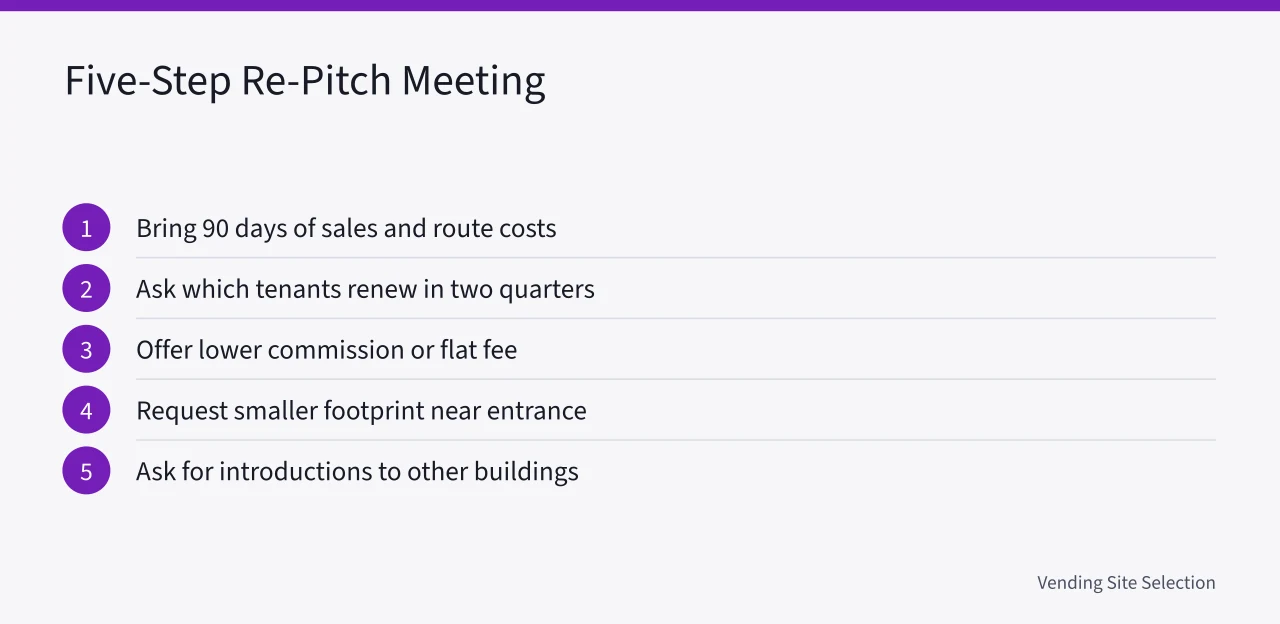
The re-pitch meeting: five steps
- Bring 90 days of sales, the cost of each route stop, and the product mix by machine.
- Ask which tenants have renewal dates inside the next two quarters.
- Offer two optionsa lower commission on a 12-month term, or a flat space fee with a 30-day exit.
- Ask for a smaller footprint, such as one machine near the entrance instead of three in a corridor.
- Request introductions to the manager's other buildings while the relationship is still warm.
Managed exit when the site cannot recover
Pull machines when no replacement tenant has signed, traffic is flat for two quarters, and cost per stop sits above gross profit.
When to Pull Machines
No replacement tenant signed?
Pull machines
Keep and re-pitch
Consolidating stops is a route design job. Route planning software can show whether moved machines fit an existing stop or need a new day on the schedule.
Clean each machine, reset the planogram, and update the cashless reader before the first fill at the new site.
Replace the location, not just the stop
Before signing a replacement, study the candidate property the way you would study a new market. Competitive analysis guidance covers counting nearby machines, shift patterns, and whether a micro market already serves the building.
Turning a dead location into referrals
The manager who lost the anchor still manages other buildings. Ask for a specific introduction rather than a general favor. "Which two properties on your list have staff who ask about snacks?"
Ask at the end of the re-pitch, whether you stay or leave. A request lands better when you name the person who can act on it, and who can refer you explains how to time that ask.
Churn math and the 2027 demand question
Vending route churn rate is the share of stops you lose in a year. Track it by property type. A route that loses anchors in office parks needs different sizing than one that loses them in retail plazas.
Before reconfiguring machines for a headline, run a four-step test for a trend claim. Few trends reach a vending route quickly enough to justify new equipment.