Guides
Vending machine operations: the workflow behind a smooth day
Vending operations guide for owners: the service visit as a repeatable unit, route sequencing, cash and card handling, and the records that hold it together.
What to take away
- The service visit is the unit of the business. Standardize it and everything upstream gets easier.
- Route sequence is set by access hours and traffic, not by distance alone.
- Cash handling needs a written procedure before you have staff, because retrofitting one implies you did not trust them.
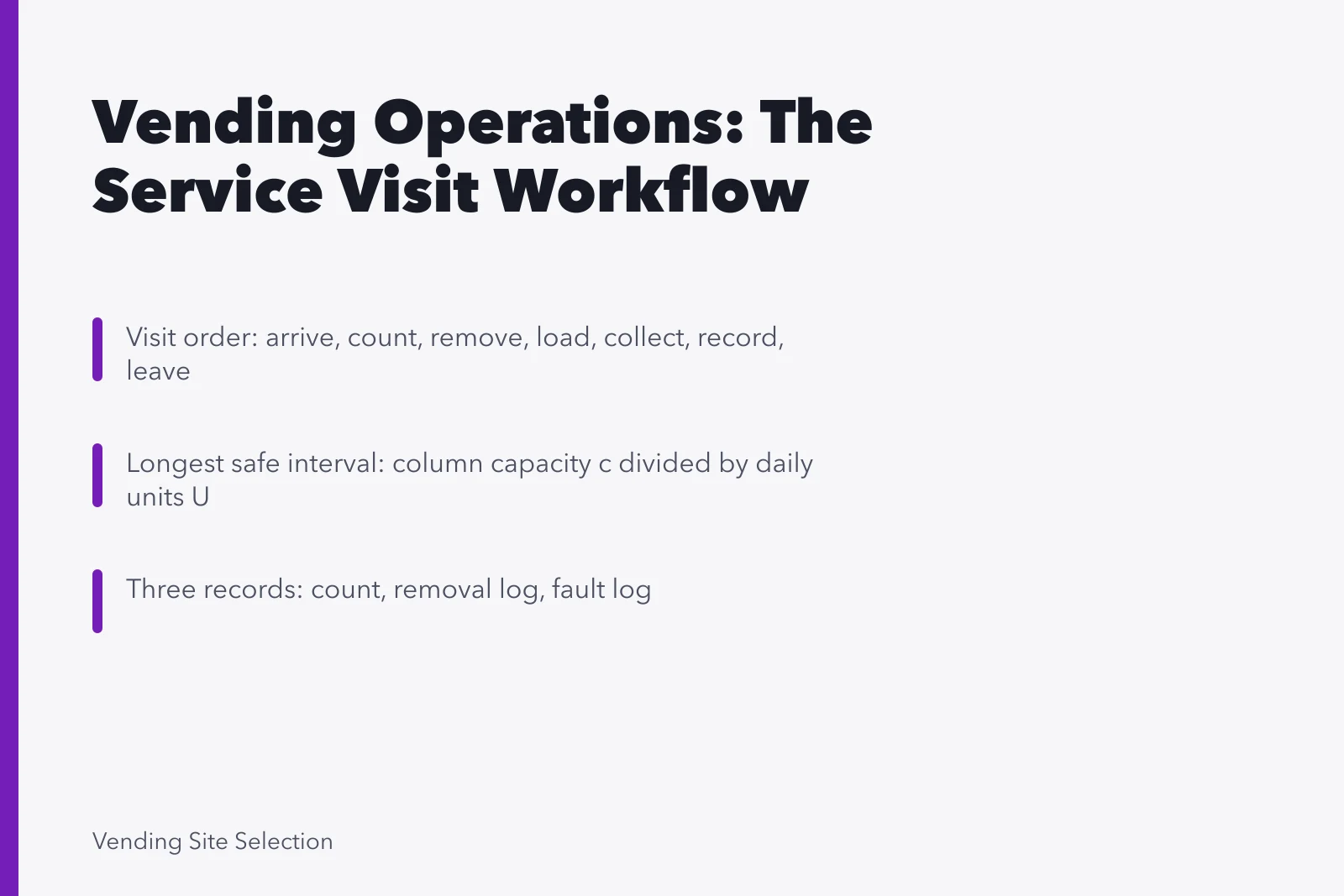
- The three records that matter are the count, the removal log and the fault log. Everything else is optional.
- Most operational failure is a scheduling failure that shows up as an empty machine.
The visit is the unit
A vending route is a repeated sequence of one activity: arrive, count, remove, load, collect, record, leave. Almost every operational problem is a defect in that sequence, and almost every improvement is a change to it.
The service visit sequence
- Arrive at the machine
- Count the previous cycle
- Remove unsold product
- Load new product
- Collect cash on site
- Record the visit data
- Leave the site
Writing the visit down as a fixed order has three effects. It makes the time per machine predictable, which is what allows a route to be scheduled at all. It makes the data comparable between visits, which is what allows par levels to be set. And it makes the work handoverable, which is what allows you to stop driving eventually.
Order matters within the visit. Count before loading, always, because loading destroys the previous cycle's information. Collect cash before you leave the site, not at the end of the day, so the amount is tied to the machine.
Building a route that survives contact with reality
Distance is the obvious input and it is not the first one. Three constraints usually bind harder.
Route constraints in priority order
Constraint
- Access hours
- Tightest windows anchor the day
- Traffic
- Map distance is not drive time
- Load capacity
- Full round or second trip
Why it binds
- Access hours
- Traffic
- Load capacity
Access hours come first. A site you can only enter during business hours, or only at shift change, has a window, and windows anchor the day. Build the route around the tightest windows and fill in the flexible sites between them.
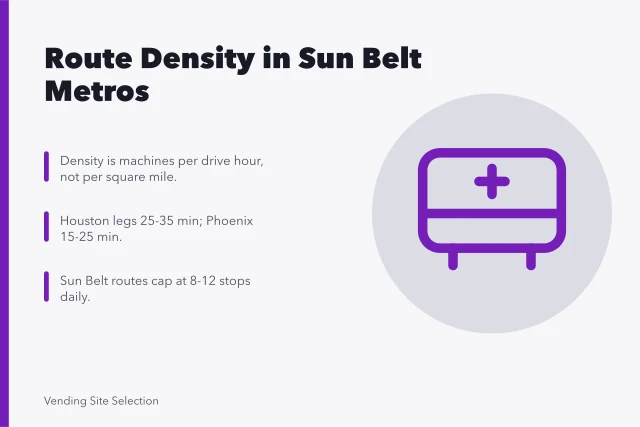
Traffic comes second. A route planned on map distance and driven in rush hour is a different route. Time the legs you actually drive rather than trusting an estimate.
Load capacity comes third. A vehicle that cannot carry a full round means either a second trip or a return to storage, and that is a cost most new operators discover after building a schedule that assumed otherwise.
Service interval as a decision, not a habit
Most routes settle into a weekly rhythm because a week is easy to remember. That is a scheduling convenience, not an analysis.
Is the interval too long or short?
Compare c divided by U against one week
Longer than a week -> visiting too often, paying for it
Shorter than a week -> running out, losing unseen sales
The interval that fits a machine is the one where par levels can hold the demand without selling out. Let U be units per day for the busiest selection and let the column hold c units. The longest safe interval for that machine is roughly c divided by U, less a buffer for variation.
If that is longer than a week, you are visiting too often and paying for it. If it is shorter, you are running out and losing sales you never see.
Different machines can run on different intervals, and on a mature route they usually do. The scheduling work is grouping them so intervals line up into days that make geographic sense.
That is the route sequencing problem in practice. Machines clustered in one area are worth more than the same machines scattered.
Cash and card handling
Write the procedure before you need it. Retrofitting controls onto an existing arrangement looks like an accusation; having them from the start is just how the business runs.
Cash and card controls
- Record cash at the machine before leaving
- Bank on a stated schedule
- Reconcile recorded amount against machine sales
- Investigate discrepancies the same week
- Match card settlements to sales monthly
- Check charged fees against quoted fees yearly
A workable minimum has four parts. Cash is collected from the machine and recorded there, on paper or in the app, before leaving the site. It is banked on a stated schedule, not when convenient.
The recorded amount is reconciled against the machine's own sales figure. Any discrepancy is investigated the same week, at the level of the machine, not the day.
Card settlement needs its own reconciliation, because the money arrives later and net of fees. Match settlements to machine sales monthly, and check the fee actually charged against the fee you were quoted at least once a year.
Sales, receipts and expenses all need to be documented for any of this to work, and they are part of what the Internal Revenue Service: What kind of records should I keep? guidance expects a small business to hold.
The three records worth keeping
Everything else is optional. These three are not.
The three records worth keeping
Record
- Count in and out
- At machine, before loading
- Removals with reason
- At machine, as they happen
- Faults and response
- Reported and attended
Written when
- Count in and out
- What sells, where you sell out
- Removals with reason
- Expiry, damage, jams or theft
- Faults and response
- Whether you meet the service standard
Answers
- Count in and out
- Removals with reason
- Faults and response
| Record | Written when | What it answers |
|---|---|---|
| Count in and out | At the machine, before loading | What each selection sells, and where you are selling out |
| Removals with reason | At the machine, as they happen | Whether your losses are expiry, damage, jams or theft |
| Faults and response | When reported and when attended | Whether you are meeting the service standard you sold |
The removal log is the one operators skip and the one that pays back fastest. Without a reason recorded, every loss looks the same, and the four causes need four different responses.
Standards at the machine
A service visit is also an inspection, and a handful of checks belong in every one.
Check the approach to the machine is clear. Hosts stack boxes in front of equipment without meaning anything by it, and machines in a place of public accommodation carry obligations about approach and operable parts that are set out in the U.S. Department of Justice: 2010 ADA Standards for Accessible Design. Move the obstruction and tell your contact.
Check refrigerated machines against the temperature record your health department expects. Record it at the machine, not later.
Your state or county health department sets what is required and what must happen after a site loses power. The U.S. Food and Drug Administration: State Retail and Food Service Codes and Regulations directory names the agency to ask. Keep those answers with your licensing file.
Check the machine is clean and that the fault contact details on it are current. A machine with a phone number nobody answers is worse than one with no number at all.
Handling exceptions without stopping the route
Three exceptions recur, and each deserves a decided response rather than an improvised one.
A machine is down. Decide in advance what you carry that can restore common faults on the spot, and what triggers a return visit versus a swap. Tell the host either way, with a time.
A site is inaccessible. Record it, tell the contact, and reschedule rather than absorbing it silently. A site that is repeatedly inaccessible is an agreement problem, not a driving problem.
A machine is short of cash against its sales figure. Do not resolve it at the roadside. Record both numbers, finish the route, and investigate at the machine level the same week.
Handing the route over
The point of writing all of this down is that somebody else can eventually drive it. Three things have to exist before that is possible.
A written visit sequence, short enough to be followed. A record format that does not depend on the driver remembering anything. And a rule for what a driver decides alone versus what they call you about.
Wage costs for a route driver in your area come from the U.S. Bureau of Labor Statistics: Occupational Employment and Wage Statistics Tables rather than a national figure, and they belong in the route arithmetic long before you hire, because a route that only works with unpaid owner labor cannot make the transition.
The classification and employment questions arrive with the first hire. Deal with them before the first pay period, and keep them alongside the rest of your compliance answers.
Reviewing operations rather than reacting
Set a monthly half hour and look at four things: machines that sold out, machines that failed, machines whose cash and sales disagreed, and sites where the visit took materially longer than planned.
Each of those points at a different fix. Sell outs are pars or intervals. Failures are maintenance. Disagreements are process or people. Long visits are access or route design. Reviewing them together, once a month, catches drift while it is still cheap, and it feeds directly into the product decisions and the wider view of how the route grows.
Common questions
How many machines can one person service in a day?
Distance between sites matters, along with how long each takes to enter. Skip the search for a number. Time your own visits for a fortnight, then divide the available driving day by the average.
That figure is your route's real capacity. It tells you whether the next site is affordable.
Should I use telemetry or open every machine?
Telemetry tells you what sold without a visit, which lets you skip machines that do not need service and prioritize ones that do. It does not replace the visit, because expiry, cleanliness and obstruction are all things you have to see. Most routes reach a size where it pays for itself in avoided trips.
What should a driver decide alone?
Anything reversible and small: swapping a selection that is out of stock, moving a product one shelf, clearing a jam. Anything that touches the host relationship, the price list or the agreement should come back to you. Write the line down, because an unwritten line always turns out to have been in a different place.