Guides
Four vending machine compliance checklists, from before the first machine to the annual review
What to ask the health department, licensing office and revenue department before the first machine, at each site, and on every service visit.
What to take away
- Compliance runs on four clocksbefore the first machine, at each installation, on every service visit, once a year.
- The installation list is where most new operators lose money, because a machine placed in the wrong spot has to be moved.
- The service visit list is six items. Past one screen it stops being filled in honestly.
- Four events reset the list earlya new jurisdiction, a refrigerated machine, a site with its own rulebook, a first hire.
- The answers live with named offices, not with a national list. Write down who told you what, and when.
Before the first machine
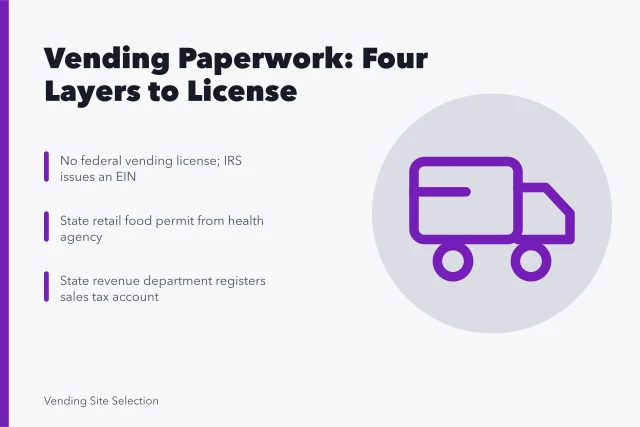
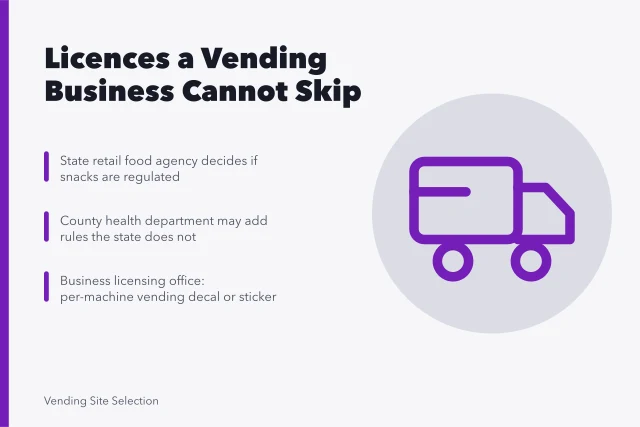
- Call the state retail food agency. Ask whether your machine type is regulated, what changes if it is refrigerated, and what records an inspector expects. Find the office through the U.S. Food and Drug Administration: State Retail and Food Service Codes and Regulations directory.
- Ask the county health department the same questions. Enforcement is often local, and the local answer is the one applied.
- Ask the county or city licensing office about a general business license and any per machine device permit or decal.
- Ask the state revenue department how vending sales are taxed, whether tax sits inside the vend price, what you register for and what you file.
- Register the entity and obtain any federal identification number your structure requires.
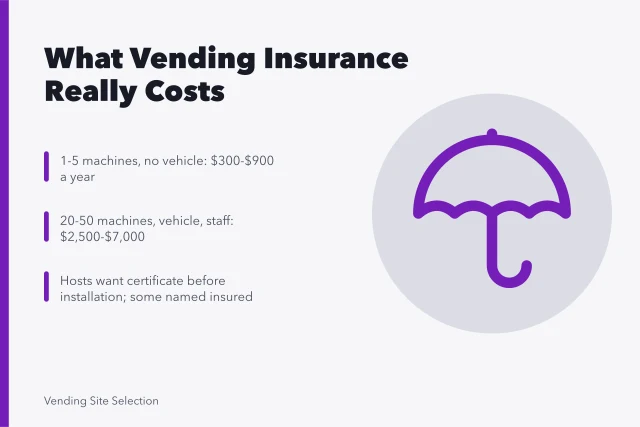
- Arrange insurance, and check the limits and additional insured wording your first host asks for.
- Open the compliance fileone entry per call, with date, office, person and answer.
- If you will employ a driver, settle classification and wage obligations before the first pay period.
Every item is a question, not an assertion. That is deliberate. Answers differ by state and county, and the full map of who decides what explains why a national license list would mislead you.
Before the first machine
- Call state retail food agency
- Ask county health department
- Ask licensing office about permits
- Ask state revenue about vending tax
- Register entity and obtain ID
- Arrange insurance and host wording
- Open compliance file per call
At every installation
- Confirm the exact position with the host, in writing.
- Check the clear approach to the machine and agree who keeps it clear. Machines in places of public accommodation carry obligations set out in the U.S. Department of Justice: 2010 ADA Standards for Accessible Design, and the U.S. Department of Justice: ADA Guide for Small Businesses covers what small businesses in existing facilities are expected to consider.
- Check the outlet is suitable and that no temporary cord is serving as a permanent solution.
- Anchor or secure the machine as the site and your policy require.
- Display any required permit or decal, plus your contact details for faults.
- Send the host the insurance certificate they asked for, in the form they asked for.
- Record the site's own rulesaccess hours, product restrictions, escort requirements, background checks.
- Note the installation date and open a service record for that machine.
Measure the approach before you drill the anchor bolts. A machine set 30 inches from a wall passes a doorway check and still fails a wheelchair turning radius, and the fix is a second installation visit you pay for twice.
On every service visit
- Check date codes and pull anything out of date, recording what and why.
- Record temperatures on refrigerated machines in whatever form your health department accepts.
- Check the approach is still clear, and move or report anything blocking it.
- Check the machine is clean, undamaged and correctly labeled.
- Record sales and cash collected before leaving the site.
- Note any fault, what you did about it, and when.
Six items. If the list grows past what fits on one screen it stops being completed honestly. A checklist nobody completes honestly is worse than none, because it creates a record saying everything was fine.
On every service visit
- Check date codes, pull out-of-date stock
- Record refrigerated temperatures in accepted form
- Check approach still clear, move or report
- Check machine clean, undamaged, labeled
- Record sales and cash before leaving
- Note faults, action taken and when
Once a year
- Re-ask the health department and licensing office whether anything has changed.
- Renew permits, decals and registrations before they lapse, not after a reminder.
- Review insurance limits against how the route has grown, and check the cover still matches the machines and stock you now hold.
- Check that your records look the way you told an inspector they would.
- Review the compliance file for answers older than a year and refresh them.
When something changes
Four events reset parts of the list before the annual review comes round.
- A machine crosses a city, county or state line. The licensing and tax position starts again, and the expansion checklist for a new area should include the same calls you made at the start.
- You add a refrigerated or temperature controlled selection. That can move you into a different regulatory category, so ask before the machine ships and check what it does to your product and sourcing plan.
- You take a site with its own rulebooka hospital, a school district, a secure facility. Their requirements are contractual and can be stricter than the law.
- You hire. Employment obligations arrive in full on the first day, not gradually.
What the checklist does not cover
It does not tell you which licenses you need, because that is a local answer and this page will not pretend otherwise. Work through the offices that hold those answers and put what they tell you in the file.
It also does not replace advice. A placement agreement you will sign many times is worth a lawyer's time once, and a driver classification question is worth an accountant's. Everything else on the list you can do yourself with a phone and a folder.
Common questions
How long should I keep the records?
Ask the health department and the state revenue department, because their retention expectations differ and both apply to you. Where you get two answers, keep to the longer one.
Is a photo of the temperature display enough of a record?
It might be, and your health department is the one to ask. What matters is that the record is contemporaneous, identifies the machine, and is kept in a form you can produce on request. Reconstructing a log later is worse than not having one.
The host says they handle compliance. Is that enough?
No. The host's obligations are theirs and yours are yours, and an agency will hold you responsible for your machines. Where a host says they have it covered, ask what specifically, and write the answer down with the rest.
What if a machine has to move after installation?
Treat it as a new installation. Re-check the approach, re-confirm the position in writing, and re-send the insurance certificate if the host changed. The permit or decal usually follows the machine, not the address, so confirm that with the office that issued it.