Guides
State vending permit and tax rules: what changes when you cross a US border
Crossing a state line changes your vending sales tax registration, health permit office and filing calendar, while FDA labeling duties stay the same.
What to take away
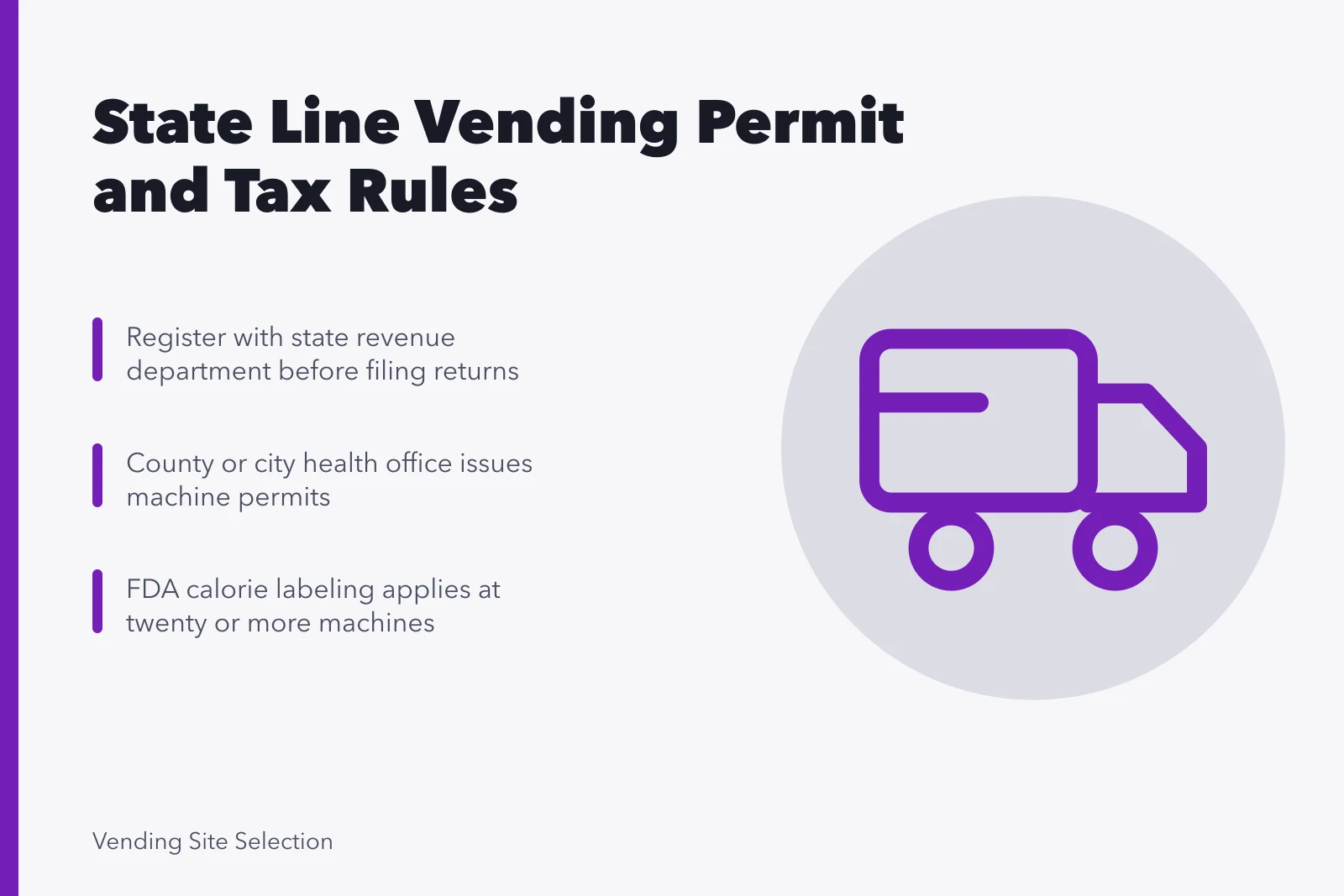
- A route crossing from El Paso into New Mexico meets three separate rule sets at one mile marker: state sales tax, county health permits and federal labeling.
- Register with the state revenue department first, then confirm the combined rate for each machine address, because district and county add-ons change at city and county lines.
- Health permits are issued by the county or city health office, not the state, and they are usually tied to the address rather than the company.
- FDA calorie and allergen duties follow the product, so one labeling setup covers every state you operate in.
- Get your EIN before any state registration, and keep one folder per state holding the certificate, permit, inspection reports and rate table.
Why the rules change at the state line
Nothing about the machine changes when a route crosses into a new state. The obligations do, and they arrive in three layers.
Three Compliance Layers
- Federal: IRS entity choice and federal accounts
- State: revenue department registration and filing
- Local: county or city health permit and inspection
- List every state, county and city touched
- Mark each: registration, permit or both
States set sales tax. Counties and cities issue food permits and inspect machines. The FDA sets labeling rules that apply everywhere. Treating those as one compliance task is how operators miss filings.
Start with the federal layer. The IRS starting a business guide covers entity choice and federal accounts for a new vending business. Settle that before you add a second state.
Then map the state layer. Each revenue department decides whether you must register, how often you file and what counts as taxable. A machine in a break room is still a retail sale in most states.
Then map the local layer. Two machines in the same state can sit under two different health jurisdictions, with different inspection schedules and different paperwork.
List every state, county and city your route touches, then mark which need registration, a permit or both. That list is your expansion checklist, not a general licensing and compliance guide you read once and file away.
Sales tax registration: four example states
These four states are examples, not the full rule set. Every state runs its own agency, rate and filing cutoff.
California registration runs through the California Department of Tax and Fee Administration, not the Franchise Tax Board. You apply for a seller's permit, then file returns on your taxable sales in the state. The state base rate is 7.25%, and district taxes lift typical combined rates to between 7.25% and 10.75%.
Sales Tax Registration by State
California
- Agency
- CDTFA
- Instrument
- Seller's permit
- Local add-ons
- District taxes
- Filing driver
- Taxable sales
Texas
- Agency
- Comptroller
- Instrument
- Sales tax permit
- Local add-ons
- Some local taxes
- Filing driver
- Taxable sales
Florida
- Agency
- Dept. of Revenue
- Instrument
- Dealer registration
- Local add-ons
- County surtax
- Filing driver
- Taxable sales
New York
- Agency
- Taxation and Finance
- Instrument
- Certificate of Authority
- Local add-ons
- City and local rates
- Filing driver
- Taxable sales
California also layers district taxes on top of the state rate. Two machines twenty miles apart can carry two combined rates, so your point of sale system or manual log has to capture the rate per address. Returns are quarterly for most sellers, with an annual option below $10,000 in taxable sales a year.
Texas registration goes through the Texas Comptroller of Public Accounts on Form AP-201. The state rate is 6.25%, and local taxes can take the combined rate as high as 8.25%. You report monthly at $500,000 or more in taxable sales a year, quarterly at $100,000 to $499,999, and annually below $100,000.
Texas has no general local sales tax added at the register the way California does, but some jurisdictions adopt their own. Confirm your rate table with the Comptroller before you set prices in a new city.
Florida registration is handled by the Florida Department of Revenue on Form DR-1. You register as a dealer, then collect the state rate plus any discretionary county surtax where the machine sits. The state rate is 6%, and county surtaxes take typical combined rates to between 6% and 7.5%.
Those county surtaxes vary, so a route crossing a county line carries two rates. That is a pricing and bookkeeping problem before it is a filing problem. Returns are monthly when tax collected is $500 or more a month, quarterly at $100 to $500, and annual below $100.
New York registration goes through the New York State Department of Taxation and Finance on Form DTF-17. You apply for a Certificate of Authority, display it, and file on your sales in the state. The state rate is 4%, and local rates take typical combined rates to between 8% and 8.875%.
New York City and some other localities add their own rates. A route through the five boroughs changes its rate table and its filing detail at the city line. Returns are quarterly when taxable sales stay below $300,000 in a quarter, and monthly at or above.
Local add-ons are the part that moves most often: California district taxes, Texas city taxes, Florida county surtaxes and New York City rates all sit outside the state base rate.
The licences a vending machine business cannot skip shape which sites justify the paperwork. Know the filing cost per address before you sign a host agreement.
Health permits come from the county, not the state
This is the layer that surprises operators. State health agencies publish a model food code, but the county or city health office issues the permit and inspects the machine.
Packaged shelf-stable snacks and sealed drinks are treated as low risk in many jurisdictions, sometimes needing only a basic registration. Refrigerated sandwiches, cut fruit or milk bring a food permit.
Permits usually attach to the location, not the company. A new machine at a new address can need its own permit and inspection even when you already hold one across town.
California environmental health is largely county-run. Texas uses city or county health departments. Florida leans on county health departments, with the Department of Agriculture involved for some packaged foods.
Outside New York City, county health departments issue permits. The city runs its own system.
Permit fees are set by the local office, so no national figure exists. Typical annual vending or food permit fees run from about $50 to $500, and higher where food is prepared on site or refrigeration is required.
Inspection cadence follows risk: packaged snacks are commonly checked once a year, and sites with refrigerated food once or twice a year.
Inspectors check temperature logs, cleaning schedules, product rotation, handwashing access for restocking staff and sometimes the machine's internal temperature readout. A route with no logs fails even when the machine runs perfectly.
Build the log templates and permit binder before your first inspection using a compliance checklist for new owners. The FDA's retail food regulatory program standards are voluntary, but county inspectors often work from the same framework, so they tell you what to expect.
FDA labeling follows the product, not the state
This is the good news for multi-state routes. FDA vending labeling duties attach to what you sell, so one correct setup travels with you.
The FDA's nutrition and food labeling guidance covers vended food and beverages. The duties that matter here are calorie disclosure for certain items and allergen statements on packaged products.
Calorie labeling applies to an operator who owns or operates twenty or more vending machines. Past that threshold you post calories per item, typically on the machine or a sign beside it.
Allergen labeling sits on the package, not the machine. Packaged goods already carry the manufacturer's allergen statement, so your job is to avoid repackaged or unlabeled items. For anything about a specific product's ingredients or allergens, the manufacturer's label is the authority, and food safety questions go to the FDA.
Front-of-package calorie disclosure has to be readable before purchase. A sticker on the glass or a digital display works if the customer can read it while choosing. Keep the format identical across states so route staff do not improvise.
Items with no meaningful nutritional claim, such as black coffee or plain water, may fall outside the calorie rule. Check each product category against the FDA guidance rather than assuming.
The four states side by side
California
- Sales tax agency
- California Department of Tax and Fee Administration
- State base rate
- 7.25%
- Typical combined rate
- 7.25% to 10.75%
- Registration instrument
- Seller's permit
- Registration form
- Seller's permit application through CDTFA online services
- Local rate add-ons
- Yes, district taxes
- Food permit issuer
- County environmental health
- Filing frequency
- Quarterly, annual below $10,000 a year
- FDA labeling duty
- Same nationwide
Texas
- Sales tax agency
- Texas Comptroller of Public Accounts
- State base rate
- 6.25%
- Typical combined rate
- 6.25% to 8.25%
- Registration instrument
- Sales tax permit
- Registration form
- Form AP-201
- Local rate add-ons
- Some local taxes
- Food permit issuer
- City or county health
- Filing frequency
- Monthly at $500,000 or more, quarterly at $100,000 to $499,999, annual below $100,000
- FDA labeling duty
- Same nationwide
Florida
- Sales tax agency
- Florida Department of Revenue
- State base rate
- 6%
- Typical combined rate
- 6% to 7.5%
- Registration instrument
- Dealer registration
- Registration form
- Form DR-1
- Local rate add-ons
- County discretionary surtax
- Food permit issuer
- County health
- Filing frequency
- Monthly at $500 or more in tax a month, quarterly at $100 to $500, annual below $100
- FDA labeling duty
- Same nationwide
New York
- Sales tax agency
- New York State Department of Taxation and Finance
- State base rate
- 4%
- Typical combined rate
- 8% to 8.875%
- Registration instrument
- Certificate of Authority
- Registration form
- Form DTF-17
- Local rate add-ons
- City and local rates
- Food permit issuer
- County health, or NYC system
- Filing frequency
- Quarterly below $300,000 a quarter, monthly at or above
- FDA labeling duty
- Same nationwide
Treat the table as a starting point. Rates, forms and filing frequencies change, and your own volume sets how often you file.
Four States Side by Side
California
- Tax agency
- CDTFA
- Registration
- Seller's permit
- Local rates
- District taxes
- Food permit issuer
- County environmental health
- FDA labeling
- Same nationwide
Texas
- Tax agency
- Comptroller
- Registration
- Sales tax permit
- Local rates
- Some local taxes
- Food permit issuer
- City or county health
- FDA labeling
- Same nationwide
Florida
- Tax agency
- Dept. of Revenue
- Registration
- Dealer registration
- Local rates
- County surtax
- Food permit issuer
- County health
- FDA labeling
- Same nationwide
New York
- Tax agency
- Taxation and Finance
- Registration
- Certificate of Authority
- Local rates
- City and local rates
- Food permit issuer
- County health or NYC
- FDA labeling
- Same nationwide
Canada is a separate market, not a fifth state. A route that crosses the border leaves the state sales tax system. The federal goods and services tax applies at 5% in Alberta and the territories.
Ontario charges 13% harmonized sales tax, and Nova Scotia, New Brunswick, Newfoundland and Labrador and Prince Edward Island charge 15%. British Columbia, Saskatchewan, Manitoba and Quebec add a provincial sales tax on top of the 5% GST.
Register with the Canada Revenue Agency for a GST/HST account once taxable revenue passes $30,000 over four consecutive calendar quarters. Filers with annual taxable supplies of $1.5 million or less can file once a year, and larger filers file monthly or quarterly.
Food permits come from provincial or municipal health units rather than counties, and the rules follow the province. Check the fee and the inspection cycle with the health unit for each machine address.
Federal registration before you expand
Get an employer identification number before you register in any state. The IRS guide to getting an EIN explains the online application and what you need to hand. Most state forms ask for it.
Federal Steps Before Expanding
- FirstGet a free EIN from the IRS
- ThenConfirm business structure with a CPA
- Before first hireAdd payroll, workers comp, OSHA
- OngoingKeep federal and state calendars separate
An EIN is free from the IRS. If someone offers to obtain one for a fee, you can usually do it yourself in minutes on the IRS site.
Your business structure also matters federally. A single member LLC, a partnership and a corporation each file differently, and the structure affects how a state revenue department treats you. Entity and tax elections are a conversation for a licensed CPA, not a general guide.
Hiring route staff in a new state adds payroll registration, workers compensation and possibly OSHA duties. Those arrive with the first hire, not the first machine. Coverage and classification decisions belong with a licensed insurance broker.
The USAGov small business hub indexes permit and registration basics when you enter a state and do not yet know which agency handles what.
Keep federal and state calendars separate. Missed federal and missed state filings carry different penalties, and merging them into one reminder is how operators miss both.
What to confirm with each revenue department
Before placing a machine in a new state, get answers from that state's Department of Revenue and write them down with the date. Rules change.
Ask Each Revenue Department
- Does activity create nexus in the state?
- Which registration form applies to vending?
- Filing frequency and first due date?
- Combined state and local rate per address?
- Does each location need its own account?
- How to update when machines change?
- Where to file, pay and keep records?
Run it once per state, then once per new city or county. The state answers tax questions. The county or city answers health permit questions.
Keep one folder per state: registration certificate, permit, inspection reports, rate table. When you add a machine you update the folder, not your memory.
A steady vending machine location routine keeps sales tax, payroll and permit fees from colliding at quarter end. Sales tax is collected money, not profit, and spending it is the fastest route to a cash shortfall.
Plan vending machine expansion as a small startup per state: federal accounts, state registration, local permits, labeling review, filing calendar. The machine is the easy part.
Common questions
Do I need a separate sales tax registration in every state where I place a machine?
Usually yes, if you have nexus and taxable sales there. The state rate comes with that registration, and the machine address sets the combined rate.
Are vending machine health permits issued by the state or the county?
In most of the country the county or city health office issues the permit and inspects the machine. State agencies set standards; the local office handles the paperwork.
Do FDA labeling rules change when I cross a state line?
No. Vending labeling duties follow the product nationwide, so calorie disclosure and allergen rules stay the same in California, Texas, Florida and New York.
When do I need an EIN for a multi-state vending business?
Before you register in any state. Most state forms ask for it, and you need it for federal filings and payroll.