Guides
Choosing vending machine products for a laundromat versus a gym
Choosing vending machine products for laundromat versus a gym means reading dwell time and foot traffic. This method details the sequence, checks, and stop point.
What to take away
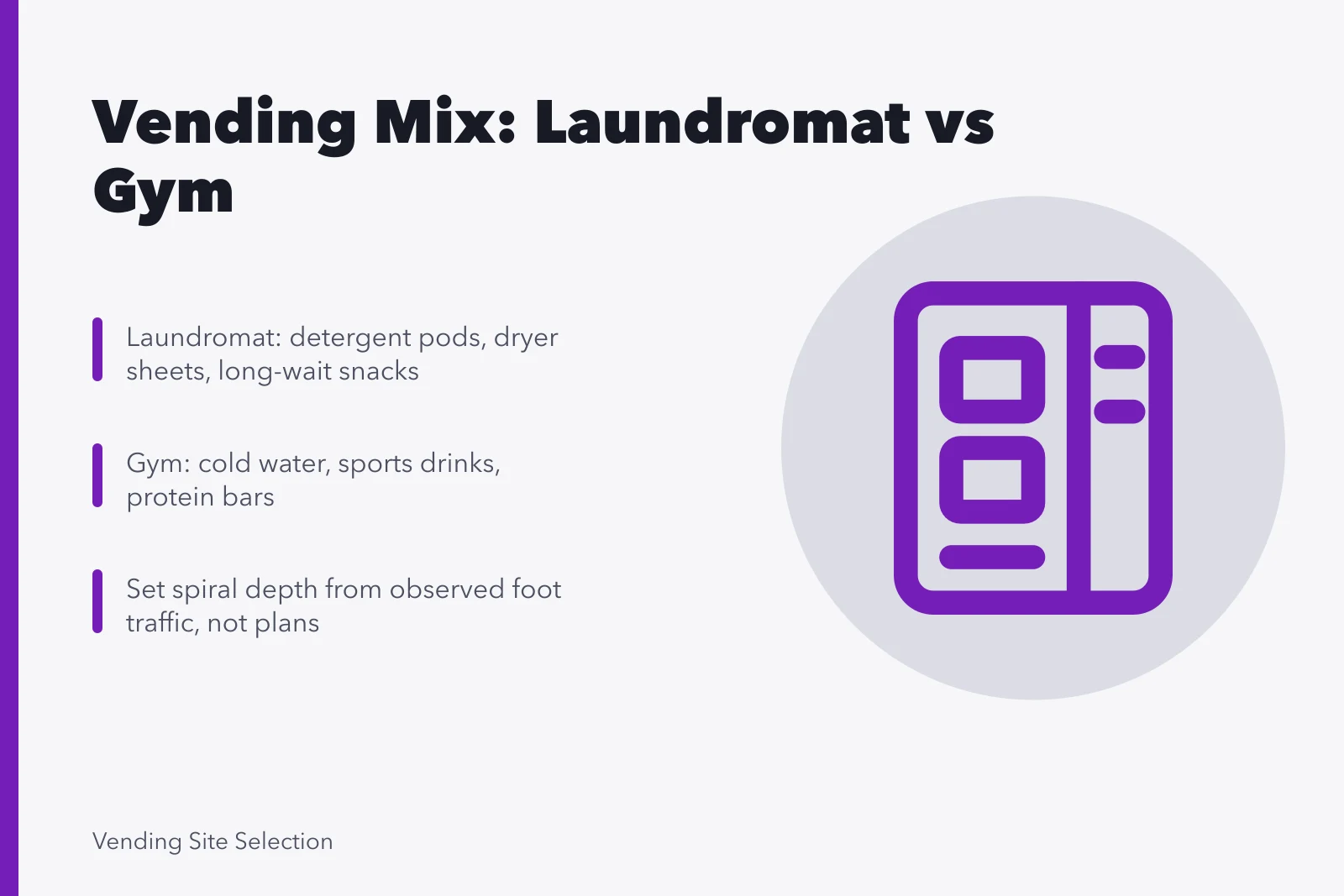
- Choosing vending machine products for a laundromat versus a gym starts with the site. A laundromat machine leads with laundry supplies such as Tide Pods, Bounce dryer sheets and Shout Wipe & Go stain wipes, plus filling snacks.
- A gym machine leads with cold water, Gatorade or Bodyarmor, protein bars and shakes, and travel-size deodorant.
- The deciding step is assigning spiral depth and row count from observed foot traffic, not from a generic plan.
- Check success after one full restock cycle by counting empty spirals and dead rows.
Dwell time decides the mix. Before you fill a single spiral, observe the site during its busiest period. A laundromat draws customers who stay near their machines and often carry baskets. A gym draws customers who walk through fast on their way in or out.
The table below shows a first-fill priority, with typical vend prices.
Laundromat first-fill priority
- Task essentials
- Tide Pods 3-in-1 pacs, Bounce dryer sheets, Shout Wipe & Go stain wipes
- Impulse
- Snickers, Lay's, Cheetos
- Personal care
- Scotch-Brite lint roller, Purell 1 oz hand sanitizer
- Recovery
- Not stocked
- Typical vend price, as of 2026
- $0.75 to $2.50 per item; a two-pod Tide sleeve $1.50 to $2.00
- What sets the price
- Laundry supplies carry a convenience premium
Gym first-fill priority
- Task essentials
- Dasani or Aquafina 20 oz water, Gatorade or Powerade, Quest Bars (about 20 g protein)
- Impulse
- GU Energy Gel (about 100 calories per pack), Jack Link's jerky, Welch's Fruit Snacks
- Personal care
- Neutrogena face wipes, travel-size Degree deodorant, Goody hair ties
- Recovery
- Premier Protein shake (30 g protein), Bodyarmor (Coca-Cola, no artificial colors), Liquid I.V. sticks
- Typical vend price, as of 2026
- $2.00 to $4.00 per item; Premier Protein shake $3.50 to $4.00
- What sets the price
- Single-serve sizes and recovery drinks
Prices vary by region and account.
A wash cycle at a US laundromat usually runs 25 to 35 minutes, and a dryer adds 30 to 45. That gives a customer time to sit, eat, and buy a second item. A gym visit is often under 90 minutes, and many members bring a refillable bottle.
What has to be true before the first step
You need a machine with adjustable spirals or trays and a way to read sales by selection. Glass-front snack machines from Automated Merchandising Systems (AMS) and the Wittern Group's USI line use adjustable coils, and so do refrigerated glass-front units.
A card reader from Nayax or Cantaloupe reports sales by selection against the planogram you loaded. You also need the property manager's permission to change the mix when the site is managed.
Your observation sheet should follow a basic market research format to record foot traffic and customer actions. Walk the site at three different times: early morning, lunch, and after work. Count customers, note what they carry, and watch where they pause.
For a laundromat, the pause is near washers and dryers. For a gym, the pause is usually at the front desk or locker room.
Observe at least two different weekdays and one weekend day. Note whether laundromat customers already carry detergent or buy it on site. Note whether gym members bring their own water bottles or buy cold drinks at the desk.
The product selection sequence
- Map the customer task and wait pattern. Laundromat customers buy things to consume while seated. Gym customers buy things to drink or carry away. For a site-level comparison, see Census and BLS data.
- List products by the job they do. For a laundromat, list Tide Pods, Bounce dryer sheets, Shout Wipe & Go stain wipes, Snickers bars and Lay's chips. For a gym, list Dasani water, Gatorade, Quest Bars, travel-size Degree deodorant and Goody hair ties.
- Assign first-fill rows. Give the three core items the top two rows each, and impulse items one row. Leave one row open for a local pick you observe on site; an open row beats a full machine of unproven items.
- Set spiral depth by foot traffic. High-traffic core items get a deeper coil, and slower items get a shallow one. A shallow coil typically holds 5 to 7 units; a deep coil holds 10 to 12. A deep coil needs fewer refill trips. A shallow coil keeps slow items from sitting past their date code.
- Load the machine and mark the coil map with plan numbers.
- After one full restock cycle, audit sales per selection against the plan.
If the site is managed, get the mix approved in the site agreement. See Working with US property managers, HOA and REIT playbooks for vending.
The step that decides the result
Step 4 matters most because it converts observations into mechanical capacity. A shallow coil on a fast-selling item causes an empty machine. A deep coil on a slow item creates dead stock that expires before it sells.
In a laundromat, the fast sellers are usually laundry essentials and cold drinks. A gym serves a membership base that passes through quickly, as gyms describes.
First-fill priority by site
Product group
- Task essentials
- detergent pods, dryer sheets
- Impulse
- candy, chips, cookies
- Personal care
- lint rollers, sanitizer
Laundromat
- Task essentials
- water, sports drink
- Impulse
- energy gel, jerky
- Personal care
- face wipes, deodorant
Gym
- Task essentials
- Impulse
- Personal care
Cold drinks sell at both sites. A 20 oz Coca-Cola or Pepsi bottle typically vends at $1.50 to $2.00 in the US, and a 20 oz Gatorade at $2.00 to $2.75. Tide Pods come as 3-in-1 pacs, typically about $13 to $17 for a 42-count bag at retail.
A high-unemployment neighborhood laundromat often needs more filling items, because customers wait longer and may buy for several needs. A suburban strip mall gym needs more cold drinks, protein and personal care, because customers pass through fast.
In both cases the first-fill table is only a starting point. The sales audit in step 6 tells you what to keep.
How to check each step came out right
After the first full restock cycle, each of the top two product rows should have at least one sale. No row should be empty across the machine except the intentional local-pick row.
Before each restock, count sold-out spirals. If more than two spirals are empty in the core rows, depth was too shallow. Deepen those coils and check them again at the next restock.
For a service checklist, read Inspecting vending machine service quality.
What to do when a step goes wrong
The most common failure is a dead row: a product group that never sells. Use a dead-row swap: replace the two lowest-selling selections with backup items from the same category, then note the change for re-audit at the next restock.
If the row stays dead after two swaps, remove that product group entirely. If a fast item sells out before restock, deepen its coil by one spiral position and move the slowest item to a shallow spot.
When to stop and hand it to a professional
Stop and hand the account to a vending route operations specialist when three or more rows stay dead after two consecutive dead-row swaps. Stop if the same two items keep selling out after a depth change.
A specialist can run a full machine-level demand study and rebuild the plan from sales data. If the contract blocks the mix, see Vending machine quotes that clients accept.
Common questions
Should I use the same product mix in a laundromat and a gym?
No. A laundromat sells Tide Pods, Bounce dryer sheets, and snacks. A gym sells water, Gatorade, and Quest Bars.
What sells best in a high-unemployment neighborhood laundromat?
Single-dose detergent such as Tide Pods or Purex UltraPacks, Bounce dryer sheets, Shout Wipe & Go stain wipes, and filling snacks such as Snickers or Cheetos. A two-pod Tide sleeve vends at $1.50 to $2.00 in most markets.
How do I know when to restock a gym machine?
Restock when core rows show one empty spiral, not on a fixed calendar. Use the sales-by-selection report from a Nayax or Cantaloupe reader to time restocks.
When does product selection become a professional service?
When the same items keep selling out after a depth change. A route operations specialist should take over with machine-level sales data.