Guides
Vending machine inventory management for owners
How much vending inventory to hold, worked as par levels from units per day and days between visits, plus the buffer stock a route needs off the truck.
What to take away
- Inventory is decided per selection, per machine, from units sold per day and the gap between visits.
- Hold buffer stock off the machine as well as in it, or one missed delivery empties a route.
- More stock is not safer. Cash tied up in slow product is the most common quiet loss in a small route.
- Short dated products are bounded by the calendar, not by the column.
Start from one number you can actually measure
Everything below rests on U, the units a selection sells per day at one machine. You get U by counting what you loaded, counting what is left, and dividing by the days between visits. Two or three cycles give a usable figure; one cycle gives an anecdote.
Do this per selection, not per machine. A machine total tells you how much stock to buy in aggregate and nothing about which column runs dry on day four.
Telemetry changes where U comes from, not what it is. Vend readings give a daily count per selection, so U comes from a running average rather than from a count you did by hand. The same reports show the sell outs you never saw. Those are what you check at the quarterly par review before you reset B.
The par level expression
Let U be units per day, D the days between service visits, and B a buffer expressed in days of cover. The par for that selection is:
Par vs Column Capacity
Par above capacity?
Shorten interval, add column, or accept sellout
Par far below capacity?
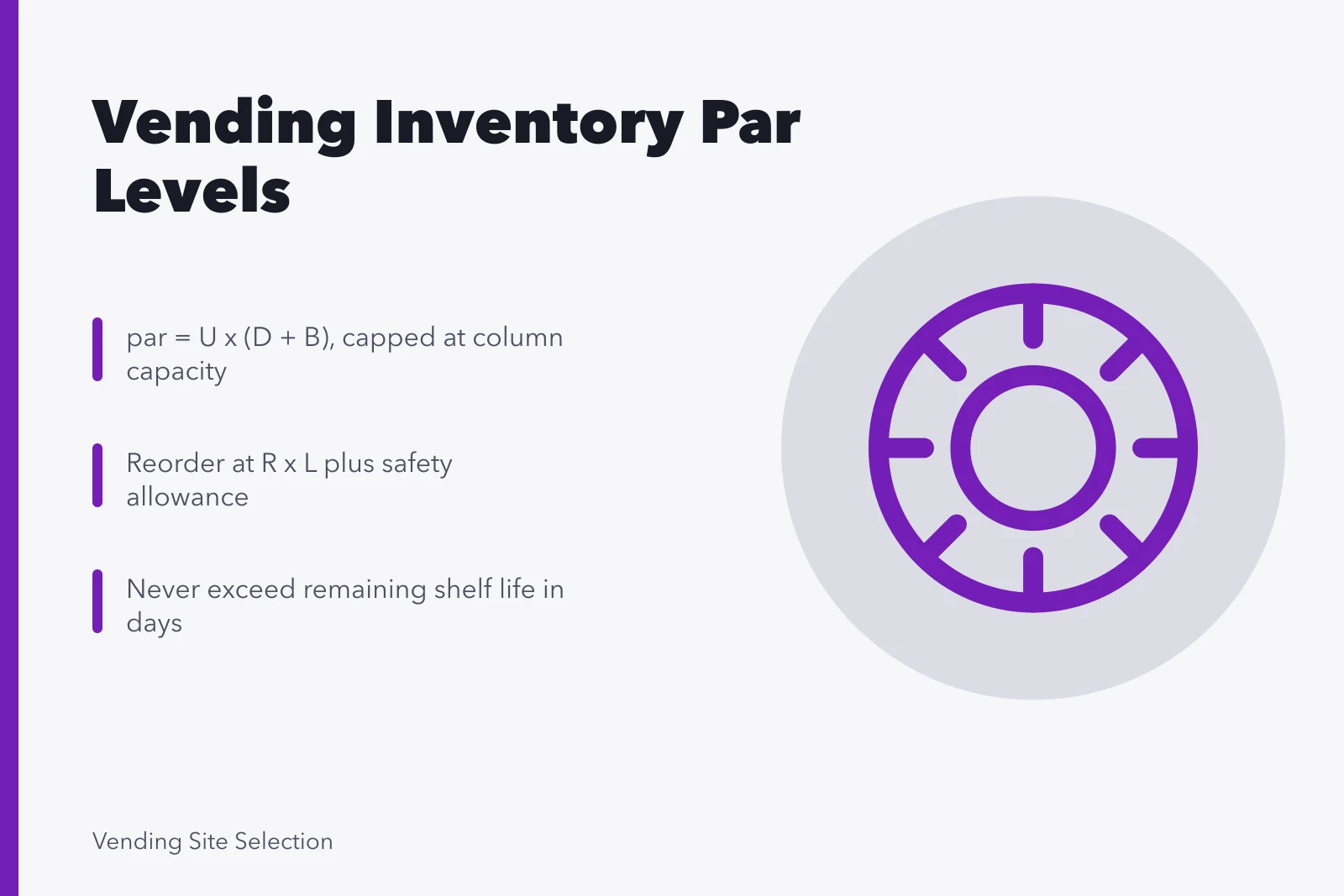
par = U x (D + B), capped at column capacity
Choose B from how variable that selection is rather than from a general rule. A steady seller in a plant with a fixed shift pattern needs little buffer. A selection that spikes when the weather turns or when a site runs overtime needs more.
As a starting range, give a steady seller 2 to 3 days of cover and a spiky one 5 to 7 days, then adjust them from your own sell out record.
Worked example. U is 6 units a day, D is 14 days, and B is 3 days. Par is 6 x (14 + 3), which is 102 units.
A column that holds 20 cannot carry that, so the interval is too long or the selection needs a second column. A column that holds 110 sits just above par, so the interval is about right.
Then read the result against the column.
- If par is above capacity, the machine cannot hold enough to reach your next visit. Either shorten the interval, give the selection a second column, or accept the sell out and know you are choosing it.
- If par is far below capacity, the selection is occupying space it does not earn. That is a candidate for replacement.
- If par is close to capacity, you have the interval about right.
Days of cover on the shelf, not just in the machine
The machine is only half of the holding. The other half is what sits in your storage between deliveries, and it is what stops a supplier problem becoming an empty route.
Reorder Point Inputs
- RTotal units consumed across all machines per day
- LLead time in days from order to receipt
- R x LReorder when stock on hand falls to this
- Safety allowanceExtra cover for late delivery
Let R be total units of a product consumed across all machines per day, and L the lead time in days from placing an order to receiving it. Reorder when stock on hand falls to:
R x L, plus a safety allowance for a late delivery
The safety allowance is a judgment, and the honest way to set it is from your own delivery log rather than from a rule. If a supplier has missed a window twice in three months, the allowance should reflect that. If they have never missed one, carrying a week of cover is money doing nothing.
Where the calendar overrides the arithmetic
Short dated products are bounded by their date code, not by the column. Two rules keep this simple.
Short Dated Stock Rules
- Never hold more days of cover than remaining shelf life allows
- Count warehouse time before stock reached you
- Record the date code on delivery
- Ask health department about power-loss discards
- Keep written temperature records if required
Where the calendar overrides
- Never hold more days of cover than the remaining shelf life allows, counting the time the stock has already spent in the warehouse before it reached you.
- Record the date code on delivery. Short dated stock arriving from a distributor moves the waste from their books to yours, and you cannot argue about it if you did not write it down.
Refrigerated selections carry a second constraint that has nothing to do with inventory volume: what happens when a site loses power. Ask the state or county health department what their rule is for a machine that has been without power, what has to be discarded, and what has to be recorded.
The U.S. Food and Drug Administration: State Retail and Food Service Codes and Regulations directory tells you which agency answers that in your state. The compliance obligations for your machines may include a written temperature record. Whichever agency answers, its retail code sets the temperature limit and the discard and record rules your machine has to meet.
What holding too much actually costs
The cost of excess stock is easy to underrate because it does not appear as a loss until the product expires. Four things happen at once.
Costs of Excess Stock
- Cash sits in cardboard instead of the bank
- Storage space fills up
- Expiry losses rise as slow product ages
- Temptation to place slow stock wrongly grows
- Spoils planogram data you have collected
What holding too much costs
- Cash tied up in stock that turns slowly, money you cannot spend on a line that sells.
- Expiry and write-off on date coded lines, where the loss lands on your books rather than the distributor's.
- Storage and handlingshelf space, counting time, and rotation work that a leaner order would not need.
- A stale planogram, where space stays with products that no longer earn it.
Underrating this is the most common inventory error among new operators, and it usually comes from a good instinct: never let a machine be empty. The better version of that instinct is never let a machine be empty of the things it actually sells.
Fitting stock to the site rather than the route
Two machines can consume identical totals and need completely different stock. A product mix built for the site starts from what the building's people do: how long they are there, whether they can leave, what time the shifts change.
Ask the host directly what people go out to buy. Ask what they complained about with a previous machine. Those two answers will change your first order more than any general list of top selling items.
They also feed straight into the case you make to win the next location, because a host who sees their answer on the shelf notices.
When you add a machine in a similar building, the existing planogram is a starting point rather than a template. Verify it over two or three cycles before treating it as settled.
Be more careful still if the new site is in a different area from the rest of the route, where supplier availability and local taste can both differ.
Keeping the count honest
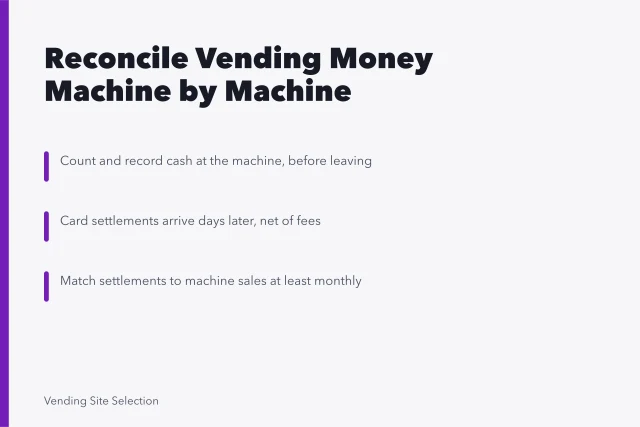
- Count in and count out on every visit, on paper or in the app, before you leave the site.
- Record removals separately from sales, with the reason.
- Reconcile machine counts against purchases at least monthly. Purchases, sales and inventory records are part of what the Internal Revenue Service: What kind of records should I keep? guidance expects a business to hold. That guidance requires records that support the income and deductions you report.
- Check that the products you place in the reachable part of the machine are the ones you want to sell, and that the installation itself meets the access requirements in the U.S. Department of Justice: 2010 ADA Standards for Accessible Design where the machine is in a place of public accommodation. Those standards set reach ranges, clear floor space and operable parts for the machine.
- Review pars quarterly, or whenever a site's headcount or hours change.
If you are still setting the route up from scratch, the first fill is a measurement, not a settled planogram.
Common questions
How much stock should I hold before the first machine goes in?
Enough for one full fill plus one replacement fill, and no more. You do not know U yet, so anything beyond that is a guess you have paid for. Buy the second order once the machine has told you what it sells.
Does telemetry remove the need for par levels?
No. It removes the need to guess at U and it tells you about sell outs you would otherwise miss. The par is still a decision about how much cover you want to carry, and that decision is yours.
What do I do with stock from a site that cancels?
Redistribute it to machines that sell the same lines, if the dates allow. If they do not, write it off and record it, because that write off is part of the true cost of losing the site and it belongs in the review of why you lost it.