Guides
What a vending machine business needs to operate legally
A vending machine business needs licenses, permits and registrations, plus a sales tax permit, and each state office issues specific documents.
What to take away
- Four layers issue paperfederal, state, county or city, and the host building. Each one names its documents differently, so ask for the document, not the category.
- The federal layer issues no vending license. It issues an EIN, and it sets labeling, wage and accessibility rules your machines must meet.
- The state layer splits in twoa retail food permit from the health agency, a sales tax account from the revenue department. Both are registrations, not licenses.
- County and city issue the paper with the word license on ita business tax receipt or occupational license, plus a device decal in some jurisdictions.
- Your compliance position is the file of dated answers, temperature logs and removal logs, not the certificates on the wall.
The four layers, and what each one issues
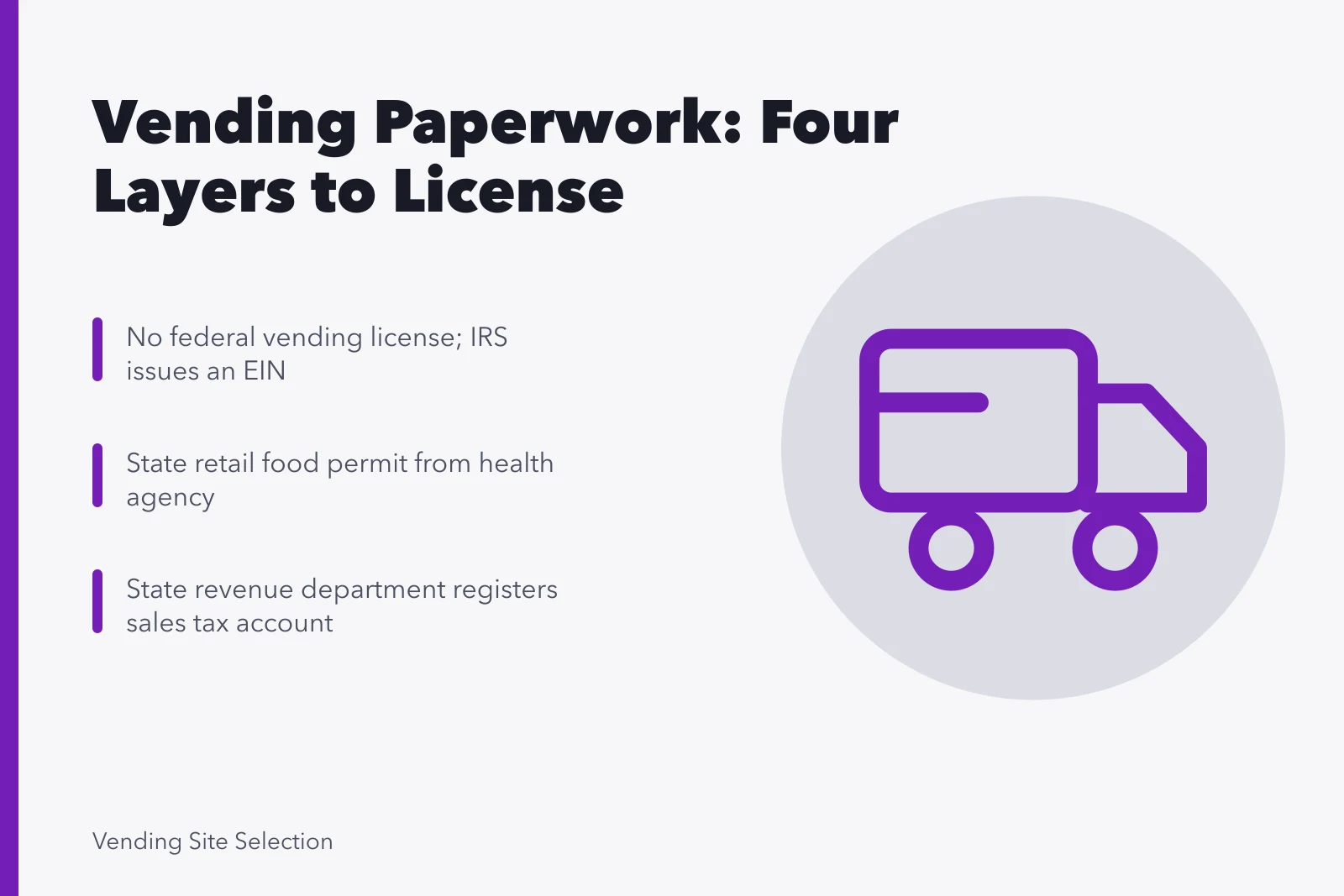
A vending route collects paper from four directions. The federal government registers the business and regulates the product and the workplace. The state registers the food operation and the tax account. The county or city licenses the business and sometimes the machine. The host building adds its own conditions.
Four layers of vending paperwork
- Federal: registers business, product, workplace
- State: food operation and tax account
- County or city: business license, machine permit
- Host building: adds its own conditions
Terminology is the first obstacle. The same document is a business tax receipt in one Florida city, an occupational license in Kentucky, and a vending device permit in parts of California. Ask each office what it issues, then ask for that document by name.
Federal: registrations, not licenses
There is no federal vending license. Three federal touchpoints apply instead.
Federal touchpoints, no vending license
- IRS employer identification number
- FDA labeling on packaged food
- DOL wage and hour rules if you employ
- DOJ ADA machine accessibility standards
The Internal Revenue Service issues the employer identification number, which every entity, bank account, and permit application will ask for. Entity type and filing obligations are determined under IRS rules, and a licensed CPA should confirm them for your situation.
The Food and Drug Administration sets labeling requirements for the packaged food and beverages you buy and resell. Those obligations sit with the manufacturer, and the FDA publishes them. If a product's label is wrong, that is the manufacturer's problem, not yours.
If you employ anyone, the Wage and Hour Division of the U.S. Department of Labor: New and Small Businesses explains minimum wage, overtime, and recordkeeping duties for a small employer.
Accessibility applies to the machine itself. The U.S. Department of Justice: 2010 ADA Standards for Accessible Design set the reach range, clear floor space, and operable-part requirements. The U.S. Department of Justice: ADA Guide for Small Businesses restates them for existing facilities, including barrier removal where it is readily achievable.
State layer one: the retail food permit
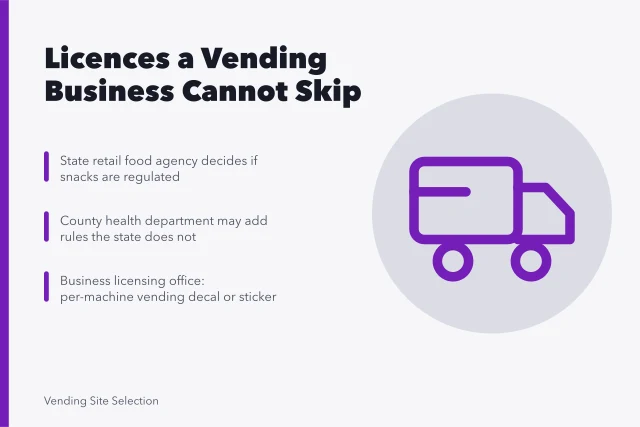
This is the registration most operators need and most often misjudge. The state retail food agency decides whether a machine that sells only packaged, shelf-stable snacks and drinks is regulated at all. Some states say no. Some say yes and require a permit anyway.
Five questions for the food agency
- Are packaged shelf-stable machines regulated here?
- What changes for refrigerated or hazardous food?
- Permit per machine, location, or operator?
- What records and retention does an inspector want?
- What is required after a power loss?
Find the agency and the code it enforces through the U.S. Food and Drug Administration: State Retail and Food Service Codes and Regulations.
Five questions get you a usable answer from that office.
- Is a machine vending only packaged, shelf-stable items regulated in this state, and if so under which section of the code?
- What changes if the machine is refrigerated or holds potentially hazardous food?
- Is the permit issued per machine, per location, or per operator, and what is the current fee?
- What records will an inspector ask to see, and what retention period applies?
- What is required after a power loss at a refrigerated site?
Write the answers down with the date and the name of the person who gave them. That note is your defense if a later inspector reads the rule differently.
State layer two: the sales tax account
What the sales tax account decides
- Whether vending sales are taxable
- Tax included in price or added
- Whether a category is treated differently
- Which returns you file and how often
Do not carry an answer across a state line. Neighboring states differ, and a vending operator selling the same SKUs in two states may file two different ways.
Registration is usually free and done online. Filing is not optional once you are registered, even in a month with no sales.
County and city: where the word license lives
This is the layer that issues documents actually called licenses. Ask the licensing office for three specific things.
Three documents called licenses
- General business tax receipt or occupational license
- Vending device permit or decal per machine
- Fire or zoning sign-off before the others
Some jurisdictions issue a sticker that must be visible on the machine. Others issue a paper certificate you keep at your office. Ask which, and ask what the renewal cycle is, because a lapsed decal is the cheapest violation to avoid and the easiest to forget.
The county health department may also hold the food permit, because many states delegate enforcement to the county. Ask the county the same five food questions you asked the state. Where the two answers differ, the county is the one an inspector will act on.
The host building sets its own conditions
A hospital, a school district, or a secure facility can require product restrictions. It can also require background checks for anyone entering. It can require certificates of insurance naming the host as additional insured. It can require windows for service access.
Put these in the placement agreement rather than learning them at the door. The three that surprise operators most are insurance certificates, product restrictions in buildings serving young people, and access procedures that turn a two-hour service round into four.
The records that decide an inspection
Licenses are obtained once and renewed. Records are where an ordinary inspection goes badly, and they are the part no office will remind you about.
| Record | What it covers | Who asks for it |
|---|---|---|
| Temperature log | Every refrigerated machine, current not reconstructed | State or county health inspector |
| Removal log | What came out of each machine and why | Health inspector, on expired stock |
| Purchase invoices | Traceable source for every SKU sold | Health agency, and your own margin math |
| Sales by machine and period | Tax returns and commission calculations | Revenue department, host |
| Dated compliance notes | Who you asked, what they said, when | You, when a rule is read differently later |
An operator who can produce a dated note of the answer they were given stands in a very different position from one who says they were told it was fine.
Employment, once a driver is not you
The moment someone else runs the route, a second set of obligations arrives: worker classification, wage and hour rules, hours-worked records, and whatever the state labor agency adds on top of the federal floor.
Settle classification before the first paycheck, not after. The federal starting point is the Department of Labor guidance linked above. A licensed CPA or employment attorney should confirm how your state treats route drivers.
Keeping the position current
Three things move: the rules, your operation, and the sites you serve.
Set an annual review. Re-ask the health agency and the licensing office whether anything changed, renew what needs renewing, and confirm your records still look the way you told an inspector they would.
When you move into a new county or state, the whole map resets at the border. Do it again when you change the product mix in your machines, because adding a refrigerated selection can move you into a regulated category. The same applies when a new type of site brings its own building rules.
Common questions
Do I need a food permit for a machine that only sells packaged chips and soda?
That is the exact question for your state retail food agency, and the answer differs by state. Some treat packaged, shelf-stable vending as outside the permit requirement. Others require a permit regardless of what is inside the machine. Get the answer in a dated note and keep it.
Is the machine or the host responsible for accessibility?
Both, and the placement agreement should say who does what. You control where the machine sits and how it is installed. The host controls the route to it and whether that route stays clear. Agree the position and the approach in writing at installation.
What happens if an inspector arrives and I am not there?
They inspect the machine and speak to the host. That is why your contact details belong on the machine, your decal belongs displayed if one is required, and the machine should be left as you would want it found. Keep records where you can produce them the same day.
Do I need a lawyer for any of this?
For the placement agreement you will sign repeatedly, once, yes. For licensing questions the issuing offices are the better source and they answer free. Nothing here is legal advice, and it does not replace the answer your own jurisdiction gives you.