Guides
Vending machine site selection and location guide
Vending machine site selection framework: captive versus choice-rich audiences, converting traffic, service radius, and what a location is worth after commission.
What to take away
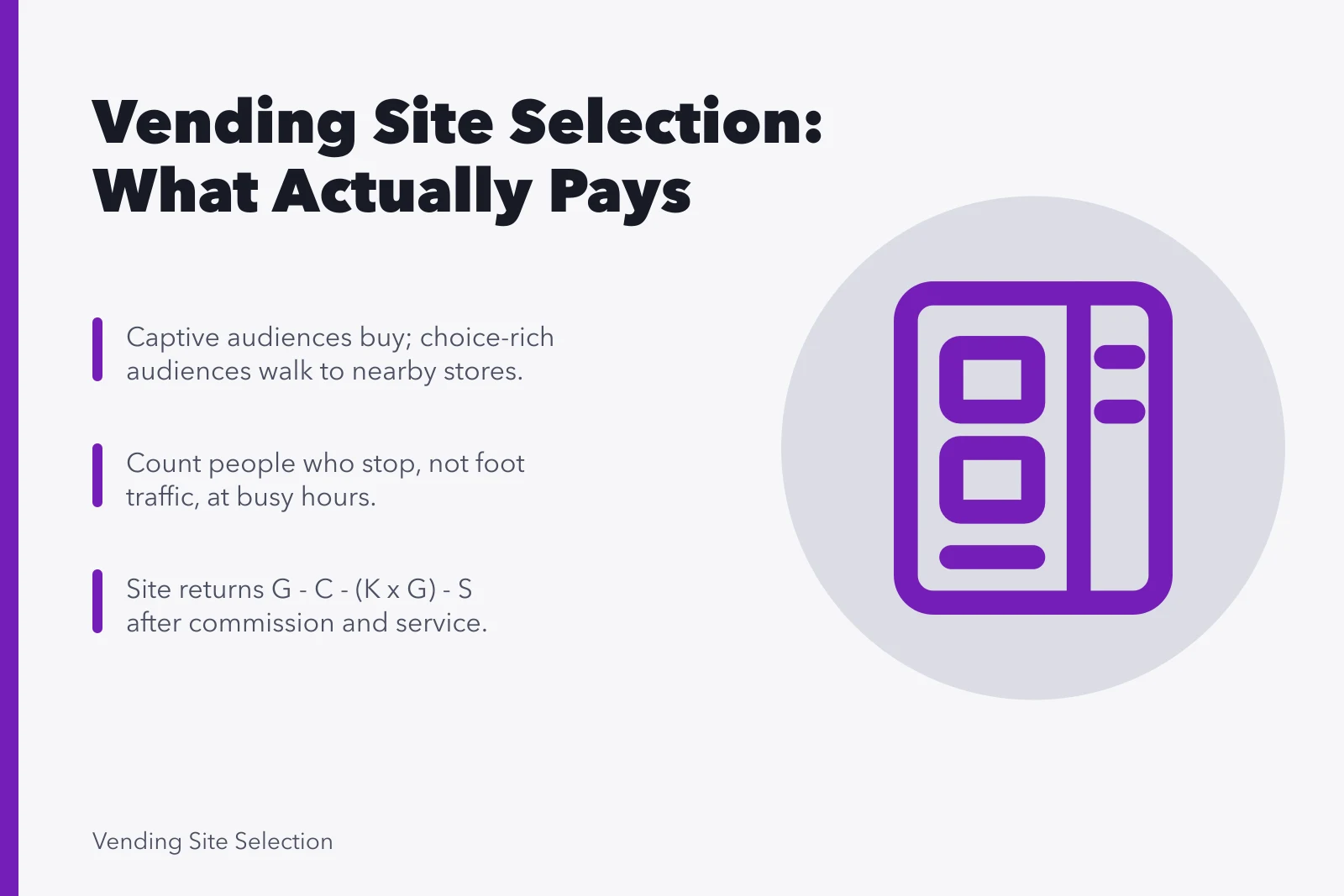
- A site is worth what it returns after commission and after the cost of driving to it. Sales alone rank sites wrongly.
- Captive audiences buy. Audiences with a store forty feet away mostly do not.
- Count people who stop, at the hour the building is busy. Headcount is a weaker signal than a stopped count.
- A site outside your service ring has to clear a higher bar than a site inside it, because it consumes a whole trip.
- Access to the machine is part of the site decision, not a detail to settle afterward.
What a site actually is
A location is three things at once, and operators who evaluate only the first make the same mistake repeatedly.
An audience: a set of people, present for a length of time, with or without alternatives. It is a contract: a commission rate, a term, and a set of obligations that decide how much of the sales you keep.
And it is a stop on a route: a fixed driving-time cost that recurs every cycle whether the machine sold well or not.
A site that is strong on the first and weak on either of the others is the classic bad placement. It looks busy, the host is pleased, and it quietly consumes more than it returns.
Captive and choice-rich audiences
The most useful division between sites is how much choice the buyer has at the moment they want something.
Captive vs Choice-Rich Sites
Captive audience
- Can they leave?
- Cannot easily leave
- Competes with
- Going without
- Examples
- Night shift, hospital floor
- Best hours
- Any time present
- Host question
- When can't people leave?
Choice-rich audience
- Can they leave?
- Can walk out
- Competes with
- Better cheaper store
- Examples
- Lobby with coffee shop
- Best hours
- Before/after cafeteria
- Host question
- When are they stuck?
A captive audience is one that cannot easily leave: a night shift in a plant, a hospital floor between rounds, a residence hall at eleven at night, an airside gate area. The machine is not competing with a store. It is competing with going without.
A choice-rich audience can walk out and buy the same thing better and cheaper. A machine in a shopping center corridor, a lobby with a coffee shop in it, a workplace with a staffed cafeteria at lunchtime. Those sites can still work, but they work at particular hours: before the cafeteria opens, after it closes, on a weekend.
The practical question to ask the host is not how many people work here. It is when can people not leave the building, and how many are here then.
Counting traffic that converts
Foot traffic is the most quoted and least useful number in this trade, because most of it is people going somewhere else.
Running a Stopped Count
- Stand where machine would go
- Pick two or three busy periods
- Count people pausing within reach
- Use a fixed interval, note time and day
- Repeat the count once
Collect a stopped count instead. Stand where the machine would go, at two or three of the building's busy periods, and count people who pause within reach of that spot.
Use a fixed interval, note the time and day, and repeat once. It costs an hour. It is the only site evidence most small operators gather about their machine.
Three things make a stopped count more informative.
- Note whether the people who stop are waiting for something. A queue for a time clock, an elevator, or a shift handover produces buyers. Traffic in motion does not.
- Note what else is within sight. A vending machine next to a water cooler competes with it.
- Note the hours with no count at all. A building that is empty for sixteen hours a day still needs servicing at the same interval.
What the commission does to a good site
Commission is charged on gross sales. Your costs come out of what remains. That asymmetry is why two sites with identical sales can sit on opposite sides of the line.
What a Site Returns
- Ggross sales
- Ccost of goods
- K x Gcommission on gross
- Sservice cost per cycle
Take gross sales G, cost of goods C, commission rate K, and service cost S for the cycle. The site returns G - C - (K x G) - S.
S barely moves with volume, so a low volume site absorbs all of it and a high volume site spreads it. Because K applies to the top line, a commission increase costs more than the same increase applied to profit.
Before agreeing a rate, work out what the site returns at the sales level you expect, not the level the host hopes for. Then work it out at a lower level; that case decides whether the agreement is safe.
The clause work belongs with the product and price decisions that follow. But the commission conversation happens first and sets the ceiling on everything after it.
Service radius, and why distance beats sales
The binding constraint on a small route is how many machines one person can serve in a day. Distance, not demand, sets that number.
Draw your existing machines on a map and mark the area you can already reach without adding a trip. A site inside that area only has to cover its own service time. A site outside it has to cover a whole journey, and it must clear a much higher bar to be worth taking.
That is not an argument against ever going further; it argues for treating a distant site as the first machine in a future cluster, not a standalone win. Set a date by which it must have neighbors, and if it does not, move it.
The wider view of how a route grows covers what happens when this discipline slips.
Comparing site types honestly
Audience shape
- Manufacturing or distribution facility
- Captive, long shifts, predictable breaks
- Corporate office
- Semi-captive, weekday only
- Medical office building
- Mixed, with waiting periods
- Residence hall or student housing
- Captive at unusual hours
- Fitness center
- Choice-rich but specific in what it wants
- Laundromat or self service site
- Captive for a fixed dwell period
- Hotel
- Captive at night, choice-rich by day
- Transportation terminal
- Captive with high volume
What decides it
- Manufacturing or distribution facility
- Whether you can get in at shift change, and who controls access
- Corporate office
- Whether there is a subsidized cafeteria, and what happens on hybrid days
- Medical office building
- Access hours, and whether the machine serves staff, visitors or both
- Residence hall or student housing
- Term time only demand, and higher exposure to damage
- Fitness center
- A narrow product range that has to be right
- Laundromat or self service site
- Unattended hours, and security
- Hotel
- Guest expectations, and what the front desk already sells
- Transportation terminal
- Rent or concession structure, which can be unlike a normal commission
Use it to ask the right question about a candidate, not to rank the categories. A weak site type with an excellent host beats a strong site type with an absent one.
Site Types and What Decides Them
Site type
- Manufacturing facility
- Shift-change access, access control
- Corporate office
- Subsidized cafeteria, hybrid days
- Medical office building
- Access hours, staff or visitors
- Residence hall
- Term-time demand, damage exposure
- Fitness center
- Narrow product range must be right
- Laundromat
- Unattended hours, security
- Hotel
- Guest expectations, front-desk sales
- Transportation terminal
- Rent or concession structure
What decides it
- Manufacturing facility
- Corporate office
- Medical office building
- Residence hall
- Fitness center
- Laundromat
- Hotel
- Transportation terminal
Access is part of the site decision
Where a machine sits in a place of public accommodation, the way it is approached and operated is governed by federal accessibility requirements. The U.S. Department of Justice: ADA Guide for Small Businesses explains the obligations of small businesses in existing facilities, including barrier removal and accessible routes, in plainer terms than the standards themselves.
Before installation, settle three things with the host: where exactly the machine stands, the clear approach to it, and who is responsible for keeping that approach clear.
A machine placed in a corridor that later fills with stacked boxes is a problem for both of you. It is far easier to agree in advance than to raise later.
Questions to settle before you sign
- Who at the site actually has authority to agree this, and who will be your day to day contact?
- What are the access hours, and how do you get in outside them?
- Where is the nearest outlet, and who pays for any electrical work?
- Is there an incumbent operator, and when does their agreement end?
- What has gone wrong with a machine here before?
- Who is told when the machine is faulty, and how?
The last question quietly decides retention. A host with no way to report a fault will report it by cancelling.
Settle Before You Sign
- Who has authority to agree
- Access hours and after-hours entry
- Nearest outlet and who pays wiring
- Incumbent operator and agreement end date
- What went wrong here before
- Who is told when machine faults
The U.S. Food and Drug Administration: State Retail and Food Service Codes and Regulations directory names the state agency. That agency decides licensing and food rules at an address. General registration guidance sits with the U.S. Small Business Administration: SBA Business Guide.
For service labor budgets at a candidate site, take wage estimates by occupation and metropolitan area from the U.S. Bureau of Labor Statistics: Occupational Employment and Wage Statistics Tables rather than a national figure.
Reviewing a site after it is live
Set a review date when you sign, not when the site disappoints. Three cycles of real data will tell you more than any pre-placement estimate, and the review should compare the actual return after commission and service cost against what you assumed.
Sites do not usually fail suddenly. They drift: headcount falls, a cafeteria opens, a shift is cut, a competitor places a machine on another floor. A scheduled review catches drift while a machine can still be moved to a better building.
Common questions
How many people does a site need to support a machine?
There is no such number because it depends on how long people stay in the building, what else they can buy, your prices, your commission, and how far you drive.
You can answer whether the site's expected return after commission and service cost is positive at a conservative sales level. Run that on your own inputs.
Should I take a site with a high commission if it sells well?
Only after doing the arithmetic. Commission on gross with your costs coming out of the remainder means a high rate can leave a busy machine returning very little. Decide with the numbers rather than with the sales figure.
What if the host asks for a machine in a spot I think is wrong?
Say so, explain what you are basing it on, and offer a trial in their spot with a review date. Hosts usually have a reason, often about traffic flow or supervision, and sometimes they are right. Insisting without evidence costs goodwill you will need later.