Guides
Vending machine faults, loss control, and repair or replace decisions
Vending machine faults, safe servicing, four kinds of loss, connected machine account security, repair or replace arithmetic, spares, and maintenance rhythm.
What to take away
- Four components cause most faultsthe bill validator, the coin mechanism, the refrigeration system and the dispensing mechanism.
- A machine that takes money and delivers nothing costs more than a machine that is switched off, because it produces a complaint to the host.
- Separate your losses into theft, damage, mechanical failure and process error. They need different responses.
- Servicing involves stored electrical energy and heavy equipment. Treat isolation as a procedure, not a habit.
- Repair or replace is an arithmetic question about the site, not a sentimental one about the machine.
What actually fails
New operators plan for catastrophic failure and are hit instead by a steady trickle from a small number of components.
The bill validator is the most common. Notes are dirty, folded and worn, and a validator that rejects them turns a working machine into a card only machine without telling you. Cleaning is the majority of validator maintenance, and it is the maintenance most often skipped.
The coin mechanism is next, and its failures are the ones customers remember. A machine that swallows a coin and delivers nothing generates a complaint to the host, and the host remembers it far longer than the amount involved.
Refrigeration is third and the most expensive when it goes. Condenser coils clogged with dust are the usual cause of a system that runs constantly and then fails, and coil cleaning is the cheapest maintenance in the trade.
The dispensing mechanism is fourth. Spirals that drop the wrong item or nothing at all are usually a loading problem rather than a mechanical one: product too tall, too tightly packed, or in the wrong column.
Servicing safely
A vending machine is a heavy appliance with a compressor, a power supply and stored energy inside it. Two rules cover most of the risk.
Isolate before working inside. If you or anyone you employ services machines beyond simple restocking, the Occupational Safety and Health Administration: Control of Hazardous Energy (Lockout/Tagout) standard explains how energy sources are isolated and kept isolated during work.
Whether it applies to your operation is a question for OSHA or your state plan. Ask before you have employees, not after.
Do not move a machine alone. Machines are top heavy and the injuries from tipping one are serious. Use equipment made for the job, plan the route through the building in advance, and refuse a move that cannot be done safely regardless of what the site would prefer.
Separating four kinds of loss
Stock and cash go missing for four reasons, and lumping them together guarantees the wrong response.
| Loss type | What it looks like | Where the fix is |
|---|---|---|
| Theft | Forced entry, missing cash box, product gone with no vends recorded | Site security, machine specification, siting |
| Damage | Broken glass, damaged keypad, forced door that failed | Siting, supervision, and sometimes the host relationship |
| Mechanical | Product dispensed without payment, or paid for and not delivered | Maintenance and loading practice |
| Process | Counts that never quite reconcile, in a stable pattern | The routine, not the people |
The pattern in your removal and reconciliation records will usually name the category within a month, provided the records distinguish them. That is the case for recording a reason against every removal rather than a bare quantity.
Reducing exposure without turning the site hostile
Security measures that make a machine unpleasant to use cost more in sales than they save in losses. The useful ones are mostly about siting and timing.
Place machines where they are overlooked during the hours the building is occupied, and ask what happens to that area when it is not. A machine in a corridor covered by the site's own systems is better placed than one in an unwatched alcove. Have that conversation with the host before installation, not after an incident.
Collect cash more often at sites with a history, rather than more visibly. A machine known to be emptied often is a poorer target, and frequent collection also limits the loss when something does happen.
Where a machine is repeatedly hit, the honest answer is sometimes that the site is not right for an unattended machine. Moving it is cheaper than a third repair, and the site level view is where that decision belongs.
The connected machine has its own exposure
Card readers and telemetry bring the route real advantages and a second category of risk. The system holds sales data, and the accounts that access it are worth protecting properly.
Use individual accounts rather than a shared login, remove access when someone leaves, and enable whatever additional verification the platform offers. The National Institute of Standards and Technology: NIST Small Business Quick-Start Guides set out what a small business should do about account access, data and recovery in plain terms, and they are written for operations without an IT department.
Payment data itself is largely handled by the processor rather than by you, and it is worth asking the processor directly what obligations sit with you as a merchant, because the answer varies by arrangement.
Repair or replace
Treat it as arithmetic about the site rather than a judgment about the machine.
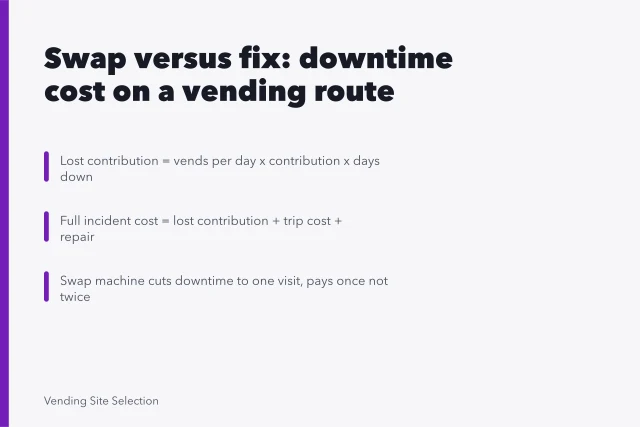
Take the quoted repair cost R, the delivered cost of a replacement M, and the contribution the site produces per period, which is vends times what each vend retains, less the cost of the service visits. Two questions follow.
Does the site produce enough contribution to justify M at all? If not, the machine should not be replaced there, and the real decision is where else it goes.
Is R a meaningful fraction of M, and is this the first such repair or the third? A pattern of repairs on a component with limited parts availability is the point at which replacement is cheaper than loyalty.
Keep the repair history per machine, with dates and costs. Without it, the decision relies on memory of the most recent failure.
Those records are also part of the expense documentation the Internal Revenue Service: What kind of records should I keep? guidance expects a business to hold. They feed the route arithmetic that decides whether a site stays.
Spares worth carrying
A small kit converts a return trip into a five minute fix, and return trips are the real cost of a fault.
Carry a spare bill validator and coin mechanism once you have enough machines that one being down matters. Carry the common locks and keys for your machine types. Carry cleaning supplies for validators and coils, since most preventive work is cleaning. And carry the fasteners and small parts that your own repair history says you have needed twice.
Deciding what to stock is a data question. Look at what has failed on your route in the last year, not at a general list, and check that parts for your machine types are still available before you buy another of that model. That check belongs with your equipment and supplier decisions.
Faults, hosts and the response you promised
The service standard you agreed is tested by faults, not by ordinary visits.
Give the site a way to reach you that works: a number on the machine that is answered, or an address that is monitored. Acknowledge a report even when you cannot attend immediately, because silence is what turns a fault into a complaint about you rather than about the machine.
If a machine will be out of service past your stated response time, tell the host a time instead of waiting to be asked.
Keep the machine's approach clear while it is out. The accessibility requirements in the U.S. Department of Justice: 2010 ADA Standards for Accessible Design apply to the installation whether or not the machine is working.
Where a fault will take days, consider whether switching the machine off is better than leaving it taking money it cannot honor. The daily service routine should say which.
Building the maintenance rhythm
Preventive work is cheap and reactive work is not, and the difference is entirely a matter of scheduling.
Attach the short checks to every visit: validator cleaning, coin path, a test vend, a look at the coil. Attach the longer ones to a fixed interval you can actually hold. Record what was done and when, per machine, because a maintenance log is what turns repair or replace from a guess into a calculation.
New operators should build this before the route grows, since retrofitting a maintenance rhythm onto twenty machines is much harder than starting with three. The licensing and record keeping obligations and the wider route economics both assume this log exists.
Common questions
Is a cashless machine more secure?
It removes cash from the machine, which removes the most common motive for forcing one open. It does not remove damage, and it adds a dependency on connectivity and on payment accounts that need protecting in their own right. Most operators find the cash handling saving is the larger benefit.
Should I fit cameras?
That is the host's building and usually the host's decision. Ask what coverage already exists before proposing anything, and be careful about recording people, which raises obligations that vary by state. In most cases the better move is siting the machine within existing coverage.
How long should a repair take before I swap the machine out?
Set the threshold against your service commitment rather than against the repair. If a fix will run past what you promised the host, swap or switch off. The relationship costs more than the machine.