Guides
Vending machine software and telemetry: what to measure and how to judge it
Vending software and telemetry guide: what changes on a route, which measures to track, how to evaluate a system without naming vendors, and what records remain.
What to take away
- Telemetry earns its cost by removing trips, not by producing charts. Measure it against the visits it saves.
- Four measures cover most of a small routesales per machine per day, sell out rate, days out of service, and cost per service visit.
- A metric without a threshold is a number. Decide in advance what result changes what you do.
- No product is named here. Evaluate systems against your own route instead.
- The system holds your sales history and your payment accounts. Treat access to it as a real risk.
What software actually changes
Before telemetry, an operator learns what a machine sold by opening it. That means every machine is visited on a fixed interval whether it needs it or not, and a fault is discovered whenever the next visit falls.
Connected machines change two specific things. You learn what sold without driving there, so a machine that does not need service can be skipped. And you learn about a fault when it happens rather than on the next visit, which shortens the time a machine sits dead.
Everything else that software offers, the dashboards and the reports, is secondary. The value is in trips avoided and downtime shortened, and both are measurable in your own numbers.
Working out whether it pays
Take the per machine cost of the system for a period and compare it to two things.
Trip and downtime savings math
- Marginal stop costdriving, labor, vehicle
- Vends per day x contributionlost sales per day
- Days saved x lost contributiondowntime saving
- Per machine system costthe comparison baseline
The first is trips avoided. If telemetry lets you skip a machine on a run, the saving is the marginal cost of that stop: driving time, labor and vehicle cost. Multiply by how often it would apply across a period.
The second is downtime shortened. If a fault currently runs until the next scheduled visit, and telemetry cuts that to a day, the saving is the lost contribution over the days you avoided. That is vends per day multiplied by what each vend retains, multiplied by the days saved.
On a busy, clustered route the answer usually comes out clearly positive. On a small route with four nearby machines it may not, and the honest conclusion is to wait. Running the arithmetic beats adopting a general rule in either direction.
The measures worth keeping
| Measure | How it is taken | The decision it drives |
|---|---|---|
| Sales per machine per day | Machine sales divided by days in the period | Whether a site is worth its visit at all |
| Sell out rate at the peak | Selections empty at the busy hour, as a share | Par levels and service interval |
| Days out of service | From the fault log, per machine | Maintenance priorities and whether to swap or remove |
| Cost per service visit | Route time and labor divided by stops | Route design, and whether the next site is affordable |
Four is enough for most routes. Operators who track twenty measures act on none of them, because a number without a decision attached is decoration.
Four measures and their decisions
Measure
- Sales per machine per day
- sales / days
- Sell out rate at peak
- empty selections share
- Days out of service
- fault log per machine
- Cost per service visit
- route time / stops
How taken
- Sales per machine per day
- worth the visit
- Sell out rate at peak
- par and interval
- Days out of service
- maintain, swap, remove
- Cost per service visit
- route design
Decision it drives
- Sales per machine per day
- Sell out rate at peak
- Days out of service
- Cost per service visit
Attaching a threshold to each
A measure only becomes useful when you decide in advance what result changes what you do.
For sales per machine per day, the threshold is the point at which vends multiplied by contribution stop covering the cost of the visit. Below that, the machine is losing money on every trip regardless of how the total looks.
For sell out rate, any repeated sell out of a fast selection at the peak is a threshold breach, because it is demand that arrived and left. Raise the par or shorten the interval.
For days out of service, the threshold is your own promise to the host. Exceeding your stated response time is a service failure whether or not the host complained.
For cost per service visit, watch the direction rather than the level. A rising cost per stop means the route is spreading out, which is the early signal of a growth problem.
What each number will not tell you
Every measure above has a blind spot, and knowing them prevents confident wrong decisions.
Sales per machine per day says nothing about margin. A machine selling a lot of a low contribution item can look better than one selling less of a better item.
Sell out rate measures availability, not demand. It cannot see the person who wanted something you have never stocked, which is why asking the host what people request stays necessary.
Days out of service depends entirely on detection. On a route without telemetry the number is bounded by your service interval and flatters you, because you cannot count what you did not know about.
Cost per service visit hides the difference between a stop that took ten minutes and one that took forty. Track visit duration separately if the average starts moving.
Evaluating a system without naming one
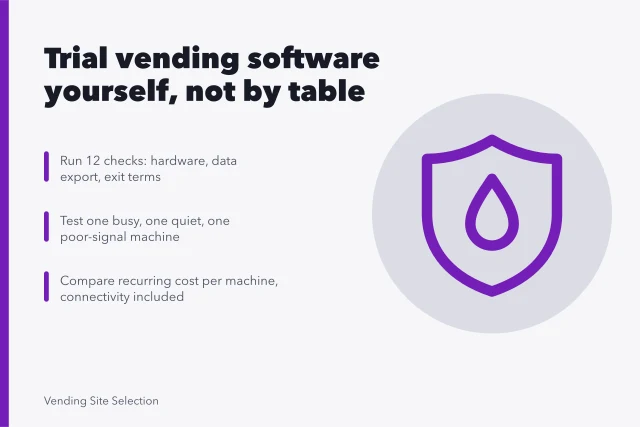
No product is recommended here. Capabilities, pricing and support vary and change, and a ranked list would be a claim about businesses nobody here has tested. Run these checks on your own candidates instead.
Evaluating a system
- Does it work with the machines and payment hardware you already own, or does it require replacement?
- Can you export your own data in a usable format, and can you do it without asking them?
- What happens to your history if you leave?
- How does it handle a machine that loses connectivity, and does data catch up afterward?
- Does it show sales per selection per machine, or only machine totals?
- Can you set individual user accounts with different permissions?
- What is the full recurring cost, including any connectivity line, per machine?
- What is the contract term and what happens at renewal?
- What support exists when a reader stops reporting, and how quickly?
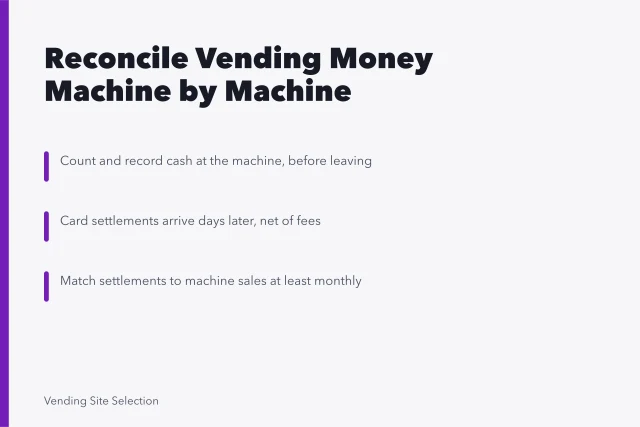
- Does it reconcile card settlements against machine sales, or is that manual?
Then trial it on a few machines rather than the whole route, and check the numbers it reports against a physical count before you trust it.
The data is worth protecting
A connected route means your sales history, your site list and your payment accounts live in a system somebody could reach.
Use individual accounts, not a shared login, remove access when someone leaves, and turn on whatever additional verification is offered.
The National Institute of Standards and Technology: NIST Small Business Quick-Start Guides cover account access, backups and recovery for organizations with no IT function. The Cybersecurity and Infrastructure Security Agency: Cyber Guidance for Small Businesses covers the same ground from a different angle. It includes what to do about a compromised account.
Ask your payment processor directly what obligations sit with you as a merchant, because the answer depends on the arrangement rather than on a general rule.
Records, which software does not replace
Software makes records easier and does not satisfy the obligation on its own. Sales, purchases, expenses and inventory all have to be documented, and the Internal Revenue Service: What kind of records should I keep? guidance sets out what a small business is expected to hold.
Two records live outside most vending platforms. For refrigerated machines, temperature logs must take the form your state or county health department requires. The U.S. Food and Drug Administration: State Retail and Food Service Codes and Regulations directory names the agency to ask.
Removals need a reason, the record that separates expiry from damage from theft. Keep both where your licensing answers live, and check whether your platform can hold them before assuming it can.
Using the numbers on the rest of the business
The measures above feed decisions that sit elsewhere.
Sales per selection per machine is the input to the planogram and par levels at that site. Contribution per vend, which the system will not calculate for you unless you give it your commission and fee inputs, belongs to the pricing arithmetic.
Cost per visit and days out of service are the numbers that decide whether a site is worth keeping and whether the service routine is holding. Sell out patterns at particular buildings often turn into a conversation with the host, which is where account retention begins.
Common questions
Do I need software for a handful of machines?
Probably not at first. A notebook and a spreadsheet answer the same questions at small scale, and the discipline of counting is more valuable than the tool. The point at which it changes is when you can no longer remember which machine sold out last cycle.
Will telemetry tell me if a machine has been broken into?
It will usually tell you that sales have stopped or that the machine is offline, which is a signal worth having. It is not a security system and it will not tell you what happened. Treat it as faster detection rather than as protection.
Should I pick software that handles bookkeeping too?
Combining them is convenient and it is not required. What matters more is whether you can get your sales data out in a form your accountant can use, which is question two on the list above.