Guides
The margin math behind a vending machine business for new owners
Vending profit margins and break-even worked three ways: per machine, per route and against the debt on the equipment, using inputs from your own records.
What to take away
- Break-even is three different calculations, and operators usually only do the first one.
- A machine can clear its own stock cost and still lose money once the drive to it is counted.
- The route level break-even is the one that decides whether the business supports a wage.
- Payback on equipment is a fourth question again, and it is the one lenders ask.
Margin is a word with three meanings here
Be specific about which margin you mean, because the three are routinely confused.
Three Margins Compared
Gross margin
- Delivered cost
- Yes
- Commission
- No
- Payment cost
- No
- Route and overhead
- No
- Best for
- Product comparison
Contribution per vend
- Delivered cost
- Yes
- Commission
- Yes
- Payment cost
- Yes
- Route and overhead
- No
- Best for
- Visit coverage
Operating margin
- Delivered cost
- Yes
- Commission
- Yes
- Payment cost
- Yes
- Route and overhead
- Yes
- Best for
- Business viability
Gross margin on an item is price less delivered cost. It ignores commission, card fees and everything else, and it is the number suppliers quote. It is the least useful of the three.
Contribution per vend is price less delivered cost, less commission on that price, less the payment cost on that transaction. This is what a sale leaves behind, and it is the input to every calculation below.
Operating margin is what the route leaves after all of its costs, including the ones that do not attach to any single vend. Only this one tells you whether the business works.
What it subtracts
- Gross margin on an item
- Delivered cost only
- Contribution per vend
- Delivered cost, commission, payment cost
- Operating margin
- Everything, including route and overhead cost
What it is good for
- Gross margin on an item
- Comparing two products from the same supplier
- Contribution per vend
- Deciding whether a machine covers its visit
- Operating margin
- Deciding whether the business supports a wage
Break-even one: the machine covers its visit
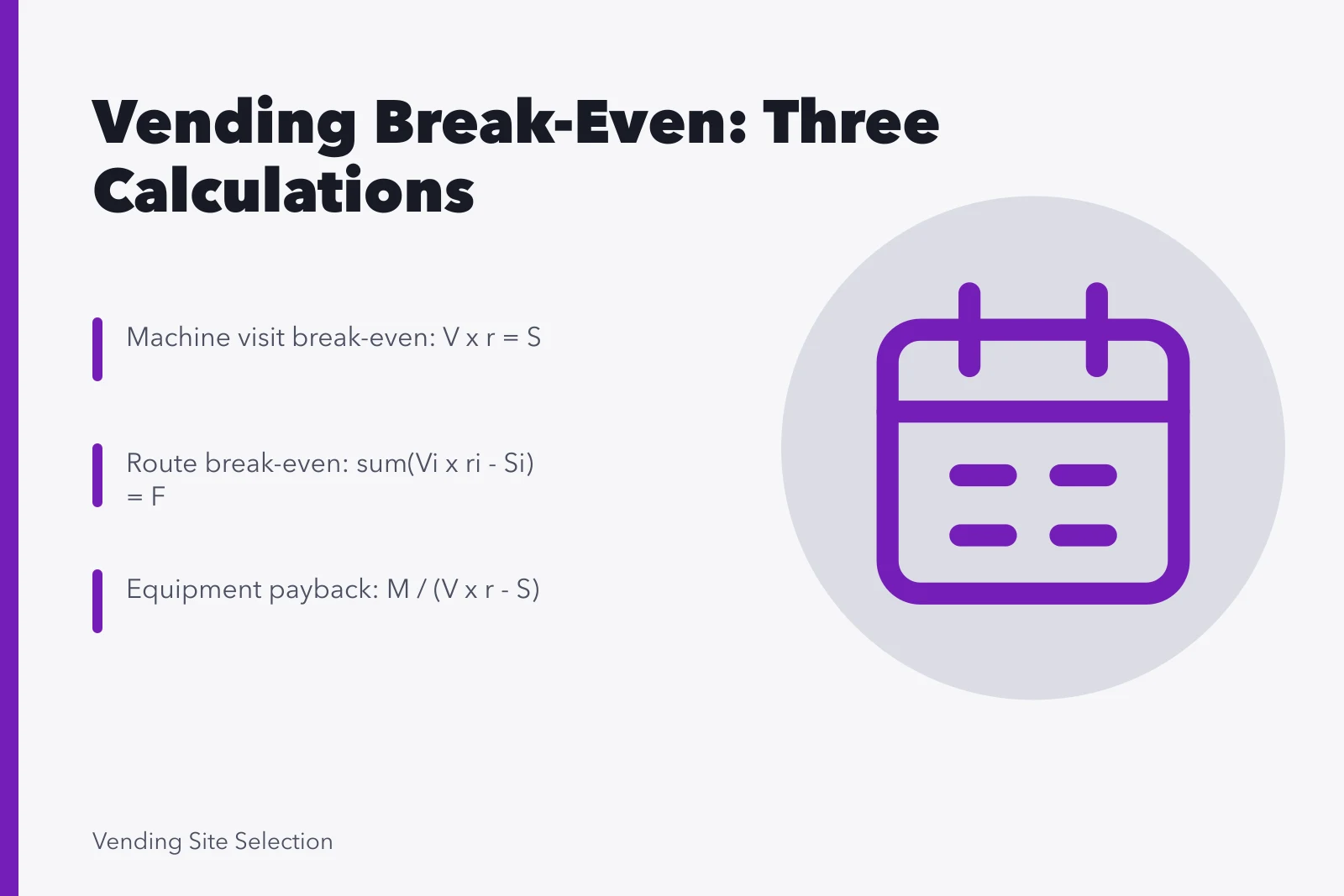
Let r be contribution per vend at that machine, V vends between visits, and S the cost of a service visit including driving time, labor and a share of vehicle cost. The visit breaks even when:
Machine Visit Break-Even
V x r = S
V = vends between visits
r = contribution per vend
S = cost of a service visit
V x r = S
Below that line the machine loses money on every visit, no matter what the sales figure looks like. Above it, the machine contributes something toward the costs that sit above the route.
This is the calculation that identifies a site to renegotiate, re-price or remove. Run it per machine, not as a route average, because an average hides exactly the sites you need to find.
Break-even two: the route covers its fixed costs
The route carries costs that no single machine causes: vehicle payments and insurance, storage, telemetry lines, business insurance, accounting, and your own time when you are not driving. Call that total F for a period.
Let n be the number of machines, and let each machine i contribute (Vi x ri) less its own service cost Si over that period. The route breaks even when:
sum over i of (Vi x ri - Si) = F
Two levers move that sum without touching price. Adding machines inside the area you already serve raises the total while Si stays small. Removing machines that fail the first test raises it too, which is the part operators resist because it feels like shrinking.
Break-even three: the equipment pays for itself
Payback on a machine is a different question and it has a different answer.
Let M be the delivered cost of the machine including payment hardware, and let the machine contribute (V x r - S) per period once running. Payback in periods is:
M / (V x r - S)
If the denominator is zero or negative, the machine never pays back at that site, and that is the useful output. The number of periods matters less than whether the denominator is comfortably positive, because that is what tells you the site is worth the equipment.
Where the machine is financed, compare the same denominator against the payment rather than the purchase price, since a machine that cannot cover its own installment is a monthly loss with an asset attached.
Where the inputs come from
- V comes from your own machine counts or telemetry, per selection and per machine.
- r comes from your price list, supplier invoices, the commission rate in the signed agreement, and the processor's full fee schedule including the fixed amount per transaction.
- S comes from your route times and your labor cost. For a driver's wage in your area use the U.S. Bureau of Labor Statistics: Occupational Employment and Wage Statistics Tables, which publish estimates by occupation and metropolitan area.
- F comes from your own accounts. Keeping the underlying records is part of what the Internal Revenue Service: What kind of records should I keep? guidance expects of a business, and none of these calculations are possible without them.
Nothing here needs an industry benchmark, which is fortunate, because a benchmark drawn from operators with different commission rates and different drive times would tell you nothing about your route.
What the arithmetic tends to reveal
Three patterns show up repeatedly once operators run these numbers on real sites.
The first is that distance dominates. A machine twenty minutes further away can fail test one while selling more than a nearer machine that passes it, because S is a whole trip rather than a stop.
The second is that commission rates agreed early are rarely revisited. A rate accepted to win a first site follows that site forever unless someone reopens it at renewal.
The third is that the worst machines are usually a small number of sites, and removing them improves the route more than any price change. The instinct to keep every placement is what keeps unprofitable stops on the map for years. Deciding which to keep is a site question with a numerical answer.
Checking the numbers before you act on them
- Have you included your own unpaid time in S? If not, the route looks better than it is.
- Are you using the fixed part of the card fee, or only the percentage?
- Is V measured over enough cycles to be more than one busy week?
- Is the commission rate the one in the signed agreement, or the one you remember agreeing?
- Does F include everything, including the costs you pay annually and forget monthly?
If you make claims about savings or earnings when pitching a host or advertising, the standards for substantiating them are set out in the Federal Trade Commission: Advertising FAQs: A Guide for Small Business. Being able to show your own arithmetic is what makes a claim defensible.
The pricing framework and the per vend method cover how to move r, and the product decisions move both r and V at once. If you are still planning a first machine, run test three before buying rather than after.
Common questions
What is a normal profit margin in vending?
Any figure quoted as normal is an average across operators with different commissions, prices, drive times and site mixes, which makes it useless for deciding anything about your route. Run the three tests above on your own inputs instead; they answer the question the average is standing in for.
How long should a machine take to pay for itself?
Ask instead whether the denominator in the payback expression is comfortably positive at that site. A machine with a thin positive contribution and a long payback is a machine that any bad quarter turns negative.
Should I count my own labor if I have no employees?
Yes. Otherwise you cannot tell whether the route could support a driver, which is the question that decides whether the business can grow beyond you.