Guides
Vending machine pricing and profit guide
Five levers set vending profit: price, product mix, commission, service interval and route density. Density is the one most routes leave untouched.
What to take away
- Price is one of five levers. Mix, commission, service interval and route density move profit without changing what the buyer pays.
- Route density is the lever most small routes never pull. Two machines in one building cost barely more to serve than one.
- Commission is charged on the top line, so every price rise hands the host a share of the increase.
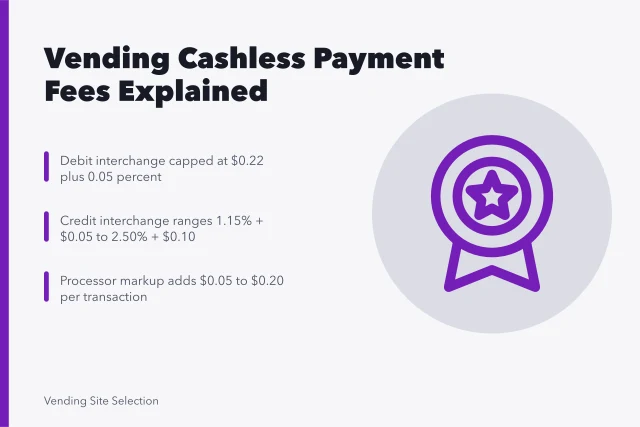
- Card acceptance carries a percentage plus a fixed amount per transaction. The fixed part punishes cheap items and does not shrink when you discount.
- Service interval is a decision, not a fixed cost. Correct pars let you visit less often at the same sales.
Five levers, one price list
Two routes can run identical prices and finish the year in different places. The table below shows what each lever moves and why it is often left alone.
Five Profit Levers
Lever
- Price
- Revenue per vend
- Product mix
- Cost and sale rate
- Commission rate
- Share of every sale
- Service interval
- Labor and fuel
- Route density
- Cost per stop
What it moves
- Price
- Feels risky
- Product mix
- Needs data
- Commission rate
- Filed and forgotten
- Service interval
- Treated as fixed
- Route density
- Confused with growth
Why unused
- Price
- Product mix
- Commission rate
- Service interval
- Route density
What it moves
- Price
- Revenue per vend, and the host's commission with it
- Product mix
- Delivered cost and rate of sale together
- Commission rate
- A share of every sale, for the life of the agreement
- Service interval
- Labor and fuel per machine per period
- Route density
- Cost per stop across the whole operation
Why it goes unused
- Price
- Feels riskier than it is at a captive site
- Product mix
- Needs per machine data most routes never collect
- Commission rate
- Negotiated once, then filed and forgotten
- Service interval
- Treated as fixed when it is a choice
- Route density
- Confused with growth, which is a different thing
The two cost levers, service interval and route density, are the safest place to start. They lower cost without touching the shelf price. A machine you visit every ten days instead of every seven costs less to run at the same sales, provided the pars are right.
The route density argument
Density is stops per square mile, not machines per route. It is the only lever that lowers cost per machine without lowering service.
Density vs Spread
Route type
- Dense route
- 40
- Spread route
- 40
Stops
- Dense route
- 20
- Spread route
- 40
Buildings
- Dense route
- Lower
- Spread route
- Higher
Cost per stop
- Dense route
- Spread route
Picture a route with one machine in a building. The drive, the park, the walk, the sign-in and the return trip are all charged to that machine. Add a second machine in the same lobby and almost none of that repeats. The second machine carries its own product cost and its own vend time, and little else.
A route of forty machines spread across forty buildings is a different business from forty machines in twenty buildings. The second wins on cost per stop before it sells a single extra unit.
Growth that adds stops without adding density makes the route worse. Sign the second machine in a building you already serve before the first machine in a new one.
What commission really takes
Commission is charged on the price you set, not on what you keep. Raise a price by a quarter and the host's share rises with it. The rise is still usually right. It just leaves less behind than the number on the sticker suggests.
Commission on a Price Rise
25 cents | price increase
Host share rises with it
Less left than sticker suggests
Read the agreement before you assume you can act alone. Some contracts require consent to a price change. Where the agreement is silent, telling the host first is still the cheaper path. A host who hears about a price rise from an employee complaint has a reason to take a competitor's call.
If you advertise prices or savings claims to hosts or to the public, the general rules on truthful advertising apply. The Federal Trade Commission: Advertising FAQs: A Guide for Small Business covers what a small business must be able to substantiate.
Card fees against cheap items
Card acceptance usually carries a percentage plus a fixed amount per transaction. The percentage scales with the price. The fixed amount does not.
Card Fees by Item Price
Item price
- Low priced item
- Scales down
- Higher priced item
- Scales up
Percentage fee
- Low priced item
- Large slice
- Higher priced item
- Smaller share
Fixed fee share
- Low priced item
- Higher priced item
Take an illustrative rate of 2.6 percent plus 10 cents. On a $1.50 item the fee is 4 cents plus 10 cents, so 14 cents, or 9.3 percent of the price.
On a $2.50 item the same rate gives 6.5 cents plus 10 cents, so 16.5 cents, or 6.6 percent of the price. The fixed 10 cents is identical on both items.
On a low priced item, that fixed amount is a real slice of what is left after cost of goods. Discount the item and the fixed amount stays exactly where it was. On a higher priced item the same fixed amount is a smaller share, which is one reason mix changes often beat price changes.
The rate above is illustrative. Run the arithmetic with your own statement, not the rate you were quoted. Then decide deliberately: change the price, change the mix, or accept the fee as the cost of a higher average sale.
Price by site, not by route
One price list across a route is easier to administer and it leaks money at both ends.
Price by Site
What is the buyer's nearest alternative?
captive site, higher band
competitive site, lower band
At a captive site with no alternative within reach, a price set for a competitive location sits below what the site would bear. Next door to a convenience store, the same list can sit above what people will pay, and the machine stops selling.
The workable middle is a handful of price bands. Group sites by the buyer's nearest alternative, set a band for each group, and record the band in the planogram you keep for that machine. That captures most of the gain of site pricing without a price list nobody can maintain.
Typical bands for one snack bag and one 20 oz bottle, before commission:
| Site type | Nearest alternative | Typical snack band | Typical 20 oz bottle band |
|---|---|---|---|
| Captive | No shop within a five minute walk | $1.75 to $2.50 | $2.25 to $2.75 |
| Semi captive | A shop five to ten minutes away | $1.50 to $2.00 | $2.00 to $2.50 |
| Competitive | A shop within sight | $1.25 to $1.75 | $1.75 to $2.25 |
These are typical ranges, not published figures. Delivered cost, the host's commission and local store prices set the floor for each site.
The costs outside the vend
Contribution per vend is not profit. Several costs attach to the machine or the route rather than to the item.
Costs Outside the Vend
- Vehicle cost
- Insurance
- Storage
- Telemetry lines
- Repairs
- Shrink and expiry
Service labor is the largest of them on most routes. To price a driver, use wage estimates by occupation and metro area from the U.S. Bureau of Labor Statistics: Occupational Employment and Wage Statistics Tables, not a national average.
If you drive the route yourself, price your time anyway. A route that only works when the owner is unpaid cannot hire.
Track at least these costs outside the vend:
Costs outside the vend
- vehicle cost
- insurance
- storage
- telemetry lines
- repairs
- the shrink and expiry your own records show
Contribution per vend has to cover all of it before anything is profit.
Worked example. A snack bag sells at $1.75 and costs $0.95 delivered, so the gross margin is $0.80. A card fee of 2.6 percent plus 10 cents takes about 15 cents, leaving $0.65. A 10 percent commission takes 17.5 cents, leaving about 48 cents of contribution per vend.
That 48 cents has to cover labor, fuel, insurance, telemetry, repairs and storage. At 800 vends a month it leaves about $380 a month for the machine. If the machine's share of those costs is $500 a month, it breaks even at roughly 1,040 vends.
Sales, receipts and expenses need documenting for any of this to be possible, which is what the Internal Revenue Service: What kind of records should I keep? guidance expects a business to hold.
Reviewing the five levers on a rhythm
Prices reviewed only when a supplier raises a price always lag. Set a review cycle and hold to it: a price review each quarter, a payment cost audit once a year, and commission terms at each renewal.
Reviewing the five levers
- Recalculate the floor each quarter and whenever delivered cost moves by more than a few cents.
- Check rate of sale per selection after any change. A rise that loses more units than it adds in margin is a loss wearing a decision's clothes.
- Audit the payment cost assumption once a year against an actual statement, not the quoted rate.
- Revisit commission at renewal, with the arithmetic in front of you.
- Count stops per square mile at every new site. If a signature does not raise density, ask what it does raise.
The profit margins and break even arithmetic turns these into a target per machine rather than a feeling.
Pricing a new site with no history
A new machine has no sales data, so the first price list is an estimate. Make it a structured one.
Ask what the nearest alternative is and how far away it sits. Ask the host what people pay for the same thing nearby. Then set the opening list from the floor:
Pricing a new site
- Add delivered cost, the card fee per vend and the host's share to get the floor.
- Compare the floor with the nearest alternative's price.
- Set the band only as high above that floor as the site will bear.
- Review after three service cycles with real numbers instead of defending the first guess.
The site constrains what is possible, so where a machine goes decides more about pricing than any list does.
Whether your posted price includes sales tax comes from the state revenue department, not a template. Keep that answer with your licensing and permit records.
See the wider startup and market view plus the U.S. Small Business Administration: SBA Business Guide for how the pieces fit together.
Common questions
Why does route density matter more than price?
Density lowers the cost of every stop without changing what any buyer pays. Price changes carry a sales risk and a commission cost. Two machines in one building share the drive, the park and the sign-in, so the second one is close to pure contribution.
Should prices end in a round number?
Round pricing speeds up cash transactions and cuts the change the machine has to hold, which has real operational value. It also locks you into coarse steps. On a mostly card machine that constraint disappears and you can price to the floor instead of to the coin.
Is it worth raising prices to cover card fees?
Compare the two arithmetics rather than assuming. Card acceptance usually raises the average sale and removes the no change excuse, and the fee is the cost of that. If the fee stings at your price points, moving the mix toward higher priced items often does more than a price rise.
What if the host wants low prices and a high commission?
Show them the arithmetic. Commission comes off the same top line the low price is holding down, and there is a point where the site cannot cover the cost of being served. The request usually comes from a host who has never seen the numbers.