Guides
Why do vending machine routes keep slipping behind schedule?
How to schedule vending routes: anchor the day on access windows, sequence by real drive times, and use slack deliberately so one delay does not cascade.
What to take away
- Schedule around access windows first. Distance is the second constraint, not the first.
- Use drive times you have measured, in the hours you actually drive, not map estimates.
- Put deliberate slack in the day. A route with none turns a single delay into a failed afternoon.
- Different machines can sit on different service intervals. Forcing them all onto one rhythm wastes trips.
The three constraints, in order
Route scheduling fails when it is treated as a distance problem. Distance is real but it is rarely the binding constraint.
Route Constraints Ranked
Access windows
- Binding order
- First
- Nature
- Fixed appointment
- Failure mode
- Missed window
- Planning fix
- Anchor first
Vehicle capacity
- Binding order
- Second
- Nature
- Load limit
- Failure mode
- Return to storage
- Planning fix
- Plan return leg
Drive time
- Binding order
- Third
- Nature
- Measurable
- Failure mode
- Underestimated
- Planning fix
- Time legs yourself
Access windows bind first. A plant that admits you at shift change, an office that is empty after five, a school with visitor hours, a hospital floor with escort requirements: each is a fixed appointment, and the flexible sites have to fit around them.
Vehicle capacity binds second. If the load for a full round does not fit, the day contains a return to storage, and that leg has to be in the plan rather than discovered at two in the afternoon.
Drive time binds third. It is the one everybody plans for and the easiest to measure once you stop trusting estimates.
Measure the legs you actually drive
Map estimates are made for an empty road. Time each leg of your route yourself, in the hour you normally drive it, and record it. Two weeks of that gives you a table you can schedule from.
Three Numbers Per Site
- 10 mindrive time to site
- 20 minwait at reception
- 30 mintotal site time
Record three numbers per site, not one: drive time to it, time inside from parking to leaving, and any wait before you can get in. The third is invisible on a map and it is where routes lose their afternoons. A site with a ten minute drive and a twenty minute wait at reception is a thirty minute site.
Anchor, then fill
Build the day in that order.
Anchor Then Fill
- Place hard-window sites first
- Fill gaps with on-route flexible sites
- Put widest-access sites last
- Leave a gap before each anchor
- Place the sites with hard windows first. These are anchors and they do not move.
- Fill the gaps between anchors with flexible sites that are geographically on the way.
- Put the sites with the widest access at the end of the day, where they can absorb a delay.
- Leave a gap before each anchor. If the anchor is missed, the whole day after it is compromised.
The last point separates a schedule that survives from one that looks efficient on paper. A plan with no gaps only works when nothing goes wrong.
Intervals do not have to match
Forcing every machine onto a weekly rhythm is a habit rather than a decision, and it produces two kinds of waste: visits to machines that did not need one, and sell outs at machines that needed two.
Interval From Busiest Selection
c / U days
c = column capacity in units
U = fastest selection units per day
Subtract a buffer for variation
Set the interval per machine from its busiest selection. If a column holds c units and the fastest selection sells U units per day, that machine can go roughly c divided by U days before it runs dry, less a buffer for variation. Then group machines whose intervals are compatible into days that make geographic sense.
Telemetry makes this much easier, because it tells you what sold without a visit and lets you skip a machine that does not need one. The par levels behind those intervals are what make skipping safe.
Where delays actually come from
Track the reasons for a fortnight and the list is usually short.
Where Delays Come From
- Waiting at reception or escort
- Parking and moving equipment
- Unexpected fault turns 10 min into 40
- Traffic on one leg at one hour
- Machine needed more stock than carried
Where delays come from
- Waiting at reception or for an escort.
- Parking and getting equipment from the vehicle to the machine.
- An unexpected fault that turns a ten minute stop into forty.
- Traffic on one particular leg at one particular hour.
- A machine that needed more stock than the vehicle held.
Each has a different fix, and only one of them is about driving. Reception waits are solved by an arrangement with the site contact, not by leaving earlier. Faults are solved by carrying the parts that fix the common ones. The stock problem is solved by better pars, which is a data problem rather than a scheduling one.
Building slack in on purpose
Slack feels like waste until the first time a machine fails at eleven in the morning.
Handling Repeated Site Delays
Is one site repeatedly causing delay?
Talk to the host about access
Keep the planned slack and flexible stops
Plan each day to a share of your available driving hours, not all of them. Keep one or two flexible sites that can be dropped to the next day without consequence. Name those sites in advance.
Choosing which stop to sacrifice while running late gives the wrong answer. The easiest site to skip is often the one that most needs the visit.
Where a site is repeatedly the cause of delay, that is a conversation with the host rather than a scheduling adjustment. Access arrangements are usually negotiable, and a manager who knows the driver waits twenty minutes every week will often fix it.
Seasonal and shift changes
Routes decay quietly because the sites change and the schedule does not.
Term time ends at a college. A plant adds a night shift. An office moves to three days in the building. Each of those changes demand and sometimes changes access, and none of them announce themselves in a route plan.
Ask your site contacts about the coming quarter rather than waiting for the sales to tell you. Then rebuild the affected days. A schedule reviewed quarterly stays roughly right; one reviewed annually is wrong for most of the year, particularly if you have taken machines into a new area where the local pattern is unfamiliar.
What to record on every run
Keep it short enough that it actually gets filled in.
What to record
- Arrival and departure at each site.
- Any wait before access, with the reason.
- Faults found and what you did.
- Sites skipped and why.
- Cash collected, recorded at the machine before leaving.
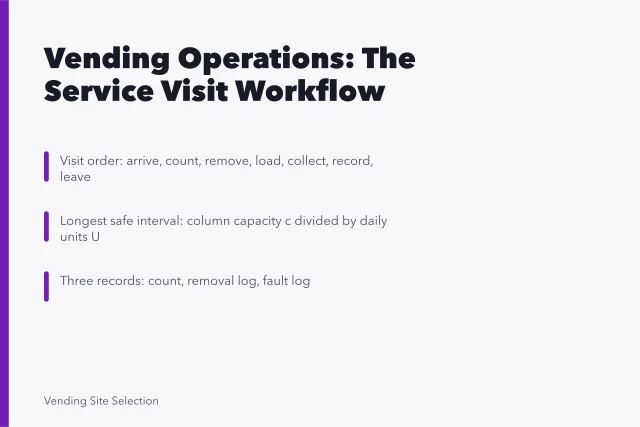
That last one is both an operational and a record keeping matter, since sales and receipts are part of what the Internal Revenue Service: What kind of records should I keep? guidance expects a business to hold. The rest of the visit sequence belongs to the operations framework, which sets out what happens at the machine itself.
Two checks belong in the run regardless of time pressure. Confirm the approach to the machine is clear, since machines in a place of public accommodation are subject to the requirements in the U.S. Department of Justice: 2010 ADA Standards for Accessible Design.
Also record temperatures on refrigerated machines in whatever form your health department expects. The U.S. Food and Drug Administration: State Retail and Food Service Codes and Regulations directory identifies the agency whose answer applies, and the licensing position you hold should already say what that is.
When the route is genuinely too long
Sometimes the schedule is not fixable because the route has outgrown the day. Three responses, in increasing order of commitment.
Lengthen intervals where pars allow it. Drop the machines that fail their own visit test, usually a small number of distant sites.
Or add a driver, turning a scheduling problem into a hiring and cost problem you can model before committing. If you are still building the first route, refusing distant sites early is the cheapest insurance against all three.
Common questions
Should I use route optimization software?
It helps once the route is large enough that the ordering is not obvious, and it is only as good as the times you feed it. Software using map estimates rather than your measured site times will produce a confident and unachievable plan.
Is it better to service in the morning or the afternoon?
Follow the site rather than a preference. Machines should be full before the building's peak, which means before a shift starts or before lunch. A route that reaches its busiest site at four in the afternoon is servicing after the sales it was meant to support.
How do I handle a site that always makes me wait?
Ask the contact for a workable arrangement: a key, a code, a named person, or a standing time. Most waits exist because nobody was asked to remove them. If it cannot be fixed, price the wait into the site's service cost and decide whether the machine still clears it.