Guides
Inventory in a vending machine business, done properly
Vending inventory and sourcing guide: build the planogram per site, set par levels from real sales, and choose suppliers on fill rate rather than list price.
What to take away
- There is no national product mix. The planogram belongs to the site, and two buildings a mile apart can want different things.
- Par levels come from observed sales at that machine, not from what the supplier packs in a case.
- Case price is not the number that matters. Delivered cost per unit sold, after waste and after slow movers, is.
- The shelf a product sits on is a commercial decision and an access decision at the same time.
- Every product that expires in the machine was paid for twiceonce at the distributor and once in the space it occupied.
The unit of planning is the machine, not the route
Operators who buy for the route buy an average, and an average fits nobody. A machine in a plant break room on a twelve hour shift sells differently from one in a medical office building where nobody stays past five. Both sell differently from a machine in a residence hall.
Plan at the machine. Keep a short written planogram for each one: what is in each selection, what price it carries, and when it was last changed. That document turns guesswork into a series of tested decisions. It takes minutes to maintain once it exists.
The route level decision is different and narrower. It is which products you buy in volume so that several machines can draw on the same case. It should follow the planograms rather than dictate them.
Reading a machine instead of guessing at it
A machine tells you what it sold every time you open it. Collect three things on each visit and the mix stops being a matter of opinion.
Reading a machine
- Units sold per selection since the last visit.
- Selections that sold out before you arrived, which are the ones costing you money invisibly.
- Anything you removed for date or condition.
Sold out selections matter more than slow ones. A slow selection ties up a little cash. A sold out selection is demand that arrived and left, and it repeats every cycle until you notice.
Telemetry reports the same figures without opening the door. If you use a connected system, remember that it holds your sales history and your payment data. The National Institute of Standards and Technology: NIST Small Business Quick-Start Guides set out how a small business should handle account access and data on systems like that.
Par levels, worked in variables
Set a par for each selection rather than filling everything to the top. The arithmetic is simple and it survives a change in any input.
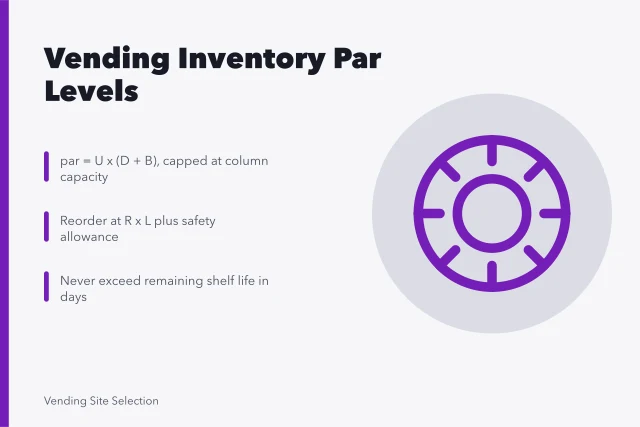
Let U be units sold per day for a selection at that machine, and let D be the number of days between service visits. Base requirement is U x D. Add a buffer for variation, B, expressed as a number of days: the par becomes U x (D + B). Cap it at the physical capacity of the column.
Two readings fall out of that. If U x (D + B) exceeds the column capacity, the selection is under-served. Either the visit interval or the machine configuration has to change. If the par is a small fraction of capacity, you are carrying a product that does not earn its column.
Where a product has a short shelf life, the same expression is bounded by date rather than by space. Never stock more days of cover than the product will stay good for on the shelf, allowing for the time it already spent in the warehouse.
The shelf is a commercial and an access decision
Product placement inside the machine is not neutral. The selections at eye level and within easy reach sell more than the ones at the extremes, which is why the mix and the layout have to be decided together.
That same geometry is also a public accommodation question. The U.S. Department of Justice: 2010 ADA Standards for Accessible Design cover reach ranges, operable parts, and clear floor space at machines in places of public accommodation.
These standards govern how a machine is installed and approached, not which snack sits in which spiral. Read them before deciding where a machine goes and how it is positioned. Ask the host what applies to their building.
Choosing suppliers on the numbers that matter
Choosing suppliers
Why it decides more than price
- Fill rate on ordered lines
- An out of stock line at the distributor becomes an empty selection two days later
- Delivered cost per unit
- Case price hides pack size, delivery charges and minimum order penalties
- Date codes on arrival
- Short dated stock transfers the waste from them to you
- Minimum order value
- A high minimum forces you to hold stock you do not need yet
- Delivery window reliability
- A missed window is a route day rebuilt
- Breadth of range
- Narrow ranges force a second supplier and a second minimum
How to check it
- Fill rate on ordered lines
- Track your own orders against deliveries for a month
- Delivered cost per unit
- Divide the full invoice by units actually usable
- Date codes on arrival
- Record the code on every delivery for a period
- Minimum order value
- Compare it to one route's weekly consumption
- Delivery window reliability
- Keep a simple log of promised against actual
- Breadth of range
- List what you actually buy and check coverage
Price is the easiest thing to compare and the least useful on its own. A supplier a little cheaper per case, who delivers short dated stock and misses one delivery in five, is more expensive by the time it reaches the machine.
Waste, shrink and the cost of a full machine
Stock disappears in four ways, and they need different responses.
- Date expiry, which is a par level problem.
- Damage in the machine, usually a dispensing or temperature problem rather than a product problem.
- Theft at the site, which belongs with security rather than with buying.
- Miscounts, which are a process problem and are the easiest of the four to fix.
Count what you remove and why. An operator who records the reason for every removed unit knows within a month which of the four is actually happening, and most are surprised by the answer.
Keeping those records also serves a duller purpose. Inventory, purchases and disposals are part of what the Internal Revenue Service: What kind of records should I keep? guidance expects a small business to hold. Reconstructing them later is far harder than writing them down on the visit.
Food safety questions belong to a named office
Whether a machine needs a permit, what temperature controls apply to refrigerated selections, how date marking is treated, and what happens after a power failure at a site are all decided by state and local rules. The U.S. Food and Drug Administration: State Retail and Food Service Codes and Regulations directory names the agency in each state.
Ask them three things: whether your machine type is regulated, what records an inspector will want to see, and what the rule is for a refrigerated machine that has lost power. Write the answers down with the date you got them.
That file is worth more than any general article, including this one. It is what the wider startup picture assumes you already have.
Changing the mix without losing the data
Change one thing at a time and give it long enough to show. Swapping four selections at once tells you the machine's total went up or down and nothing about why.
Replace the single worst selling selection on each visit, record the change date, and leave everything else alone. Over a few cycles the machine converges on what that building actually buys. You also have a written record of how it got there.
When you take on a second machine in a similar building, that record is the starting planogram rather than a guess.
Common questions
Should healthy options be stocked even if they sell slowly?
Sometimes, because the host may require it, and a host requirement is a commercial fact rather than a product preference. Where it is your choice, treat those selections like any other: give them a fair position, measure them for a few cycles, and decide on the data rather than on the argument.
How many selections should a machine carry?
As many as it can keep full. A machine with more selections than your visit interval can support runs out of the popular ones and carries dead stock in the rest. Capacity per column, not total column count, is the constraint worth watching.
Is it worth buying from a warehouse club instead of a distributor?
It can be at very small scale, and it stops working quickly. The comparison to run is delivered cost per unit including your own time to collect it, plus whether the pack sizes match your par levels. Time spent driving to buy stock is time not spent servicing machines.