Guides
Inspecting vending machine service quality
A vending service quality audit: what to inspect unannounced, the four measures worth tracking, and how to ask hosts a question they will answer honestly.
What to take away
- Audit the machine the way a buyer meets itunannounced, at a busy hour, without opening it.
- Four measures cover most of service quality: fill rate at the peak, uptime, response time, and complaints reaching the host.
- Ask the host one specific question rather than a satisfaction scale.
- Audit results are only useful if a defect leads to a change in the routine that produced it.
Audit the machine as a customer meets it
The service log tells you what the driver did. It does not tell you what the buyer found. Those diverge, and the gap is where accounts are lost.
So the core of a quality check is an unannounced visit at the hour the site is busy, made without opening the machine. Stand in front of it and record what a person would see.
- Are any selections empty or visibly low?
- Is the machine clean, lit, and free of marks or damage?
- Is the price display correct and legible on every selection?
- Is the approach to it clear, or is something stacked in front of it?
- Are your contact details visible and current?
- Does a card transaction work on the first attempt?
Buy something. It is the only way to know that the whole chain works, and it takes a minute.
The four measures
Everything else is detail around these.
Four service quality measures
Measure
- Fill rate at peak
- Available at busy hour
- Uptime
- Days in full working order
- Response time
- Report to attendance
- Host complaints
- Asked of the host
How to take it
- Fill rate at peak
- Pars or interval
- Uptime
- Maintenance or parts
- Response time
- Route or reporting path
- Host complaints
- Everything, worst way
Bad result points at
- Fill rate at peak
- Uptime
- Response time
- Host complaints
- Fill rate at the peakthe share of selections a buyer can actually buy at the busy hour, taken per selection.
- Uptimethe share of the audit period the machine was working and able to sell.
- Response timethe hours from a fault being reported to the machine working again.
- Host complaintsthe number of complaints the site contact has heard since the last audit.
The last one is the leading indicator. A host fielding complaints is a host who will listen to a competitor, and by the time it shows in sales the account is already at risk.
Fill rate is a peak measurement
A machine that is full when you leave and empty by the busy hour has a fill rate problem that a service log will never show, because the log records a full machine.
Peak fill rate by selection
Scenario
- One empty popular column
- Worse
- Three empty unpopular columns
- Less bad
- Full at leaving, empty at peak
- Hidden problem
Result
- One empty popular column
- Three empty unpopular columns
- Full at leaving, empty at peak
Take the measurement at the peak, not at a convenient time, and take it per selection rather than for the machine as a whole. One empty column of the item everyone wants is a worse result than three empty columns of things nobody buys.
Where fill rate at the peak is poor, the fix is upstream: pars, interval, or the mix. That is a product and par level question rather than an effort question, and treating it as an effort question is how drivers get blamed for arithmetic.
Asking the host a question they will answer
Satisfaction scales produce polite numbers. Specific questions produce information.
Host questions to ask
- Has anyone mentioned the machine, and what did they say?
- Is there anything people ask for that we do not stock?
- When it broke, how easy was it to reach us?
Ask one of these, in person or by a short message, and listen to the whole answer.
- Has anyone here mentioned the machine to you in the last month, and what did they say?
- Is there anything people ask for that we do not stock?
- When it has broken, how easy was it to get hold of us?
The first question surfaces complaints you never heard. The second is the most reliable source of product ideas in the trade. The third tests the part of the service standard you sold and rarely measure.
Do this on a schedule rather than when something has gone wrong, and do it with the same wording each time so the answers are comparable.
Turning a defect into a change
An audit that produces a list and no change is a cost. Each defect should map to one of four fixes, and the mapping is usually unambiguous.
Map each defect to a fix
What defect was found?
Empty selection at peak -> par or interval
Dirty machine or obstructed approach -> visit routine step
An empty selection at the peak is a par or an interval. A dirty machine or an obstructed approach is a step in the visit routine. The approach in particular carries obligations set out in the U.S. Department of Justice: 2010 ADA Standards for Accessible Design where the machine sits in a place of public accommodation.
A slow response to a fault is route design or an unclear reporting path. A repeated complaint the host mentioned and you did not know about is a communication problem, and the fix is a working way for the site to reach you.
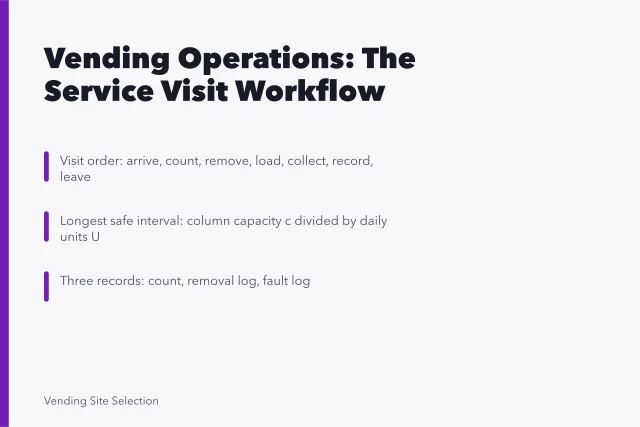
Write the change into the routine that failed, not into a memo. The daily visit procedure is where a lasting fix lives.
Score each defect before you leave the site. Two questions do it: can a buyer see it, and does it block a sale? A visible defect that blocks a sale goes first, a hidden one that blocks a sale next, a visible cosmetic one after that, and the rest last.
Keep one record per visit so audits stay comparable:
Field / Entry
- Site and machine
- name and asset number
- Date and hour
- the busy hour, not the convenient one
- Empty or low selections
- list, per selection
- Working on first attempt
- yes or no
- Host complaints
- what the host said, in their words
- Defects found
- one line each
- Fix and owner
- the routine change and who owns it
- Recheck date
- when you will confirm the fix
Frequency and coverage
Every machine should be audited unannounced at some point in a cycle you choose, and the sites that matter most should be audited more often than the sites that are easiest to reach.
A workable default for most operators is every machine once a quarter, with the highest-exposure sites audited monthly. Set the numbers, write them down, and hold to them.
Rank by exposure rather than convenience: a machine at your largest host, a machine at a site whose agreement is near renewal, a machine at a building with a competitor's equipment in it. Those three earn a visit before a quiet site that never causes trouble.
Where machines are far apart, fold the audit into an existing run at a different hour rather than making a special trip. A special trip is exactly the cost that makes audits stop happening. On a spread out route, the travel arithmetic argues for auditing what you pass rather than what you plan to pass.
Two checks that are about compliance rather than quality
They belong in the audit because they are visible from the front of the machine.
Temperature on refrigerated units, in whatever record form applies to you. What is required, and what has to happen after a site loses power, is decided by your state or county health department; the U.S. Food and Drug Administration: State Retail and Food Service Codes and Regulations directory names the agency to ask.
And date codes on what is in the machine, spot checked. Expired stock at the front of a column is the most damaging thing an audit can find, and the one a host is most likely to find first.
Both belong in the file with your sales and removal records, which are part of what the Internal Revenue Service: What kind of records should I keep? guidance expects a business to hold. The broader operations framework sets out where each of these sits in the visit.
Common questions
Should I tell the driver when I am auditing?
Announce the program and not the visit. People should know that unannounced checks happen and roughly how often, because that is fair, and they should not know which day, because that defeats the measurement.
What if the audit finds the same defect repeatedly?
Stop treating it as a defect and treat it as a design problem. A step that fails repeatedly is either impossible in the time allowed, ambiguous, or not actually in the routine. All three are fixed by changing the routine rather than by reminding someone.
Is a photo record worth keeping?
Yes, and it takes seconds. A dated photo of the machine front at the peak hour is the clearest evidence of fill rate and cleanliness you can hold, and it settles disagreements about what the machine looked like far faster than a note.