Guides
How to analyze vending machine locations before you pitch a host
How to find vending machine locations that pay: build a prospect list inside your service ring, run a stopped count, and qualify hosts before you pitch.
What to take away
- Prospecting is a mapping exercise before it is a sales exercise. Start with the ring you can already service.
- A stopped count at the busy hour beats any headcount a host quotes you.
- Qualify the host as hard as you qualify the building. An absent contact turns a good site into a bad account.
- Most sites are lost at the agreement, not at the pitch.
Step one: draw the ring
Put your existing machines on a map and draw the area you can serve without adding a trip. Every prospect inside that ring starts with an advantage no extra sales at a distant site can match: it costs you minutes rather than a journey.
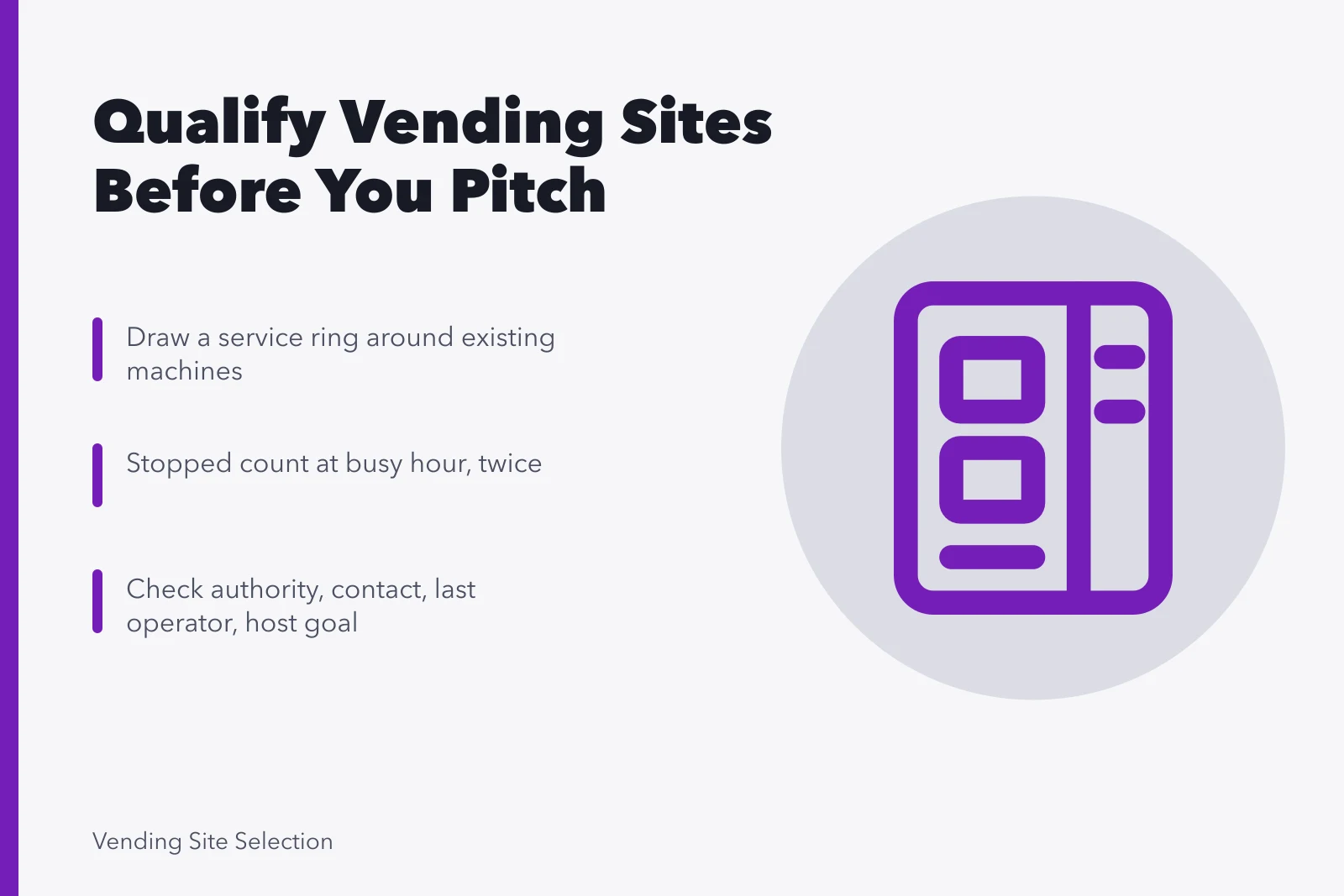
Draw your service ring
- Map existing machines or home base
- Draw area servable without extra trip
- List buildings holding people for hours
- Use aerial imagery and business directory
- Confirm list by driving the ring
If you have no machines yet, draw the ring around where you live or where your storage is. It will move later. What matters is that you are prospecting a defined area rather than reacting to whatever comes up.
Then list every building inside the ring that holds people for hours at a time. Industrial parks, distribution facilities, medical office buildings, campuses, larger apartment complexes, self service laundries, fitness centers. Aerial imagery and a county business directory will build this list faster than driving, though driving is what confirms it.
Step two: filter before you visit
Not every building on the list is worth an hour. Filter on three things you can check without going in.
Filter before you visit
- Does the building hold people for a long stretch?
- Is there an obvious alternative within a short walk?
- Is there likely to be an incumbent?
- Keep only a shortlist you can work
- Does the building hold people for a long stretch? A site people pass through has to be exceptional to work.
- Is there an obvious alternative within a short walk? A convenience store next door changes the arithmetic entirely.
- Is there likely to be an incumbent? A large employer almost certainly has machines. That is not a reason to skip it, but it changes the approach from placement to replacement.
What is left is a shortlist you can actually work. Twenty buildings you visit properly beats two hundred you drive past.
Step three: the stopped count
Visit at the hour the building is busy and count the people who pause where a machine would stand. Not the people who walk by. The people who stop.
Run the stopped count
- Visit at the busy hour
- Count people who stop, not walk by
- Repeat at a different time
- Record time, day, and interval
- Note queues, shift changes, waiting areas
- Note existing competitors on site
Do it twice, at different times. Write down the time, the day, and the interval. Look for what produces buyers: a queue, a shift change, a waiting area, a break people take in the same place.
Look also at what is already there. A staffed cafeteria, a water cooler, a fridge with an honesty box are all competitors.
That count is the piece of evidence you will use in the pitch and in the decision. It is worth more than anything the host tells you, because hosts quote headcount, and headcount includes everyone who is never near the machine.
Step four: qualify the host
The building can be right and the account still fail. Find out four things before you invest more time.
Qualify the host
- Who has authority to sign?
- Who is the contact when something breaks?
- What happened with the last operator?
- What does the host actually want?
- Who has authority to sign, and are you talking to them or to someone who will relay a version of it?
- Who will be your contact when something breaks, and do they want the job?
- What happened with the last operator? A host who cannot say is a host who was not paying attention.
- What does the host actually want? Some want revenue. Some want their staff to stop leaving the site. Those are different asks and they lead to different machines and different products.
A host who wants staff to stay on site is a better long term account than one focused on commission, because their interest and yours point the same way.
Step five: pitch the service, not the machine
Managers are not buying a machine. They are buying the absence of a problem: no empty shelves, no complaints, no equipment sitting broken in their lobby.
Pitch service, not the machine
Host buys
- Focus
- Absence of a problem
- Stocking
- No empty shelves
- Faults
- No broken equipment in lobby
- Credibility
- No complaints
You bring
- Focus
- Evidence from the count
- Stocking
- What you would stock and why
- Faults
- Report route and attend speed
- Credibility
- What you will not do
Bring the count you took, say what you would stock and why based on what they told you. State your service interval, how a fault gets reported, and how fast you attend.
Say what you will not do, which builds more credibility than another promise. If you are not sure you can service them at the interval they want, say so before signing, not after.
The wider approach to winning hosts matters here, but the specific thing that wins a first site is usually evidence rather than polish.
Step six: the agreement is where sites are won and lost
More placements are lost after a positive meeting than during one, because the paperwork raises questions nobody had discussed. Settle the commission base, the term, the notice period, the exclusivity if any, access hours, who supplies power, and what happens to the machine at the end. The detail of those clauses is worth reading before you draft anything.
Do the arithmetic on the agreed commission before you sign, at a conservative sales level rather than an optimistic one. A rate that works at the sales the host predicts and fails at the sales you actually expect is not a rate you can accept.
Step seven: place it, then review it
Agree exactly where the machine stands and what the clear approach to it is. Machines in places of public accommodation are subject to federal accessibility obligations, and the U.S. Department of Justice: ADA Guide for Small Businesses explains what small businesses in existing facilities are expected to consider.
Then set a review date at installation. Three cycles of real sales will tell you whether your count translated, and a review scheduled in advance is much easier to act on than one triggered by disappointment.
The local questions to settle in parallel
Prospecting and compliance run at the same time, not one after the other. Ask the state or county health department whether the machine type you plan to place needs a permit at that address, and use the U.S. Food and Drug Administration: State Retail and Food Service Codes and Regulations directory to find the right agency.
Ask the county licensing office about business licensing and any device decal. General registration guidance sits in the U.S. Small Business Administration: SBA Business Guide, and the state by state licensing position is worth having in writing before a host asks.
Have the product plan roughed out too, since a host will ask what goes in the machine at the first meeting. The site level product decisions can be adjusted later, but an answer of some kind is expected on the day. If this is your first placement, work through the launch sequence alongside the prospecting rather than after it.
Common questions
Should I pay a locator service to find sites?
Ask what exactly you are buying and what happens if a site cancels in the first months. The risk with locators is that the placement is the product, so nobody is accountable for whether the site sells. If you use one, keep your own stopped count discipline and be ready to move a machine that does not perform.
Is cold calling in person still worth doing?
Yes, in this trade more than most, because the decision maker is often physically present and the ask is small. Go at a quiet hour, ask who handles the break room, and expect to come back. The first visit is usually about finding the right person rather than pitching.
How do I approach a building that already has machines?
Look at the incumbent's machine. If it is half empty, dusty, or shows a fault, that is your opening: pitch service. If it is well kept, leave a card and note when the agreement ends if the host will share it. Come back later.
Undercutting on commission to displace a well served incumbent starts the account on the worst possible footing.