Guides
Vending machine downtime costs: formula and fault log
Calculate vending machine downtime costs with a formula for lost contribution, extra trips, and repairs, then log faults to guide route decisions.
What to take away
- A fault can cost lost contribution, an unscheduled return trip, repairs, and host confidence; only some costs arrive as direct invoices.
- Estimate direct downtime costs from your own recordsvends per day, contribution per vend, days out of service, trip cost, and repair cost.
- Host confidence is not part of the formula, but communication during an outage can help protect the account.
- A spare machine can shorten an outage to one visit; compare its holding cost with the downtime and extra trips it could avoid.
The four components of a fault
Vending machine downtime costs include lost contribution, an unscheduled return trip, parts and labor, and the effect on the host relationship.
Four costs of a fault
Cost
- Lost contribution
- No invoice
- Return trip
- Fuel and labor
- Repair
- Parts and labor
- Relationship cost
- No invoice
How it arrives
- Lost contribution
- Site and downtime length
- Return trip
- Route distance
- Repair
- Component failure
- Relationship cost
- Host confidence
What drives it
- Lost contribution
- Return trip
- Repair
- Relationship cost
Lost contribution is the sales that did not happen while the machine was down. Its size depends entirely on the site and on how long the fault lasted before you knew about it.
The return trip is the journey made specifically to fix the machine, outside your normal route. On a clustered route this is small. On a route with a distant outlier it can exceed the repair itself.
The repair is parts and labor, whether yours or a technician's.
The relationship cost is what the host takes from an empty or dead machine in their lobby. It has no invoice and it is the one that decides whether the site is still yours next year.
Calculating direct downtime costs
Use inputs you already hold.
The downtime cost formula
- V x r x Dlost contribution
- Tunscheduled trip cost
- Rparts and labor
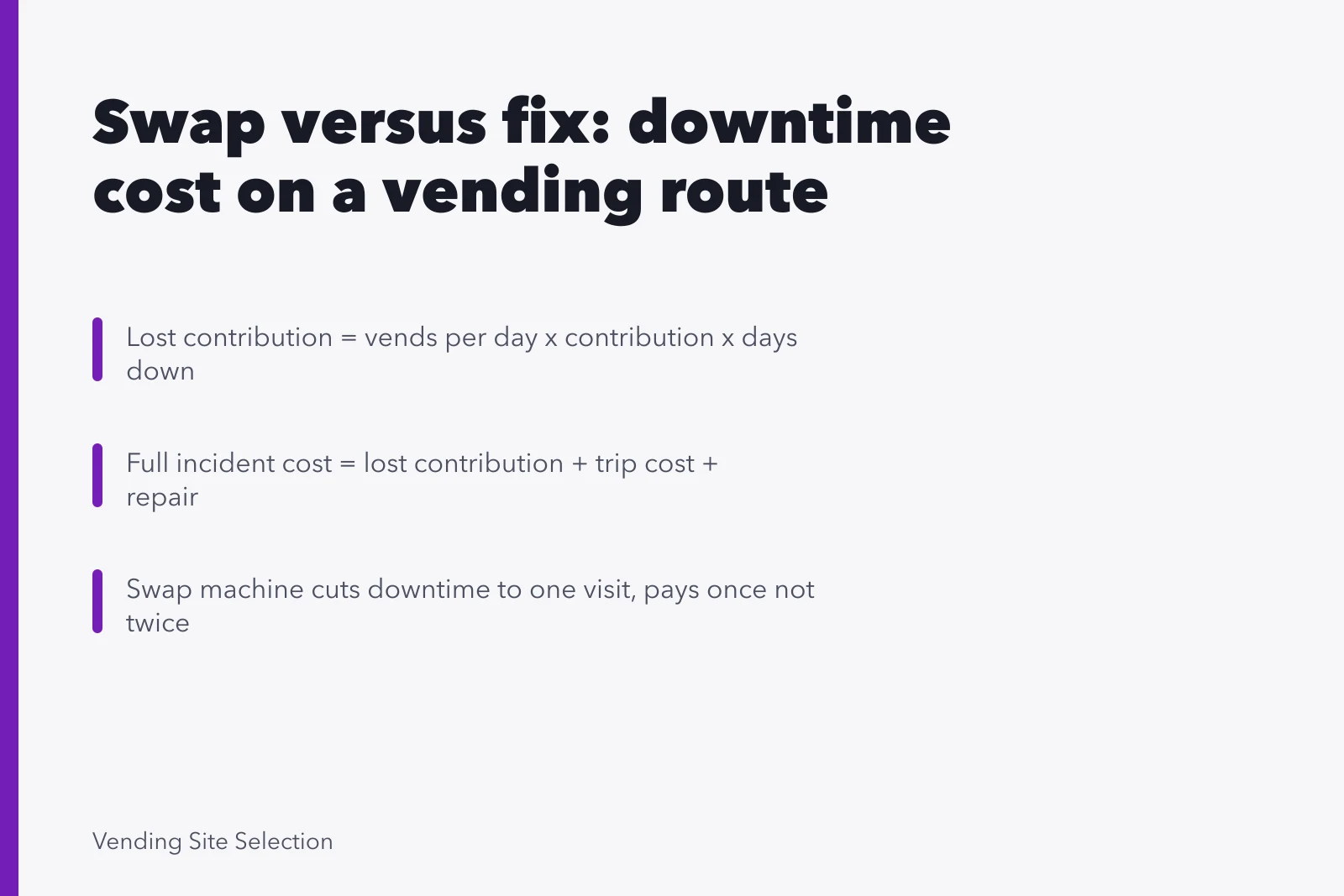
- (V x r x D) + T + Rfull incident cost
Let V be vends per day at that machine and r the contribution each vend retains after cost of goods, commission and payment cost. Let D be days out of service. Lost contribution is:
V x r x D
Let T be the cost of an unscheduled trip: driving time, labor and vehicle cost for that journey. Let R be parts and labor for the repair. The full cost of the incident is:
(V x r x D) + T + R
D is the term you can control most directly. If a fault is found only on your next scheduled visit, downtime includes the time between the fault and that visit, not just repair time.
T is a property of the route, not the fault, so distance makes every fault more expensive.
Detection is where the money is
Most operators try to reduce repair cost. The larger saving is usually in reducing D.
Three ways to shorten D
- Monitored number the host can call
- Telemetry reporting faults or stopped sales
- Service interval short enough to bound worst case
Compare the cost of telemetry on a machine against V x r for a single average outage at that machine. On a busy site the comparison is not close. On a quiet one it may be, and that is the point of running the arithmetic rather than adopting a general rule.
The swap machine
Once a route reaches a certain size, holding one spare machine changes the shape of every fault.
Instead of diagnosing at the site, you swap the machine, restore service in one visit, and repair the faulty unit at your own convenience. D falls to the time it takes to get there. T is paid once rather than twice. And the host sees a working machine rather than a series of visits.
Whether it pays depends on the same inputs. Compare the cost of holding a spare against the sum of (V x r x D) plus a second trip across the faults you actually had last year. Your maintenance log is what makes that calculation possible, which is one more reason to keep it per machine rather than per visit.
Repair, swap or remove
Three questions in order, and they take you to a decision rather than a preference.
Repair, swap or remove
Does the site produce enough contribution?
keep and repair
move the machine
- Does this site produce enough contribution to justify a machine at all? Multiply V x r over a period and subtract the cost of the visits. If that is not comfortably positive, the fault is an opportunity to move the machine rather than to repair it.
- Is the repair cost R a meaningful share of a replacement, and is this the first such repair or the third? A component failing repeatedly, particularly one with limited parts availability, is a machine reaching the end of its life at that site.
- Can the repair be done inside your promised response time? If not, swap or switch the machine off, because a machine taking money it cannot honor is worse than one that is plainly out of service.
The cost you cannot invoice
The host's confidence does not appear in any calculation above, but it can affect whether the site remains yours.
A host who has fielded complaints about an empty or dead machine is a host who will listen when a competitor offers a better commission. Nothing in the repair budget offsets that, and the only remedy is communication: tell them before they find out, give a time, and tell them again when it is fixed.
Keep a record of days out of service per machine and show it to the host on the commission statement, even if the agreement does not require it.
An operator who volunteers that the machine was down for two days is trusted about everything else on the page. That protects the site when somebody offers them a higher rate.
Working on a machine safely
Cost is not the only reason to be deliberate about repairs. Isolate power before working inside a machine, and keep it isolated during the work.
The OSHA standard Occupational Safety and Health Administration: Control of Hazardous Energy (Lockout/Tagout) sets out principles for controlling hazardous energy during servicing. Whether it applies to your operation is a question for OSHA or your state plan.
Do not move a machine alone, and keep the approach to an out of service machine clear, since the accessibility requirements in the U.S. Department of Justice: 2010 ADA Standards for Accessible Design attach to the installation regardless of whether it is vending.
Recording faults so the arithmetic works
- Machine, site, date and time the fault was reported or detected.
- How it was detectedhost call, telemetry, or found on a visit.
- Date and time service was restored, so D is a measurement rather than an estimate.
- Component and cause.
- Parts, labor and whether a trip was made specifically for it.
- Whether the host was told, and when.
Repair and maintenance costs are part of the expense documentation the Internal Revenue Service: What kind of records should I keep? guidance expects a business to hold. The detection field shows, after a year, whether your problem is machines or notification.
The security and repair framework covers the fault types themselves. loss prevention covers the ones that are not mechanical at all.
Common questions
Should I quote a downtime figure to a host?
Only if it is your own measurement. A general industry figure means nothing about your machine at their site, and a host who checks it will trust you less. Your own days out of service per machine is a number you can stand behind.
Is a maintenance contract worth it?
Compare it against your own record of R and T over a year rather than against a fear of a large repair. Contracts are usually worth more to a route with many machines of one type and less to a small mixed fleet, and the response time in the contract matters more than the cost.
How do I decide whether to refund a customer directly?
Decide the refund policy before it happens, tell the host what it is, and put a contact on the machine. An unhandled refund request becomes a host complaint, which costs more than any single refund.
A policy applied inconsistently is worse than either. As the route grows and machines sit further from home, a clear refund route matters more because you are less often nearby.