Guides
Vending machine startup and market guide
Vending machine startup guide covering route density, host commissions, converting traffic, card fees, and the three ways operators enter the trade.
What to take away
- A vending route is a delivery business with a retail front end. The machine sits still; the truck is what costs money.
- The number that decides whether a site earns is not the number of people who walk past it. It is the number who stop, and the share of those who buy.
- A location agreement, and the commission written into it, turns a good site into a profitable one or a busy one that loses money.
- Machines far from the rest of the route cost more to serve than they can plausibly return, no matter how well they sell.
- Almost everything a new operator wants to know is local: who inspects the machine, what the sales tax treatment is, whether a license is needed at all. Those answers come from named offices, not from a national article.
What the business actually sells
New operators usually describe the business as selling snacks and drinks. That framing hides where the money goes. A single machine holds a few hundred dollars of stock and generates sales without staff. What it consumes is driving time, restocking labor, cash handling, card processing, repairs, and the commission owed to whoever owns the floor it stands on.
The trade sells two different things to two different customers. To the person at the machine, it sells convenience when leaving the building is not an option. To the host business, it sells a service: a machine that is full, working, clean, and never a complaint at the front desk.
The second sale decides whether the first one keeps happening.
That distinction shapes every later decision in this guide. Product choice follows the buyer. Route design, service standards, and the agreement follow the host.
Traffic that converts and traffic that passes
A shopping center corridor with heavy footfall can be worse than a plant break room with a fraction of the traffic. The corridor has choice: a coffee shop, a convenience store, a car outside. The break room has none for the length of a shift.
Two questions separate the two kinds of traffic.
Traffic that converts
- How many people are in the building, and for how long at a stretch? A person present for eight hours with one paid break has a different buying pattern from a person passing through in four minutes.
- What else can they buy from, and how far away is it? A machine that competes with a staffed store forty feet away is not selling convenience. It is selling the same product at a worse price.
Count people who stop, not people who move. Stand where the machine would go, at busy hours, and count anyone who pauses within reach.
That number, not the building's headcount, is the basis for your estimate. It is free to collect.
It is the single most useful evidence a new operator can gather before signing anything.
The commission split decides the site
Most host locations expect a share of sales. The share is negotiated, not fixed, and the split is where a promising site turns into a marginal one.
Work the arithmetic in variables before you agree to any number.
Let G be monthly gross sales at the machine, C the cost of the goods sold, and K the commission rate paid to the host.
S is the cost of serving the machine: driving time, labor, card fees, and a share of vehicle cost. What the operator keeps is:
G - C - (K x G) - S
Two things fall out of that expression: commission is charged on gross, while the operator pays costs from what is left, so a rise in K bites harder than it looks.
S is largely fixed per visit. A site with low sales and a generous commission can consume more service cost than it returns while still looking busy.
Write the split down. Say whether it is calculated on gross sales or on sales after sales tax, when it is paid, what records the host can see, and what happens if the machine is out of service for part of the period. Ambiguity in that clause is the most common source of a soured account.
Route density is the real constraint
The limit on a small operation is not capital and it is not demand. It is how many machines one person can service in a day, and that is decided by distance.
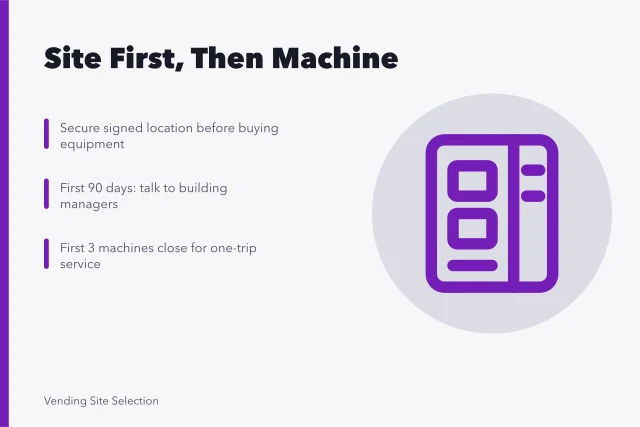
Machines clustered in one industrial park can be serviced in a single stop.
A machine forty minutes away needs its own trip, fuel, and hour. It repays that only if it sells unusually well. If growth scatters machines across a county, the route cannot run on schedule. That yields empty machines and canceled agreements.
The practical rule is to expand in rings rather than in leaps. Fill the area you can already reach before taking a site that opens a new one. When a distant site is genuinely worth taking, treat it as the anchor for a future cluster and set a date by which it must have neighbors or be given up.
For a sense of what service labor costs in a given area, the U.S. Bureau of Labor Statistics: Occupational Employment and Wage Statistics Tables publish wage estimates by occupation and metropolitan area, which is the right source for a route driver's cost in your market rather than a figure quoted in an article.
Cash, cards and the cost per transaction
Card acceptance raises the average sale and removes the excuse of having no change. It also adds a per transaction cost, and on low ticket items that cost is a meaningful share of the margin.
Ask the processor for the full structure: the percentage, the fixed amount per transaction, any monthly fee for the telemetry line, and the term of the contract. Then apply it to your own price points rather than to an average. A card fee that is trivial on a large purchase can take a noticeable slice of a single small item.
Cash brings quieter costs: one person counts it and another banks it. A machine that occasionally swallows a coin creates a complaint that costs more to settle than the coin.
Most operators accept both, and the decision worth making deliberately is not whether to take cards, but how the price list is set once card fees are in the model.
Three ways into the trade, compared
Three ways into the trade
What you are buying
- Buy machines and find your own sites
- The lowest cost of entry and full control over the agreement
- Buy an existing route
- Sites, agreements and proven sales history from day one
- Buy into a franchise or business opportunity package
- Training, equipment and a supplier relationship
What it hides
- Buy machines and find your own sites
- Site acquisition is the hard part, and it takes far longer than equipment delivery
- Buy an existing route
- Agreements may be near renewal, and the seller's service standard is now your reputation
- Buy into a franchise or business opportunity package
- Location promises are the part to examine hardest, and the terms may bind product sourcing
None of these is the right answer for everyone. The choice depends on whether your scarce resource is money, time, or access to buildings. An operator with contacts inside local employers should not pay someone else for locations. An operator with capital and no contacts probably should.
What to settle before the first machine moves
Registration, tax treatment and food handling are all decided locally, and this is where a national guide stops being useful. Three inquiries cover most of it.
- Ask the state or county health department whether machines that vend packaged snacks and drinks require a permit where you operate, what a temperature controlled machine changes, and who inspects it. The U.S. Food and Drug Administration: State Retail and Food Service Codes and Regulations directory tells you which agency to call in each state.
- Ask the state revenue department how vending sales are treated for sales tax, whether the tax is included in the vend price or added, and what records they expect. Do not assume the treatment from a neighboring state.
- Ask the city or county licensing office whether a general business license, a vending device decal, or a location specific permit applies.
For the federal layer, the Internal Revenue Service: Starting a business pages set out entity choice, employer identification numbers and recordkeeping obligations, and the U.S. Small Business Administration: SBA Business Guide covers planning, funding and the sequence of launching a business.
Common questions
How many machines does an operator need before this is a full time living?
No one can answer that from a page. It depends on sales per machine, agreed commission rates, and how tightly the machines cluster.
The honest question is answerable: calculate what one machine nets on your own route after commission and service cost, then divide the income you need by that figure. If the answer is more machines than you can service in a week, route design is the constraint, not sales.
Is it better to start with drinks or snacks?
It follows the site rather than the product. A site where people stay for hours and the water is bad sells drinks. A site with a long shift and no cafeteria sells food. Ask the host what people leave the building to buy, and stock that.
Should a new operator sign an exclusive supply clause with a host?
Exclusivity cuts both ways and is worth reading closely. It protects you from a competitor placing a second machine in the same lobby, and it binds you to serve a site that may stop being worth serving. If you accept it, tie it to a term you can live with and to service standards you can actually meet.