Guides
Getting vending machine placement agreement right the first time
Vending placement agreement clauses read one by one: commission base, term, notice, exclusivity, access, power, and what happens when a competitor bids higher.
What to take away
- The commission base matters more than the commission rate. On gross or after sales tax is a different agreement.
- Term and notice together decide whether a site is an asset or a machine you happen to be servicing.
- Exclusivity protects you and binds you. Read it in both directions.
- Write down who reports a fault and how fast you attend. That clause is what keeps the account.
- A competitor offering a higher rate is a normal event. Plan for it in the agreement rather than at the moment it happens.
Why the document is the site
Two operators can hold identical machines in identical buildings and get very different results, because one has an agreement that defines the relationship and the other has an understanding. When something goes wrong, and eventually it does, the understanding turns out to have been two different understandings.
What follows is a clause by clause read of a placement agreement, in the order the clauses usually cause trouble.
Clause one: the commission base
The rate gets the attention. The base decides the money.
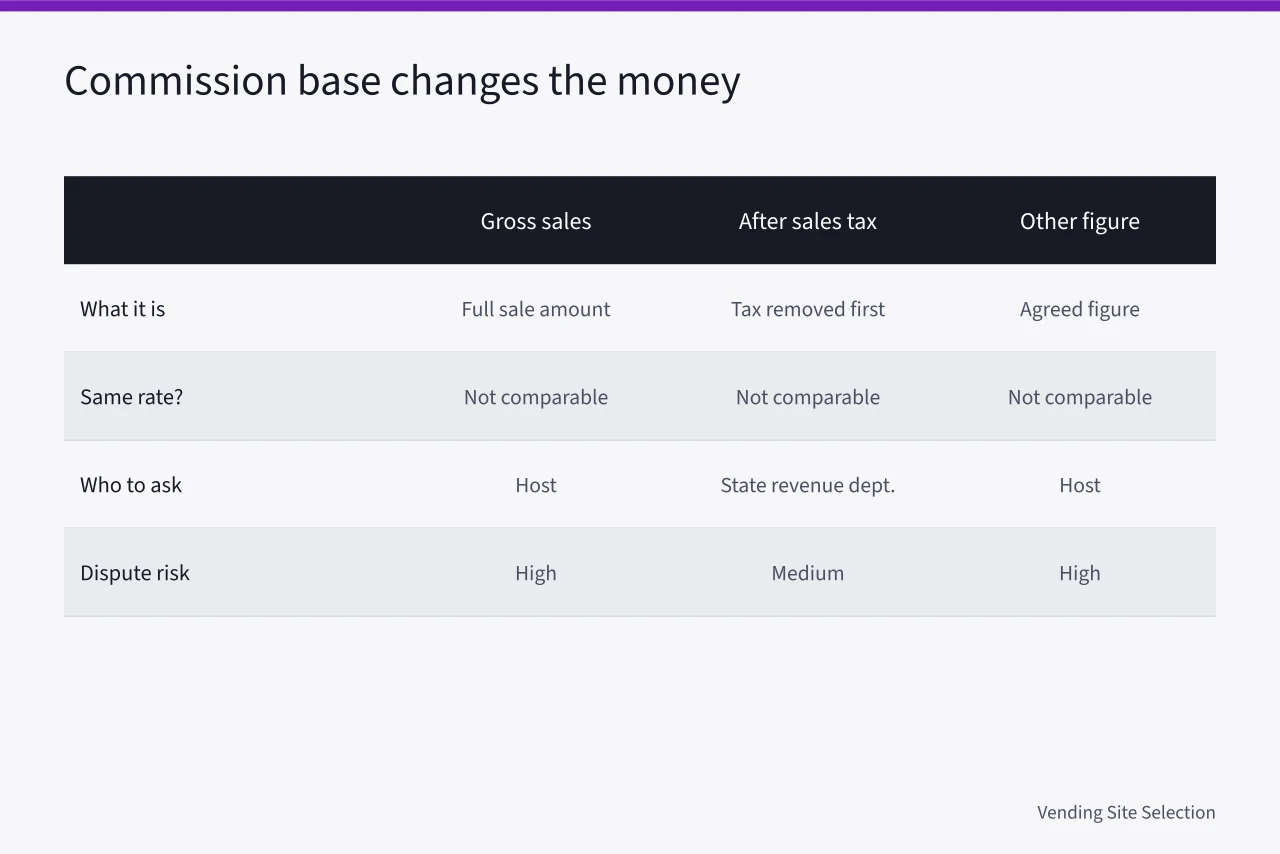
Ask, and write down, whether commission is calculated on gross sales, on sales after sales tax is removed, or on another figure. These are different numbers. A rate quoted against one base is not comparable to the same rate against another.
Where sales tax treatment of vending sales is unclear, ask the state revenue department. Do not settle it between you and the host.
Then set out the mechanics: the period, the payment date, and what the host receives as evidence. A statement showing sales per machine per period, produced the same way every time, prevents most commission disputes before they start.
Clause two: term, notice and renewal
Term without notice is meaningless, and notice without term leaves you at the host's convenience. Read the two together.
Term and notice questions
- How long does the initial term run?
- What notice ends it?
- Does notice differ for cause?
- Does it renew automatically?
- If so, for how long?
Three questions settle it. How long does the initial term run? What notice does either side give to end it, and does that notice differ for cause? Does it renew automatically, and if so for how long?
An automatic renewal that neither party thinks about is usually fine until the host changes manager. Whatever the term, a diary entry a few months before it expires is worth more than the clause itself, because a renewal conversation you started is a much better conversation than one the host started.
Clause three: exclusivity
Exclusivity means the host will not put another operator's machine in the same building, or the same area of it. It is valuable and it is not free.
Define exclusivity scope
- Whole site or one floor?
- Snack and drink only?
- Coffee and micro markets too?
- Water service included?
- Survives change of ownership?
If you take it, define the scope precisely. Is it the whole site or one floor? Does it cover coffee, micro markets and water service, or only snack and drink machines? Does it survive a change of building ownership? A vague exclusivity clause produces an argument later about whether a coffee brewer counts.
Expect the host to want something in return, usually a service standard or a minimum. Agree a standard you can actually meet with your current route, not one you hope to grow into.
Clause four: access, power and space
Three practical items that cause more day to day friction than commission ever does.
Access, power and space
- Access hours and entry outside them
- Which outlet, whose electricity
- Who pays electrical work
- Exact machine position
- Who keeps approach clear
- Access hours, and how you get in outside them. A site you can only reach between nine and five is a site that constrains your whole route.
- The outletwhich one, whose electricity, and who pays for any electrical work at installation.
- The exact position of the machine, and who keeps the approach to it clear. Machines in a place of public accommodation carry accessibility obligations, and the U.S. Department of Justice: ADA Guide for Small Businesses sets out what small businesses in existing facilities are expected to consider. Agree in writing that the host will not stack goods in front of the machine, because they will otherwise do it without meaning anything by it.
Clause five: service standard and fault reporting
This is the clause that decides retention, and it is the one most often left out.
Service standard and fault reporting
- State the service interval
- Name who reports a fault
- Give number or address
- State your response time
- State what happens if missed
State the service interval. State who at the site reports a fault, to what number or address, and what your response time is. State what happens if you miss it. A host who knows exactly how to reach you rarely becomes a host who quietly talks to your competitor.
Keep your side of it visible. A dated service record left at the machine or shared with the contact turns your reliability from a claim into something they can see.
Clause six: what happens at the end
The end of an agreement is where money is lost. Cover four things.
Cover the end of agreement
- Who removes machine, when, at whose cost
- What condition space is left in
- Stock inside and partial commission
- Host keeping machine while new operator found
What happens at the end
- Who removes the machine, when, and at whose cost.
- What condition the space is left in.
- What happens to stock inside the machine and to any commission owed for a partial period.
- Whether the host may keep the machine in place while a new operator is found, which they will sometimes assume and which you should not permit by silence.
The competitor who offers a higher rate
At some point a host will be offered a better commission by someone else. It is the most common way a good site is lost and it is worth thinking about before it happens rather than during the phone call.
Three things reduce the risk, none of them a guarantee. A defined term with notice, so the host cannot switch instantly. A service record that makes the comparison about more than the rate. And a relationship with a named contact who will tell you the offer exists rather than simply ending the agreement.
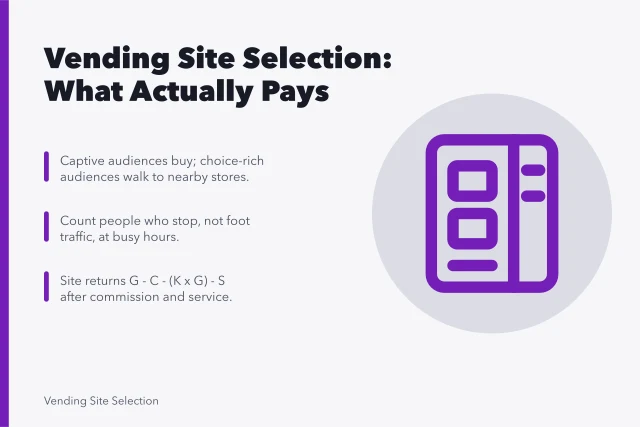
If it happens, do the arithmetic before responding. Take gross sales G, cost of goods C, the proposed commission rate K, and your service cost S for the cycle: the site returns G - C - (K x G) - S.
If matching the offer takes that below what the stop is worth, let it go and redeploy the machine. Losing a site on price is not a failure. Keeping one at a rate that does not clear your service cost is.
What to keep on file
- The signed agreement and any variation, with dates.
- Commission statements issued to the host for each period.
- Sales records per machine per period, which are both the basis of the commission statement and part of the business records you have to keep anyway.
- The service log for that site, including faults reported and response times.
- Any correspondence about position, access or obstruction.
That file is what turns a disputed conversation into a settled one, and it is also the evidence base for deciding whether to renew.
Common questions
Is a written agreement really necessary for a single machine in a small office?
A short written agreement is still an agreement, and it can be a page. The value is not formality; it is that both sides have answered the same questions in advance. If the host resists anything longer, a page covering commission base, term, notice, access and fault reporting covers most of what goes wrong.
Should commission be a percentage or a flat amount?
Both are used. A percentage moves with sales and shares the risk of a quiet period. A flat amount is predictable for the host and becomes expensive for you when sales fall. Whichever you agree, run the arithmetic at a sales level below your expectation, because that is the case where the difference between the two structures shows.
Can I move a machine to a different spot in the building without asking?
Not without telling the host, and the agreement should say so. Position affects sales, access and their own operations. Agreeing a change in writing, even briefly, avoids a dispute about who moved it and why. For how position affects the numbers, see the site evaluation method and the wider location framework.
Where do the legal and tax questions go?
To the offices that answer them. The U.S. Food and Drug Administration: State Retail and Food Service Codes and Regulations directory names your state's retail food agency, the state revenue department handles sales tax treatment, and the U.S. Small Business Administration: SBA Business Guide covers general business registration.
Nothing on this page is legal advice, and a contract you will sign repeatedly is worth an hour of a lawyer's time once. Keep your licensing position and your product plan current, because hosts ask about both, and settle both before you place a first machine.