Guides
15 vending machine location types to target in 2027: the parts worth your time
Vending machine location types sorted by audience shape, dwell time and access, with the one question that decides each and the trap each type hides.
What to take away
- Site types are useful as a set of questions, not as a ranking. The best category with a bad host loses to a modest one with a good host.
- Sort candidates by how long people stay and what else they can buy. Everything else follows from those two.
- Access hours and security are what separate a type that looks good from one that services well.
- Fifteen types are listed below. None of them is recommended in the abstract.
How to read the table
Every row answers three things: what the audience looks like, the single question that most often decides whether that type works, and the trap it hides. There are no ratings, because a rating would be a claim about buildings nobody here has visited.
Site types: audience, question, trap
Site type
- Manufacturing plant
- High dwell, low choice
- Distribution center
- High dwell, night activity
- Corporate office
- Medium dwell, weekdays
- Medical office building
- Mixed dwell, waiting
- Hospital support areas
- High dwell, around clock
Audience shape
- Manufacturing plant
- Shift change access
- Distribution center
- Night shift served?
- Corporate office
- Subsidized cafeteria?
- Medical office building
- Staff or visitors?
- Hospital support areas
- Who controls access?
Deciding question
- Manufacturing plant
- Narrow service windows
- Distribution center
- Seasonal headcount swings
- Corporate office
- Empty two days a week
- Medical office building
- Different needs by hour
- Hospital support areas
- Slow formal procurement
The trap
- Manufacturing plant
- Distribution center
- Corporate office
- Medical office building
- Hospital support areas
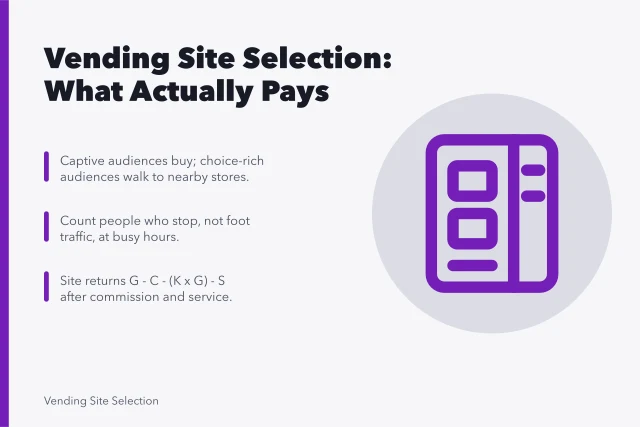
Two columns explain most of the variation. Dwell is how long people stay in one stretch. Choice is what else they can buy without leaving. High dwell and low choice is the combination the trade is built on.
| Site type | Audience shape | The question that decides it | The trap |
|---|---|---|---|
| Manufacturing plant | High dwell, low choice, shift based | Can you get in at shift change, and who escorts you? | Service windows are narrow and the plant sets them |
| Distribution center | High dwell, low choice, night activity | Which shifts are staffed, and is the night shift served? | Seasonal headcount swings are large |
| Corporate office | Medium dwell, medium choice, weekdays only | Is there a subsidized cafeteria, and what are hybrid days like? | An empty building two days a week still needs the same drive |
| Medical office building | Mixed dwell, waiting periods | Is the machine for staff, for visitors, or both? | Staff and visitors want different things at different hours |
| Hospital support areas | High dwell, low choice, around the clock | Who controls access to non public floors? | Procurement can be slow and formal |
| University residence hall | High dwell, unusual hours | What happens in the months when term is out? | Damage exposure is higher than elsewhere |
| Community college | Low dwell between classes, medium choice | Are there gaps in the timetable where people wait? | Demand disappears entirely during breaks |
| Apartment complex | Low dwell, high choice at home | Is there a laundry room or a shared amenity space? | Residents have a kitchen upstairs |
| Hotel | Captive at night, choice-rich by day | What does the front desk already sell? | Guest complaints go to the hotel, not to you |
| Fitness center | Short dwell, specific demand | Will they let you stock what their members want? | A narrow range that has to be right |
| Laundromat | Fixed dwell for the wash cycle | How is the site secured when unattended? | Unattended hours raise the risk on the machine |
| Auto dealership | Waiting customers plus staff | Is the machine for the service waiting area or the workshop? | Two audiences, one machine, often mismatched |
| Warehouse or self storage | Low headcount, long presence | Is there enough staff and traffic to justify a stop? | Looks captive, is often just empty |
| Transportation terminal | High volume, captive | Is the space let on a concession basis rather than a commission? | The cost structure can be unlike a normal agreement |
| Municipal building | Steady weekday staff, public visitors | What is the procurement process, and how long does it take? | Approval timelines can run for months |
Using the table on a real candidate
Take a building you are considering and answer the deciding question first. If you cannot answer it, you are not ready to pitch, and finding the answer is usually one conversation with the site contact.
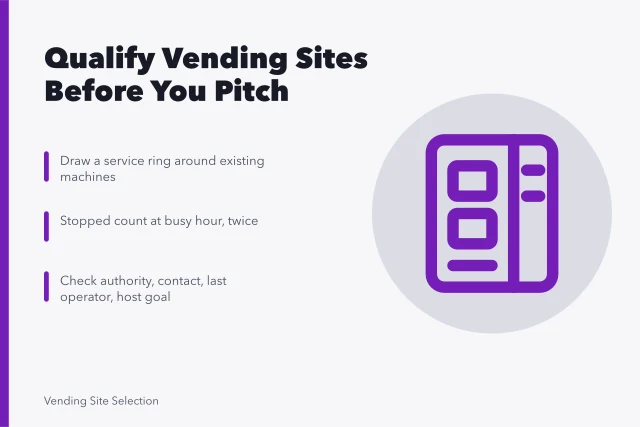
Qualify a candidate site
- Answer the deciding question first
- If you cannot answer, do not pitch
- Run a stopped count at busy hour
- Place candidate on your service map
- Check it sits inside your service radius
Then run a stopped count at the busy hour rather than accepting a headcount. The method for counting and qualifying a site applies to every type in the table, and it is what turns a category into an estimate.
Last, place the candidate on your map. A row in this table can be excellent and still not be worth taking if it sits outside the area you can service, because a distant stop consumes a whole trip. The service radius argument is the one that overrides site type most often.
The types that reward patience
Three of the rows above tend to take longer to win and to last longer once won.
Patient site types
Site type
- Manufacturing
- Facilities manager, safety induction
- Distribution
- Access process, induction
- Municipal buildings
- Procurement, paper heavy
- Hospitals
- Slow, higher hygiene expectations
Why it takes longer
- Manufacturing
- Less contested once won
- Distribution
- Operator tends to stay
- Municipal buildings
- Longer agreements
- Hospitals
- Access and hygiene bar high
Why it lasts
- Manufacturing
- Distribution
- Municipal buildings
- Hospitals
Manufacturing and distribution sites usually involve a facilities manager, a safety induction and an access process. That friction is why they are less contested, and why an operator who gets through it tends to stay. Municipal buildings involve procurement, which is slow and paper heavy, and the agreements that come out of it are often longer.
Hospitals sit in the same group. Nothing there moves quickly, and access and hygiene expectations are higher than elsewhere.
Whether a machine needs a permit, or what temperature records are expected, are questions for the state or county health department. The U.S. Food and Drug Administration: State Retail and Food Service Codes and Regulations directory names the agency to ask in each state.
The types that need a second look
Apartment complexes and self storage sites appear on every beginner list because they are easy to approach. They are easy to approach because the traffic is thin. Before taking one, count. If the count is low, the site is a favor rather than a placement.
Second-look site types
Site type
- Apartment complexes
- Thin traffic
- Self storage
- Thin traffic
- Fitness centers
- Narrow range, strong host views
- Hotels
- Concession or minimum guarantee
- Terminals
- Different cost structure
The problem
- Apartment complexes
- Count before taking
- Self storage
- Count before taking
- Fitness centers
- Agree range up front
- Hotels
- Read agreement terms
- Terminals
- Read agreement terms
What to do
- Apartment complexes
- Self storage
- Fitness centers
- Hotels
- Terminals
Fitness centers have the opposite problem: real demand, but a narrow range and a host with strong views about what belongs in the machine. That works when you agree the range up front and hold to it.
It fails when an operator stocks a standard snack and drink mix into a site that wanted something else.
Hotels and terminals both carry cost structures that differ from an ordinary commission. Read the agreement terms carefully in those two cases, because a concession or a minimum guarantee changes the arithmetic completely.
Access applies to every row
Wherever the machine goes, the way it is approached and operated is part of the placement decision. Federal accessibility obligations for small businesses in existing facilities are explained in the U.S. Department of Justice: ADA Guide for Small Businesses, and the practical version is to agree the exact position and a clear approach with the host, in writing, before installation.
Universal placement checks
- Agree exact position with host
- Agree clear approach in writing
- Confirm ADA obligations for existing facility
- Check local business licensing
- Check any device permit locally
The other universal item is registration. Whatever the site type, business licensing and any device permit are decided locally. The U.S. Small Business Administration: SBA Business Guide covers general registration steps, and your county licensing office covers the rest.
Which building types are available near you is separate. The local market assessment is for that.
Common questions
Which type is most profitable?
No type is, on its own. Return depends on dwell time, alternatives, the commission you agree, and how far you drive. Two manufacturing plants can sit on opposite sides of the line because one is fifteen minutes away and one is fifty.
Should I specialize in one type?
Specializing is usually worth it early. You learn one gatekeeper, one access pattern and one product mix, and the second site of a type is far easier than the first. Widen once the route is dense enough that the drive is not the constraint.
How do I find out whether a building already has machines?
Walk in and look. Most of these buildings have a public entrance or a reception, and the state of an incumbent's machine tells you whether there is an opening and what your pitch should be.