Guides
Vending machine lease vs buy for a first US route
Vending machine lease vs buy for a first US route: how Section 179, depreciation, cash flow, and maintenance costs decide it, with Florida and Ohio examples.
What to take away
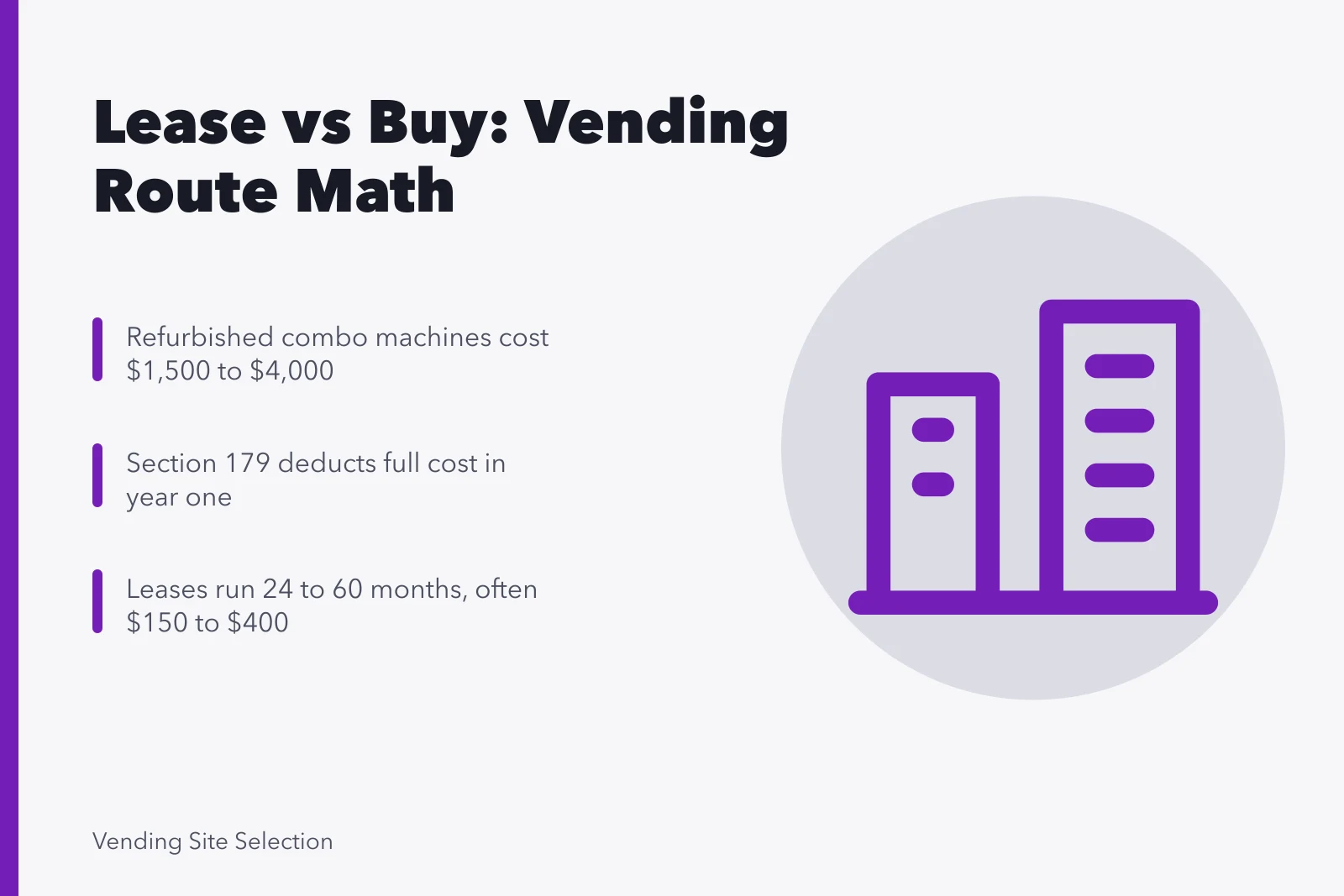
- Buying used machines with cash is usually the cheapest path to a first route, because Section 179 can deduct the full cost in year one instead of spreading it over seven years.
- Leasing preserves cash and moves repairs to the lessor, but you pay interest and you own nothing at the end.
- A 48-month lease on a $2,500 machine can run $3,000 to $3,500, against a $2,500 cash purchase.
A first route is usually five to twenty machines placed in laundromats, gyms, break rooms and small offices. The machines are the easy part. What separates a lease from a purchase is not the sticker price but who carries the risk when a compressor fails in August.
The criteria that matter
Four criteria decide most first-route choices:
- Cash on hand and how much of it you can tie up in machines.
- Taxable income, because Section 179 only offsets profit.
- How long you expect to keep the machines before selling or upgrading.
- Who pays for repairs, shipping and service calls.
Buy vs Lease Criteria
Buy
- Cash out at start
- Full price $1,500-$4,000
- Tax treatment
- Depreciable, Section 179
- Repairs
- Yours
- End state
- You own asset
Lease
- Cash out at start
- First and last $150-$400
- Tax treatment
- Deductible operating expense
- Repairs
- Usually lessor's
- End state
- You return machine
Section 179 lets a business deduct qualifying equipment's full purchase price in the year it is placed in service, up to an annual limit set by Congress. For the 2025 tax year the limit is $2,500,000, and the deduction phases out once qualifying purchases pass $4,000,000. The IRS explains the mechanics in Publication 535.
A used vending machine bought for $2,500 and placed in a Tampa break room can be deducted in full that year. The business must have enough taxable income.
Option by option
Buying outright
A refurbished snack and drink combo runs $1,500 to $4,000, and a new machine can exceed $8,000. Paying cash removes a monthly obligation and puts the asset on your books. The trade-off is that the money is gone. If a location underperforms, you sell the machine at a loss rather than cancelling a contract.
Four Financing Options
Buying outright
- Cost
- $1,500-$4,000 refurbished
- Ownership
- Yes
- Term
- One-time
- Repairs
- Yours
Leasing
- Cost
- 20-40% more over 48 months
- Ownership
- No
- Term
- 24-60 months
- Repairs
- Usually lessor's
Lender financing
- Cost
- Rates depend on credit
- Ownership
- Yes
- Term
- Varies
- Repairs
- Yours
Buying used
- Cost
- Negotiated price
- Ownership
- Yes
- Term
- One-time
- Repairs
- Yours
Leasing a vending machine
Leases typically run 24 to 60 months. Payments cover the machine and often a service agreement. This suits an operator who wants ten machines on the street without spending $25,000. The cost is real: over a 48-month term you can pay 20 to 40 percent more than the purchase price, an illustrative range that varies by lessor and credit.
A $2,500 refurbished combo leased over 48 months runs about $65 to $75 a month, or $3,000 to $3,500 in total payments. Buying the same machine outright costs $2,500.
Buy outright
- Machine price
- $2,500
- Interest or financing
- $0
- Total paid
- $2,500
- Ownership at month 48
- You own it
- Assumed resale, typical used market
- $800 to $1,200
- Net cost
- $1,300 to $1,700
Lease
- Machine price
- $2,500
- Interest or financing
- $500 to $1,000
- Total paid
- $3,000 to $3,500
- Ownership at month 48
- Lessor owns it
- Assumed resale, typical used market
- $0
- Net cost
- $3,000 to $3,500
Figures are typical ranges for one mid-size combo machine, not quotes.
Equipment financing through a lender
A bank or equipment finance company lends against the machines. The SBA 7(a) and 504 programs are the two common federal options, and the SBA caps 7(a) rates at the prime rate plus a fixed spread. Live Oak Bank is one SBA-participating lender.
This keeps ownership while spreading cost. Compare it against an SBA-backed option, and ask whether it is the SBA loan or a local bank before signing anything.
Buying used from another operator
Route buyouts bundle machines, locations and sometimes a vehicle. Price is negotiated, and the tax treatment follows the same Section 179 rules for the equipment portion. Verify each location's contract separately, since a lease with a property manager does not transfer automatically. The Cornell definition of lease agreements is a useful starting point for reading those placement contracts.
Where each one wins
Buy outright when you have the cash, expect to hold the machines five years or more, and have taxable income to absorb the Section 179 deduction. A two-machine route in a Columbus laundromat fits this well; the machines are cheap enough to pay for outright and the deduction offsets other income.
Lease when cash is tight and the site is proven. A Miami gym with steady foot traffic and a signed three-year placement agreement justifies a lease, because the revenue covers the payment and the lessor handles breakdowns.
Finance through a lender when you want ownership but not a lump-sum hit. Used-equipment purchase from another operator suits an operator buying an existing route with established locations.
What none of them solve
Every option assumes the location performs. None protects you from a property manager who cancels after six months, a site with no foot traffic, or a machine that sits empty because nobody services it.
A lease on a dead location is the worst outcome: you owe payments on equipment that earns nothing. Before committing, check the site as you would any placement using how to use Census and BLS data.
Cash flow discipline matters more than the financing label. Track downtime costs, because a machine that is out of service for two weeks costs more than the interest on a lease. The swap versus fix breakdown shows how those numbers stack up.
Leasing buys use of the machine for a set term. It builds no equity.
Tax treatment in Florida and Ohio
Florida has no state income tax for individuals, so the Section 179 deduction matters mainly for federal purposes. Ohio has a state income tax and a commercial activity tax, which changes the math for a Columbus operator.
Neither state exempts vending machine purchases from sales tax in every case. State sales tax rates are 6 percent in Florida and 5.75 percent in Ohio, before county additions. Confirm with the Ohio Department of Taxation or the Florida Department of Revenue before assuming a purchase is tax-free.
Worked example: a $2,500 machine placed in a route earning $10,000 of profit. At a 22 percent federal marginal rate the Section 179 deduction saves about $550 in either state. Florida adds no state income tax on that profit.
Ohio's business income deduction covers the first $250,000 of business income, so a first route in Columbus usually owes no Ohio income tax either. Above that threshold the Ohio rate applies.
The deduction is limited by business income. A first-year operator with a small route and a day job may not have enough business income to use the full Section 179 amount, in which case bonus depreciation or regular depreciation applies instead.
- Confirm the machine qualifies as Section 179 property
- Check whether your business income covers the deduction
- Read the lease for who pays for repairs and shipping
- Verify the placement contract term and cancellation clause
- Compare total lease cost against purchase price plus interest