Guides
Micro market vs vending machine profit for office locations
Micro market vs vending machine profit in US offices: compare upfront costs, daily sales, and margins to see which fits an office of a given size.
What to take away
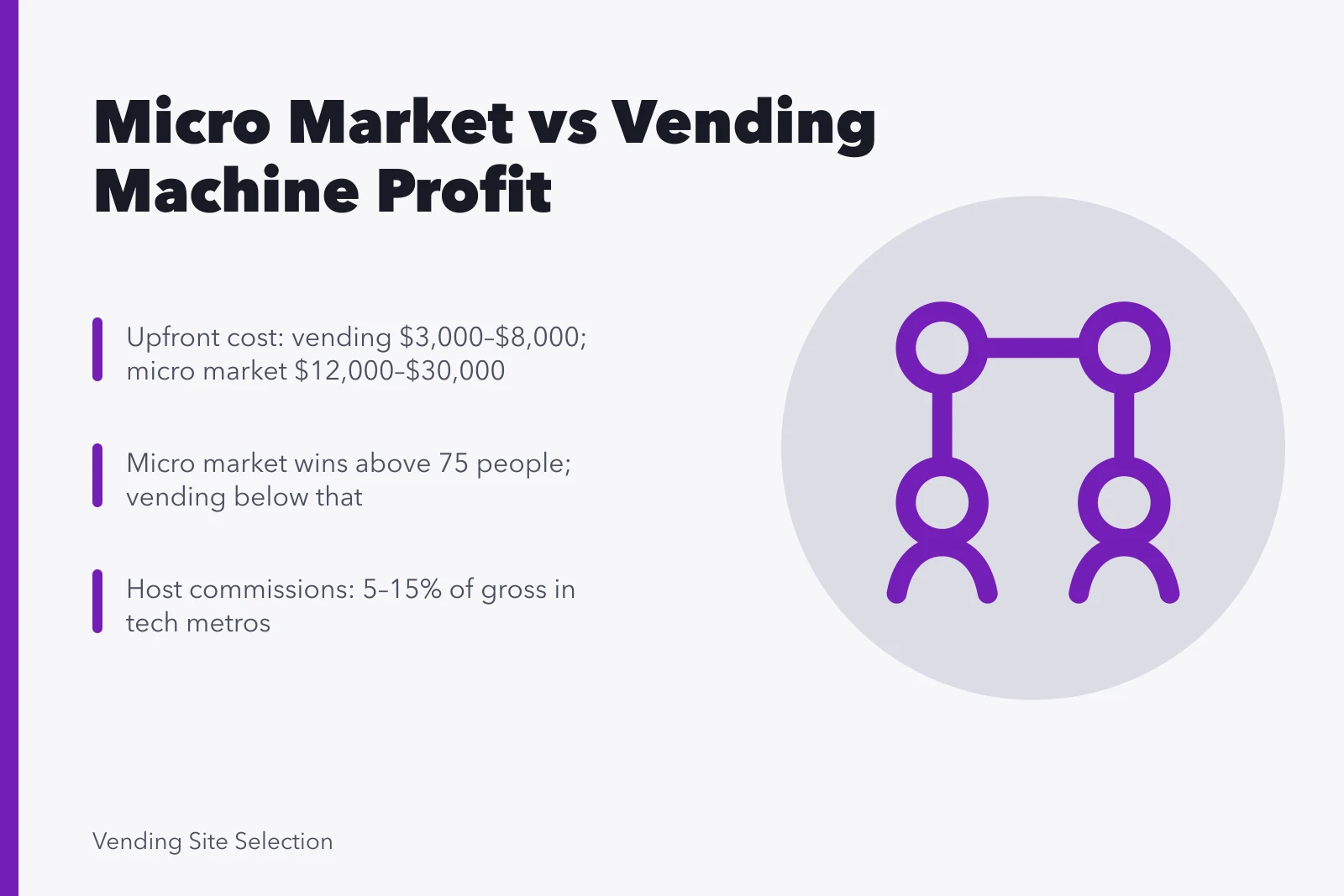
- A micro market wins on revenue per visit in offices above roughly 75 people; vending wins on capital risk below that.
- Gross margin on vending typically runs higher on paper, but micro market baskets are larger, so net dollars per stop often favor the market.
- Host commissions are the swing line. Tech-heavy metros commonly expect 5 to 15 percent of gross, quoted as illustrative ranges here.
- Neither model fixes a bad site. Traffic, dwell time and shift pattern decide the outcome before equipment does.
- Cashless fees apply to both. The Federal Reserve explains the debit interchange cap that shapes those costs in Regulation II.
What is being compared
Two ways to sell snacks and drinks in a US office building. A vending machine is a closed cabinet, one transaction at a time, card or cash. A micro market is an open shelving and cooler setup, usually with a self-checkout kiosk, in a room the client controls.
The comparison is not about which is modern. It is about capital, shrink, labor and what the property will allow. A micro market needs floor space, power and a signed agreement. A machine needs a footprint and an outlet.
The criteria that matter
Vending machine
- Typical upfront cost per location
- $3,000 to $8,000
- Headcount to justify
- 40 to 100
- Product mix
- Packaged snacks, cans, bottles
- Shrink risk
- Low
- Service visits
- Every 1 to 2 weeks
- Host commission
- Often none
- Exit cost if site fails
- Low
Micro market
- Typical upfront cost per location
- $12,000 to $30,000
- Headcount to justify
- 75 and up
- Product mix
- Fresh food, better coffee, produce
- Shrink risk
- Real, needs cameras and audit
- Service visits
- 2 to 3 times per week
- Host commission
- Common, negotiated
- Exit cost if site fails
- High
Costs above are illustrative ranges drawn from operator reporting, not a published index. Your numbers depend on equipment, freight and the room you are given.
Vending vs micro market criteria
Vending machine
- Upfront cost
- $3,000-$8,000
- Headcount
- 40-100
- Product mix
- Packaged snacks
- Shrink risk
- Low
- Service visits
- Every 1-2 weeks
- Host commission
- Often none
- Exit cost
- Low
Micro market
- Upfront cost
- $12,000-$30,000
- Headcount
- 75 and up
- Product mix
- Fresh food
- Shrink risk
- Real
- Service visits
- 2-3 times per week
- Host commission
- Common
- Exit cost
- High
Option by option
Vending suits a site where the client will not sign a multi-year agreement or give up a room. It also suits a first location, because the downside is bounded. You can move a machine in a truck.
Micro market suits a site with a captive, predictable population that stays on campus for lunch. The economics depend on basket size. A worker who buys a sandwich, a drink and a snack spends more in one visit than a machine can capture across a week.
The product mix is the hard part. Fresh food has a shelf life measured in days. If you cannot rotate it, you are throwing away margin. That is a route discipline problem more than a sales problem, and the same discipline shows up in inspecting vending machine service quality.
Where each one wins
Vending is the right answer for a 50-person office, a building with no spare room, or a client that wants zero paperwork. It is also right when the site is unproven and you want to test traffic before committing capital.
Micro market suits a 200-person tech campus with badge access and a break room. The facilities manager wants the space to look current.
Commission expectations in those metros run higher. Property managers often treat the market as an amenity they can advertise. The negotiation playbook is in working with US property managers, HOA and REIT vending.
A micro market is a small retail store with a lease. Treat it that way before you sign anything.
Where the numbers actually separate
Run the arithmetic on a 150-person office. A vending pair might turn $1,200 a month at a 45 to 55 percent gross margin. A micro market in the same room might turn $4,000 to $6,000 at a 30 to 40 percent margin after shrink and spoilage.
Monthly revenue and margin
- Vending revenue$1,200
- Vending margin45-55%
- Micro market revenue$4,000-$6,000
- Micro market margin30-40%
The market wins on gross dollars. It loses on margin percentage, and that gap is what confuses operators reading trend pieces. The SBA guidance on calculating startup costs is a reasonable framework for stress-testing both.
Labor is the second gap. A market needs restocking two or three times a week plus audit. That is route density, and density is what makes or breaks the model in spread-out metros, a problem covered in route density in Houston, Atlanta and Phoenix.
What none of them solve
Both models share one limitation: neither creates demand that is not already there. If the office empties on Fridays, or half the staff works remotely, revenue falls regardless of format.
Neither model fixes a bad lease either. A micro market agreement with a commission floor can lose money in a soft quarter, and a vending machine in a low-traffic corridor just sits. Site selection comes before format, every time.