Guides
Vending machine cashless payment fees: interchange, markup and monthly charges
Explains the fee layers in US vending machine cashless payments: debit and credit interchange, processor markup, per authorization and monthly charges, and examples.
What to take away
- Total card fees on a US vending ticket usually land between 5 and 10 percent of the sale, or about $0.27 to $0.75 on a $2 to $5 vend.
- The federal debit interchange cap is $0.22 plus 0.05 percent of the ticket, with a possible 1 cent fraud adjustment.
- Credit interchange has no cap and varies by card reward level and network schedule.
- Processor markup, per-authorization fees, gateway fees, and monthly charges sit on top of network fees.
- A Chicago operator on a $2.00 debit vend may pay about $0.27; a Phoenix operator on the same vend with a rewards credit card may pay $0.35 or more.
A posted processing rate of 2.6 percent plus 10 cents is rarely the whole cost. A cashless vending transaction carries several fee layers.
Card network interchange fees
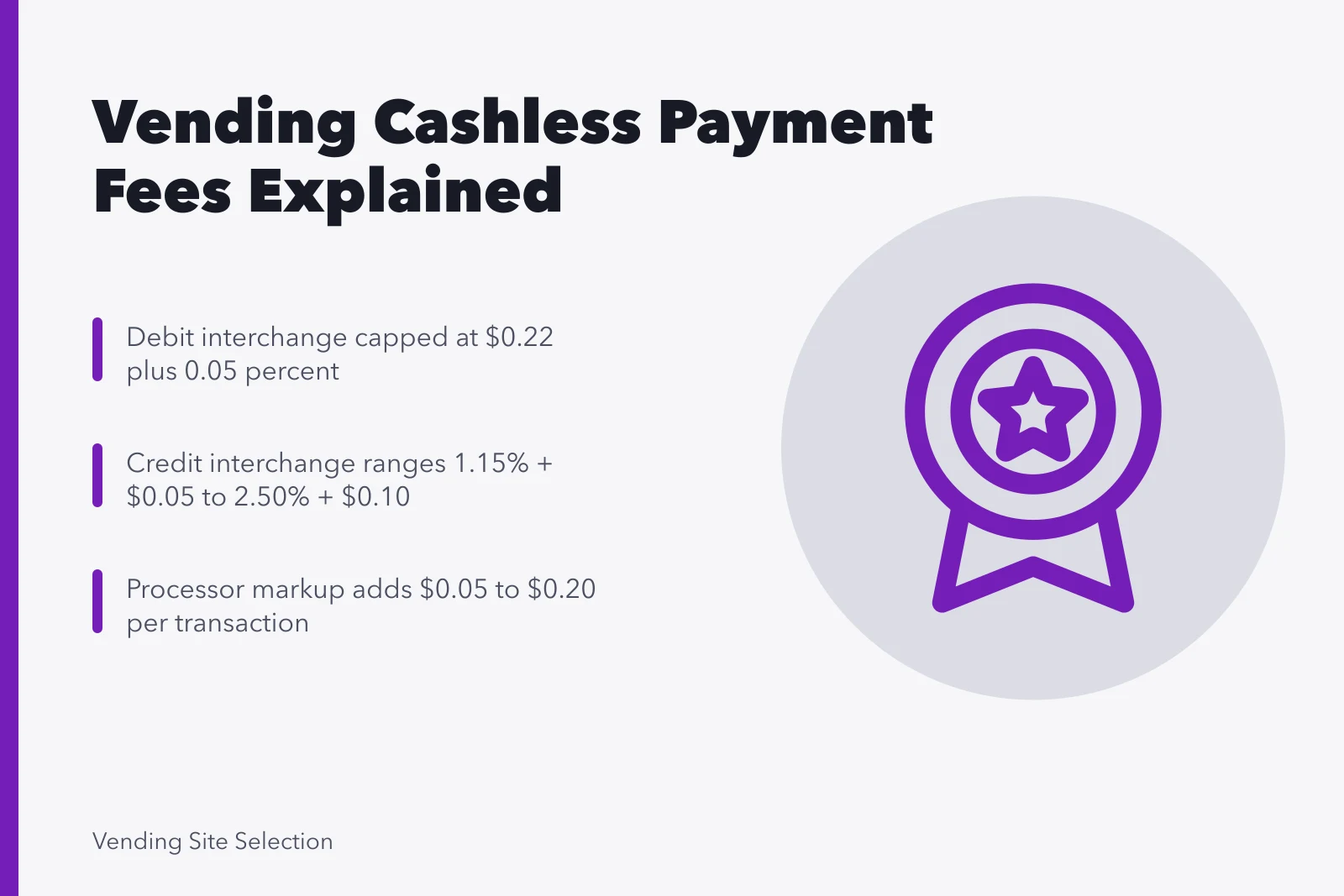
When a customer taps a card, the issuing bank takes an interchange fee. For debit cards, the Federal Reserve caps the fee under Regulation II. The cap is $0.22 plus 0.05 percent of the ticket, with an extra 1 cent allowed for fraud prevention. Learn more from the Federal Reserve. Credit cards have no federal cap.
Each card network publishes an interchange table. Higher rewards cards cost more than basic cards. A card-not-present vending transaction often runs from 1.15 percent to 2.50 percent of the ticket plus a flat fee, based on published network schedules. The exact rate depends on the card brand, the merchant category code, and the processor's table version.
Processor markup and account fees
The processor adds a markup on top of interchange and assessments. A common markup is $0.05 to $0.20 per transaction, but some processors use a flat percentage with no per-transaction fee.
Monthly charges are fixed, so they apply even in a slow month. Typical ranges:
- Account fee
- $0 to $25 a month.
- PCI compliance
- $0 to $12.95 a month, or $99 to $129 a year.
- Gateway
- $0 to $25 a month.
- Statement fee
- $0 to $10 a month.
Flat-rate pricing is published. Square lists 2.6 percent plus 10 cents for card-present payments. Stripe Terminal lists 2.7 percent plus 5 cents. On a $2.00 vend those all-in rates come to $0.152 and $0.104.
The general structure of card processing fees is explained on the payment card page. Card brand assessments often add 0.13 to 0.15 percent on Visa and Mastercard.
Example: a $2 vend in Chicago and Phoenix
Consider a $2.00 cold drink sale. In Chicago, if a customer uses a basic debit card, the interchange is $0.22 plus $0.001, or $0.221 before fraud adjustment. Add a processor markup of $0.05 and a per-authorization fee of $0.00 or $0.05. Total card fees run about $0.27 to $0.32.
In Phoenix, a rewards credit card on the same $2.00 vend might pay 1.65 percent plus $0.10, or $0.133, before processor markup. With a $0.15 markup and a $0.05 authorization fee, the total reaches $0.333. A $5.00 energy drink with a high-rewards card can exceed $0.75.
An operator who sees a 4 percent total fee on a $2.00 vend should check the fee math against priced examples.
The invoice line items
A processor invoice for a vending route shows the line items below. Figures are typical ranges for a $2 to $5 ticket.
Invoice line items: low to high
Line item
- Debit interchange
- $0.22 + 0.05%
- Credit interchange
- 1.15% + $0.05
- Processor markup
- $0.05
- Per-auth/gateway fee
- $0.00
- Monthly/PCI allocated
- $0.00
Low
- Debit interchange
- + 1 cent fraud
- Credit interchange
- 2.50% + $0.10
- Processor markup
- $0.20
- Per-auth/gateway fee
- $0.10
- Monthly/PCI allocated
- $0.06
High
- Debit interchange
- Credit interchange
- Processor markup
- Per-auth/gateway fee
- Monthly/PCI allocated
| Invoice line item | Low | High | Billing |
|---|---|---|---|
| Debit interchange | $0.22 | $0.25 | Per transaction |
| Credit interchange | 1.15% | 2.50% | Per transaction |
| Card brand assessment | 0.13% | 0.15% | Per transaction |
| Processor markup | $0.05 | $0.20 | Per transaction |
| Per-authorization fee | $0.00 | $0.10 | Per transaction |
| Gateway fee | $0.00 | $25.00 | Per month |
| PCI compliance fee | $0.00 | $12.95 | Per month |
| Statement or account fee | $0.00 | $25.00 | Per month |
Many operators read only the stated processing rate and miss the per-authorization fee.
A $2.00 debit card vend with no gateway fee may show $0.23 interchange, $0.05 markup, and $0.00 authorization. A $5.00 rewards card vend may show $0.15 interchange, $0.20 markup, and $0.10 authorization.
State tax is not in the table. Read about sales tax by state.
What moves the number
Three drivers change the total on an invoice. First, ticket size matters. A $5 vend pays a larger interchange dollar amount, but the fixed per-authorization fee becomes a smaller share of the sale. Second, card mix matters. Debit cards carry the Reg II cap, while premium credit cards carry higher interchange.
Third, processor pricing model matters. Interchange-plus pricing passes through actual network costs plus a stated markup, while flat-rate pricing may hide a higher effective rate on small tickets. A fourth driver is monthly volume. Some processors lower the markup at 5,000 or more transactions per month. Chargeback and retrieval fees also add cost when a cardholder disputes a vend.
At a university stop, students may use low-fee debit cards; at an airport or hotel lobby, business travelers often carry premium credit cards. The same machine can show a 1.5% effective fee at one stop and 3.0% at another.
Route software that reports cashless mix by stop helps an operator see which locations drive high-fee cards. For a side-by-side view, see three tools compared.
How to lower the fees
Ask for interchange-plus pricing once monthly volume is known. At 5,000 card transactions a month, a markup of $0.20 per transaction can often be negotiated down to $0.05 or $0.10.
Bundle the fixed charges. Ask the processor to waive the gateway fee or cut the PCI compliance fee when the monthly account fee is above $10.
Watch card mix by stop. Debit cards carry the Reg II cap, so a stop with mostly debit traffic pays less than a hotel lobby with premium credit cards.
Check the effective rate each month. Divide total card fees by card sales for the route and compare stops.