
Guides
How to price vending machine services with site economics
Learn how to price vending machine services with a per-visit viability test, contribution per vend and measured reviews of price changes.
What to take away
- Contribution per vend is not profit. Multiply it by vends per visit before you compare it to the cost of the trip.
- A site clears its own cost when V x blended exceeds S. Run that test before you renegotiate a price.
- Commission and the card percentage both scale with the price, so a rise hands part of itself to the host and the processor.
- The fixed card fee per transaction does not scale. It bites hardest on your cheapest items.
- Judge a price change on units times retained, not on revenue.
The per-visit test
For a small operator, how to price vending machine services starts with a per-visit viability test. Two numbers decide whether a machine deserves its place on the route. V is the vends between visits at that machine. S is what one visit costs you: driving time, labor, vehicle.
Does this visit pay?
Is V x blended greater than S?
The machine clears its visit cost
The machine costs more than it returns
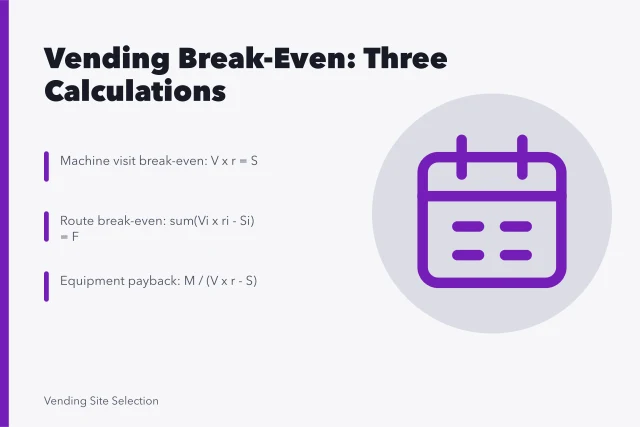
A visit clears its own cost when V x blended is greater than S. Nothing else on this page matters as much as that inequality.
It explains what raw sales figures hide. A machine can sell steadily and still cost more to serve than it returns, if the service interval is short or the drive is long.
What one vend leaves behind
Start with the price p and the delivered cost per usable unit d. Subtract the host commission, which is a rate K applied to gross. Then subtract the card fees on the share of vends paid by card.
What one vend leaves
- Start with price p
- Subtract delivered cost d
- Subtract host commission K x p
- Card sale: subtract f x p and q
- Blend by card share c
A card sale retains p minus d minus (K x p) minus (f x p) minus q. Here f is the processor's percentage and q is the fixed fee per transaction.
A cash sale retains p minus d minus (K x p). Blend the two by the card share c to get the figure the visit test uses.
Why the blend punishes cheap items
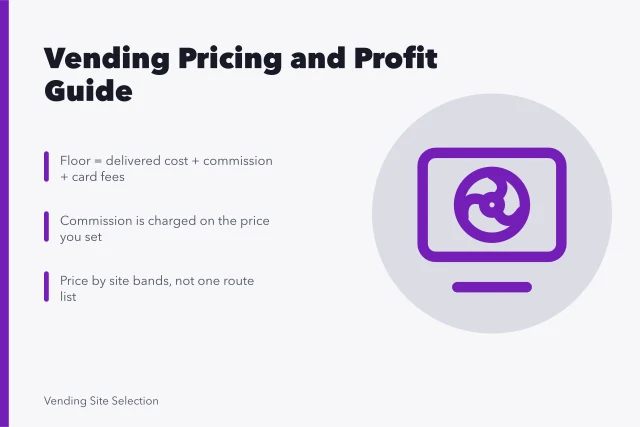
Both K and f scale with the price you set. Raise a price and you hand a slice of the rise to the host and another to the processor. What you keep is smaller than what you charged.
Percentage vs fixed fees
Percentage fees (K, f)
- Scales with price
- Yes
- Effect of price rise
- Slice goes to host and processor
- On cheap items
- Small share
- Example
- Commission and card percent
Fixed fee (q)
- Scales with price
- No
- Effect of price rise
- Unchanged
- On cheap items
- Large share of retained
- Example
- Chips at $1 vs sandwich at $4
The fixed fee q behaves differently. It does not scale at all. On a low-priced item it is a flat subtraction, and as a share of what is left after cost of goods it can be large.
That is an argument about mix as much as about price. A bag of chips at a dollar carries the same q as a sandwich at four.
Three remedies when the test fails
Raise the price, if the site's alternatives allow it. Fix the mix so the same V produces more contribution. Or stretch the interval, which lowers S per period and requires par levels that support the longer gap.
Three remedies when the test fails
- Raise the price if alternatives allow
- Fix the mix for more contribution
- Stretch the interval to lower S
- Pick one and measure it
Pick one and measure it. Changing price and mix together tells you nothing about either.
Setting the opening price at a new machine
You have no V yet, so the opening list is an estimate. Structure it.
- Compute the zero-contribution floor as (d + c x q) / (1 - K - c x f), where c is the share of vends paid by card. Nothing goes below it.
- Find the nearest alternative to the buyer and what it charges. Ask the host, then walk the area yourself.
- Set the opening price between the floor and that alternative. Sit closer to the alternative where the site is choice-rich, further from it where the site is captive.
- Write down the V you expect, so the review has something to measure against.
- Review after three cycles with real numbers.
Step four is the one operators skip. It is what turns a review into a measurement instead of an opinion.
Testing a price change properly
Change one price at a time. Let V0 be units per period before and V1 after, with retained amounts r0 and r1. Keep the change when V1 x r1 exceeds V0 x r0.
Revenue can rise while that product falls. That is how a price increase becomes a quiet loss.
Give it enough cycles to see past normal variation. Where demand is seasonal or shift-driven, compare like periods rather than consecutive ones.
What sits outside the vend price
Contribution per vend has to cover more than the visit. Vehicle costs, insurance, storage and telemetry lines sit above it. Repairs and expiry also sit above it. So does your own time when you are not driving.
For a driver's wage in your area, use the U.S. Bureau of Labor Statistics: Occupational Employment and Wage Statistics Tables. It gives estimates by occupation and metropolitan area, which is the right input for S.
For everything else, your own invoices are the source. Sales and expense records are part of what the Internal Revenue Service: What kind of records should I keep? guidance expects a business to hold.
Sales tax affects how the price reads to the buyer, because tax inside the vend price looks different from tax added on top. Your state revenue department sets that answer, and it belongs with your other licensing and tax answers.
Talking to the host about price
A price change moves the host's commission, so treat it as a conversation. Name the input that moved. Hosts accept a supplier cost increase far more readily than a bare price rise.
Read the agreement first. Some require consent to a change. If you make comparative claims about your prices while pitching, the standards for truthful and substantiated advertising apply, as set out in the Federal Trade Commission: Advertising FAQs: A Guide for Small Business.
Where a site's economics do not work at any price the buyers will pay, renegotiate the commission or move the machine. That is a site question rather than a pricing question, and it is the one operators avoid longest.
Common questions
What margin should I aim for on a vend?
There is no correct figure, and any percentage quoted in an article ignores your commission rate, your card fees and your drive time. The version you can answer is whether V x blended clears S at that machine with enough left to cover the costs above the route. Run it on your own inputs.
Should every machine on the route carry the same prices?
A small number of price bands, grouped by what the buyer's alternative is, captures most of the benefit without a list nobody can maintain. Identical prices everywhere is simpler and leaves money on the table at both ends.
Does going cashless simplify the arithmetic?
It simplifies operations more than arithmetic. You lose coin handling, the change float and the machine that swallows a coin, and you gain f and q on every transaction. Whether that trade is good depends on your price points and your card share, both of which you can measure.
If you are still setting up the route, measure before committing, and keep the product mix decision in view, since it moves d and the fixed fee's bite together.