Guides
Working with US HOAs, REITs and property managers on vending agreements
How vending agreements are signed in US buildings by HOA boards, REIT asset managers and landlords, with insurance proof, approval timelines and contract terms.
What to take away
- Three different people sign vending agreements in the United States: an HOA board, a REIT asset manager, or a landlord and their property manager.
- Each wants a different contract shape. HOAs want a short term and a way out. REITs want a national form and insurance on file. Landlords want indemnity and clean removal.
- A certificate of insurance comes before installation, and most hosts want additional insured status on it.
- Approval runs from about a week with a single owner to a full quarter with a REIT.
- Commission rarely decides the deal. Response time, paperwork and an exit clause do.
Who signs the vending agreement in a US building
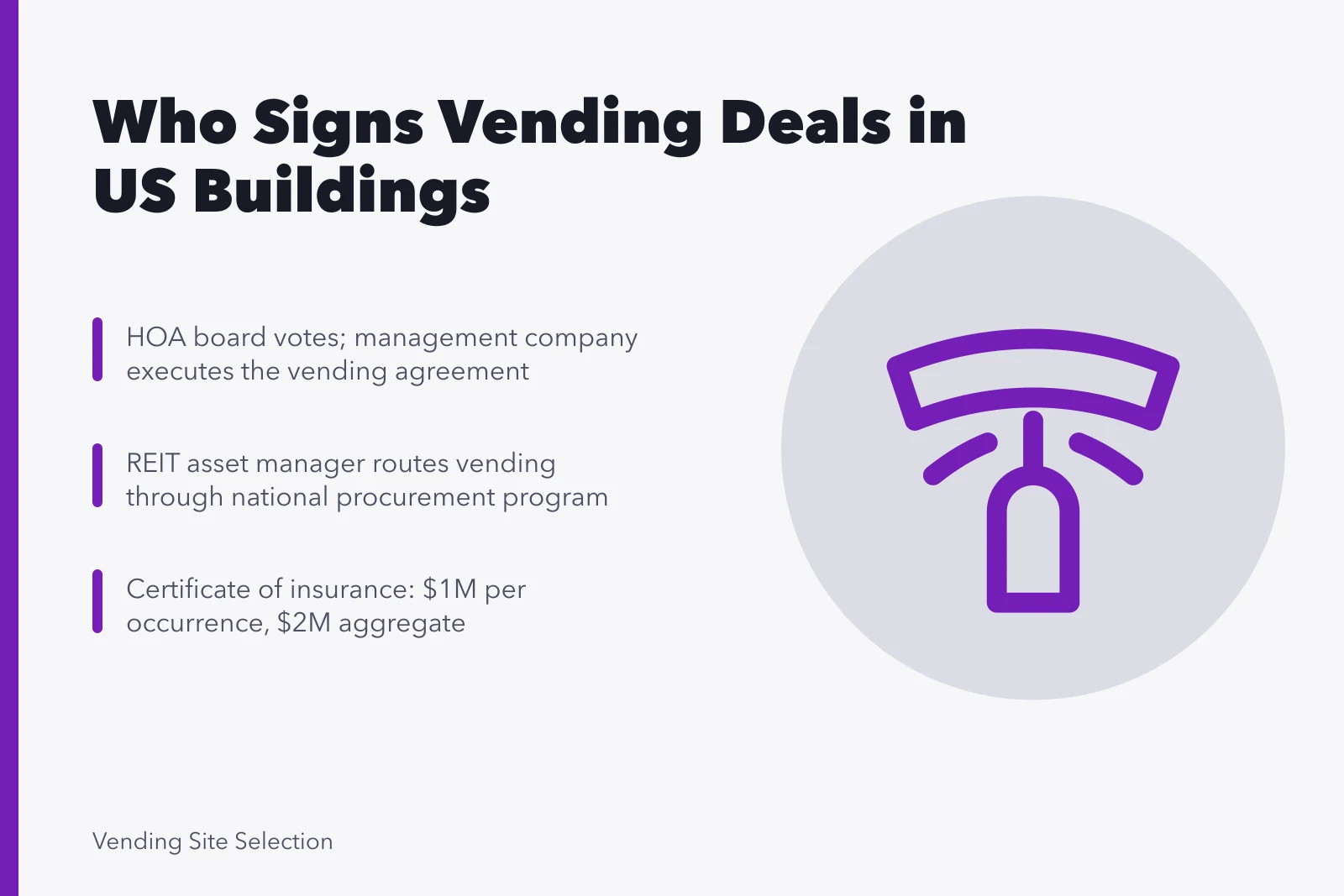
Find the signer before you pitch. In a condominium or planned community, the HOA board holds authority over common areas. The board votes and the management company executes.
Who signs the vending agreement
What type of property is this?
HOA -> board votes, management executes
REIT -> asset manager or procurement decides
In a REIT property, the asset manager or an outside management firm decides. National portfolios often route vending through a procurement program rather than the building office.
In a plain commercial building, the owner or managing agent decides. A small landlord decides alone. A larger one delegates to a property manager with a spending threshold.
You can usually read the type off the leasing office, the signage and the entity name on the lobby directory.
This matters because insurance limits, contract forms and approval calendars differ by type. A pitch built for a landlord falls flat in front of a volunteer board.
What each host type requires in a vending contract
HOA requirements center on control and reversibility. Boards want a defined term, often one year with renewal, a termination right on notice, and language that the association is not liable for the machine or its contents.
Boards also want to know who handles spills, who handles refunds, and who to call at 9 p.m. Put a named contact and a response window in the agreement.
REIT requirements lean toward standardization: a national vendor agreement, insurance certificates held centrally, background checks for service technicians, and sales or commission reporting.
REITs also care about appearance. Machines must match a cabinet or color standard, and some restrict exterior signage entirely.
Commercial landlord contracts vary most. A single owner operator may accept a one page letter of agreement. An institutional landlord may hand you a twenty page license.
Across all three, the same points come up. These include term, termination, insurance and indemnity. They also include equipment ownership, utilities and commission. Getting your placement agreement right the first time saves a renegotiation later.
What each host type requires
HOA
- Typical term
- 1 year, renewable
- Termination
- 30 to 60 days notice
- Insurance proof
- Certificate to board
- Commission
- Small or none, often a donation
- Appearance rules
- Cabinet color, noise limits
- Reporting
- Annual or on request
REIT
- Typical term
- 1 to 3 years, national form
- Termination
- Per portfolio agreement
- Insurance proof
- Certificate to risk management
- Commission
- Percentage of gross or fixed fee
- Appearance rules
- Brand and cabinet standard
- Reporting
- Monthly or quarterly sales report
Commercial landlord
- Typical term
- 1 to 5 years
- Termination
- 30 to 90 days notice
- Insurance proof
- Certificate to property manager
- Commission
- Percentage of gross
- Appearance rules
- Signage and placement rules
- Reporting
- Monthly commission statement
Insurance proof and accessibility before installation
Landlord insurance expectations start with general liability. Most US landlords want at least one million dollars per occurrence and two million in the aggregate, with the landlord named as additional insured.
Insurance proof before installation
- General liability$1M per occurrence
- Aggregate$2M
- Landlord named as additional insured
- Certificate of insurance from carrier
- Endorsement page showing wording
- Umbrella and workers comp for REITs
- ADA reach ranges and clear floor space
A certificate of insurance is standard. It comes from your carrier and lists the named insured, limits, policy dates and the additional insured endorsement.
Many landlords will not accept the certificate alone. They want the endorsement page or the policy showing the additional insured wording. Send both.
HOAs usually ask for the same general liability limits and rarely more. Some ask that the association be named as additional insured for common area claims.
REITs often set higher limits and may require umbrella coverage, workers compensation proof, and auto liability if your driver services the site. National vendors keep these on file and refresh them at renewal.
If your machines sell food or refrigerated product, expect questions about product liability. The FDA sets vending machine labeling rules for certain food items, so keep labels current and refer product questions to the manufacturer.
Accessibility is a placement question, not only a paperwork one. Vending machines sit in places of public accommodation, and the ADA Title III regulations govern reach ranges, clear floor space and operable parts. A machine wedged into a tight alcove can fail that test. The ADA guidance and resources page answers the questions that come up in public areas.
Budget for coverage before you sign anything. Real numbers live in insuring a vending machine business, and a landlord can tell when an operator is guessing.
Approval timelines by property type
Timelines are the biggest source of lost deals. Operators treat a maybe as a yes and stop working the pipeline.
Approval timelines by property type
- DaysSmall landlord or single owner
- 2-4 weeksProfessional management company
- 4-8 weeksHOA board
- 1-3 monthsREIT
A small landlord or single building owner can approve in days. The chain is one person, sometimes two if a spouse or partner is involved.
A professional management company usually takes two to four weeks. The manager recommends, the owner approves, and the license goes to counsel.
An HOA board usually takes four to eight weeks. Boards meet monthly, and a vending proposal may need to reach the agenda, clear a committee, then face a vote at the following meeting.
A REIT can take one to three months or longer. The building contact recommends, procurement reviews, legal reviews, and insurance is verified before a national agreement issues.
Plan around the slowest path. While a REIT decision is pending, keep other vending machine location types moving.
How to pitch an HOA board versus a REIT asset manager
An HOA pitch leads with residents. Board members are volunteers who answer to neighbors, so frame the machine as an amenity rather than a revenue deal.
Pitching HOA vs REIT
HOA board
- Lead with
- Resident amenity
- Bring
- One-page summary
- Key questions
- Noise, lighting, trash
- Offer
- Short trial term
REIT asset manager
- Lead with
- Numbers and risk
- Bring
- Capability sheet
- Key questions
- Coverage, install speed, insurance
- Offer
- Consolidate several buildings
Bring a one page summary: what goes in, where it sits, who services it, what residents pay, and how complaints are handled. Offer a short trial term.
Expect questions about noise, lighting, loitering and trash. Offer to place the machine away from units and keep the cabinet in a neutral color.
A REIT asset manager wants numbers and risk. They manage a portfolio, so they ask how many properties you can serve, how fast you install, and what your insurance limits are.
Bring a capability sheet: coverage area, machine types, service frequency, reporting format, and references at comparable properties. Say plainly that you can consolidate several buildings under one agreement.
Do not oversell a single building. A vendor who can serve ten properties is more useful to an asset manager than one who can serve one.
A short written proposal serves both audiences. A quote template with pricing examples keeps the numbers consistent when you pitch several boards in the same month.
Commission and placement terms that close
Commission structures vary by host type and traffic. In an office building, a percentage of gross sales paid monthly with a statement is common.
Terms that close vending deals
- Term covers equipment cost, not too long
- Mutual termination for cause
- Equipment ownership stays with vendor
- Right to remove and restore space
- Utilities responsibility stated
- Commission and term in writing
Apartment communities often prefer a flat monthly or annual fee over a percentage, because the amount is predictable and easy to budget.
REITs may want commission netted against a service fee or paid quarterly through accounts payable. Ask how their AP process works before you promise a payment schedule.
Terms that close share a few traits. The term runs long enough to recover your equipment cost and short enough that the host does not feel locked in.
Termination for cause is mutual. If the machine is down for an extended period, the host can end the agreement. If the site becomes unsafe, you can pull the equipment.
Equipment ownership stays with you. Say so plainly, and include a right to remove the machine and restore the space at the end of the term.
Utilities deserve a line. If the machine draws from a host outlet, state who pays. Most hosts absorb a small electrical draw, but a bank of refrigerated machines is a different conversation.
Get commission and term in writing before installation. A verbal agreement with a building engineer will not survive a management change.
Following up without burning the relationship
Follow up on the host's calendar, not yours. If the board meets on the second Tuesday, your follow up belongs the week before, not the day after you sent the proposal.
Keep a tracking sheet with these fields:
Follow-up tracking sheet fields
- Property
- Contact
- Type
- Date sent
- Next action
- Decision date
One follow up per cycle is enough. Two emails and a call in the same week reads as pressure to a volunteer board.
When a host says no, ask what would change the answer. Sometimes it is price, sometimes placement, sometimes a competing contract that expires next year.
Keep the file. Management companies rotate staff, boards turn over at annual meetings, and a polite note six months later often lands with a new decision maker.
A steady, patient sequence is how operators win more vending machine location partners without wearing out the ones they already have.
If you are adding machines and need financing, the SBA guidance on how to Plan your business is where the documentation starts.
Treat every host as a long term relationship. One apartment community can refer you to the management company that runs twenty more.
Worked example: a 180 unit HOA community
A 180 unit apartment community in a suburban market is managed by a board that meets monthly. You pitch in March and the board adds you to the April agenda.
The board approves in April with a one year term, a flat monthly fee, and one million dollars in general liability with the association named as additional insured. Installation happens in May. First contact to machine on the floor runs about ten weeks.
Use that as your baseline. A deal moving faster means you are probably talking to a landlord. A slower one means a REIT.
- Confirm who signs vending contracts before pitching
- Match the contract form to the host type
- Send certificate of insurance and additional insured endorsement
- Verify placement meets ADA reach and clear floor space
- Set the follow up date on the host's meeting calendar
- Put commission, term and termination in writing before installation
Common questions
Do HOAs usually allow vending machines in common areas?
Many do, if the board approves and the contract limits the association's liability. Some declarations restrict commercial activity, so read the governing documents before you pitch.
What insurance limits do REITs typically require?
One million dollars per occurrence and two million in the aggregate is a common floor, often with umbrella coverage and additional insured status for the ownership entity.
How long does a vending contract with a commercial landlord take?
A small owner can approve in days. A professional management company usually takes two to four weeks once the proposal reaches the owner.
Should I offer a percentage of sales or a flat fee?
Offices and retail sites usually accept a percentage of gross. Apartment communities and HOAs often prefer a flat monthly or annual fee for predictable budgeting.
Do I need a separate agreement for each building in a portfolio?
Not always. One agreement with a schedule of properties is common with REITs and large management companies, with each site listed as an exhibit.