Guides
The real cost of insuring a vending machine business
Vending machine insurance costs depend on machine count, site type and limits, so here are the coverage lines, the premium drivers and the questions to ask.
What to take away
- Insuring a vending machine business starts around a few hundred dollars a year for one unattended machine.
- A twenty machine route with a vehicle and an employee commonly lands in the low thousands.
- The drivers are machine count, site type, route stock value, vehicle use, payroll and the limits you choose.
- Most hosts want a certificate before installation. Some want to be named as an additional insured on the general liability policy.
- The two gaps operators find late are stock inside the machine and the machine itself while it sits in a van.
- Ask every broker for the same limits and deductibles. Otherwise the quotes are not comparable.
What a policy actually costs
The ranges below are the ones brokers work from. Treat them as illustrative and confirm with your own broker.
| Operation | Typical annual premium |
|---|---|
| General liability, small route | $300 to $1,200 |
| Commercial auto, per vehicle | $1,000 to $2,500 |
| Workers compensation | Priced per $100 of payroll by class code, and your state sets the rate |
| Stock and inland marine | $150 to $600 |
| Crime and money | $100 to $400 |
| Total example, 20 machines, one van, one employee | $2,000 to $6,000 |
Typical annual premium by operation
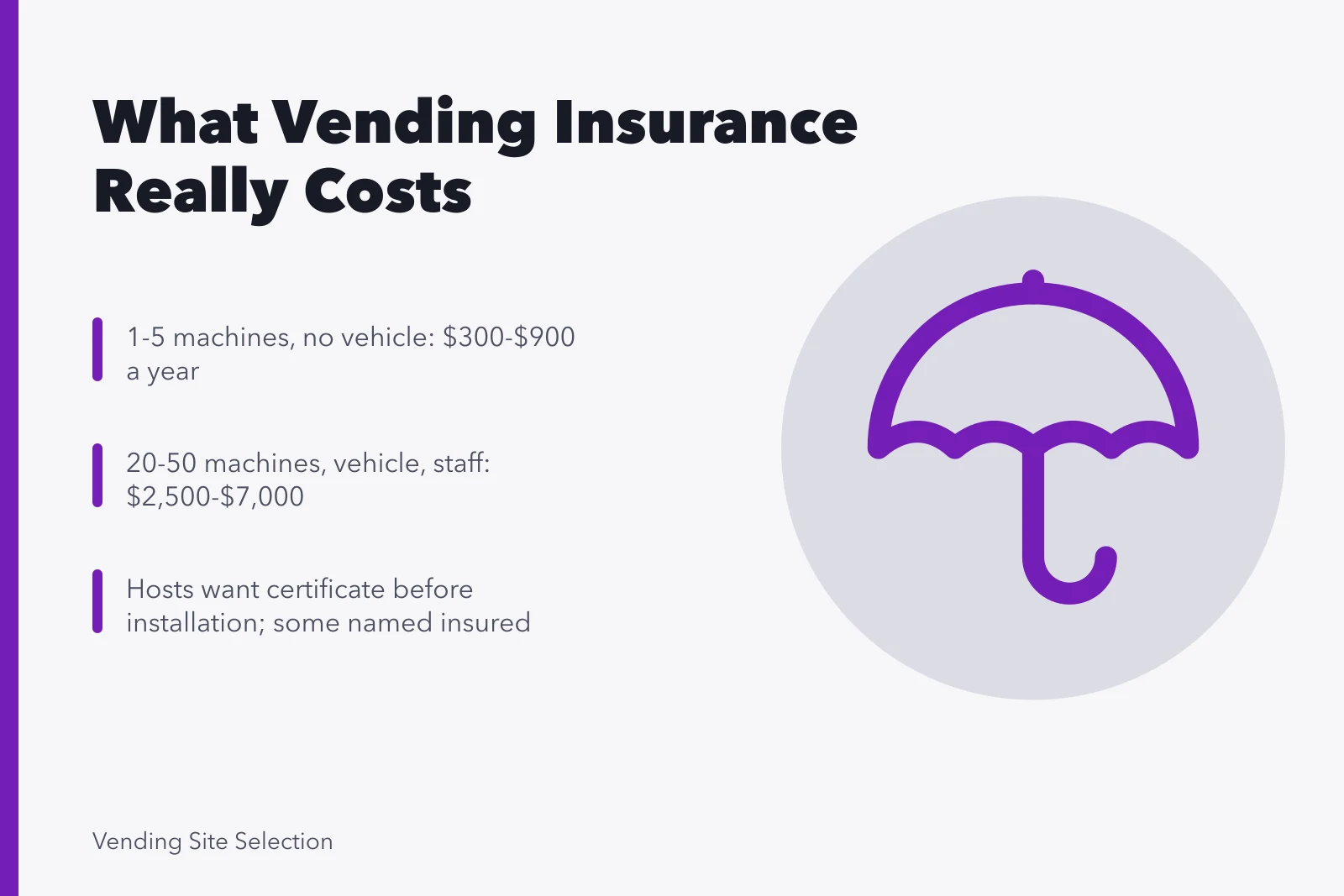
- 1-5 machines, no vehicle$300-$900
- 6-20 machines, one vehicle$900-$2,500
- 20-50 machines, vehicle and staff$2,500-$7,000
- 50+ machines, multiple vehicles and staff$7,000+
Line by line, general liability often runs $300 to $1,200 a year for a small route. Commercial auto often runs $1,000 to $2,500 a year per vehicle. Workers compensation is priced per $100 of payroll by class code, and the rate is set by your state.
Stock and inland marine cover commonly runs $150 to $600 a year on a small route. It is priced on the peak value sitting in the machines and in your storage. Crime and money cover commonly runs $100 to $400 a year. It is priced on the cash you hold on site and in transit.
A worked example: 20 machines, one van and one employee. General liability $300 to $1,200. Commercial auto $1,000 to $2,500. Stock and inland marine $150 to $600. Crime $100 to $400. Workers compensation on payroll. Typical total: $2,000 to $6,000 a year.
Deductibles drive comparability. General liability typically carries a $0 to $1,000 per event deductible. Inland marine and property cover typically carry $250 to $1,000 per machine, or a $500 to $2,500 per event deductible. Ask your broker which basis applies before you compare two quotes.
General liability is usually the smallest line. It is often the one the host demands first.
Commercial auto is frequently the largest single line once a route vehicle is on the policy. A personal auto policy will not respond to business use.
Workers compensation is priced on payroll and class code. Your state sets the rate, not the broker. Ask your state workers compensation agency what applies to you.
For general liability and commercial auto, small business carriers such as The Hartford, Hiscox and Next Insurance are starting points. A vending route with machines off your premises often needs an inland marine endorsement or a specialty program through a broker.
The National Association of Insurance Commissioners lists every state insurance department. The Independent Insurance Agents & Brokers of America can point you to a local independent agent.
The covers a vending route carries
General liability responds to a third party injured by your operation. Examples include a machine that tips, someone hurt while using it, or damage to the host's wall during installation. This is the certificate most hosts ask for.
Coverage lines on a vending route
- General liabilitythird-party injury, host certificate
- Product liabilityinjury from sold products
- Commercial property or inland marinethe machines
- Stock coverproduct in machine and storage
- Crime or money covercash lost in transit
Product liability usually rides inside general liability. It responds to injury caused by something you sold. Ask whether it covers products you did not manufacture, and how it stacks with the manufacturer's own cover.
Commercial property or inland marine covers the machines. This line decides more claims than any other. A machine at a third party site is not automatically covered by a standard property policy. Ask how machines off your premises are treated, and how one is treated while it is in the van.
Stock cover handles the product in the machine and in your storage. It looks small per machine and adds up across a route. Spoilage after a refrigeration failure or a site power loss is a separate peril and may not be included.
Crime or money cover handles cash lost in transit or on site. Price it before deciding a cash heavy route does not need it.
The wording questions that decide claims
Wording questions that decide claims
- How are machines at third party sites described? Is there a per site limit as well as an overall one?
- Is theft from a machine covered? Does the wording require forcible entry?
- Is vandalism covered? Is graffiti treated separately?
- Is spoilage covered? Does it require a mechanical failure rather than a site power outage?
- Is the machine covered while in transit between sites?
- Is the deductible per machine or per event?
- What conditions apply to how machines must be anchored or locked?
That last one is easy to breach. An anchoring condition is a condition, not a suggestion, and the security measures at each site may have to change to satisfy it.
Wording questions that decide claims
- How are third-party site machines described?
- Is theft covered, and does it require forcible entry?
- Is vandalism covered, and graffiti separately?
- Is spoilage covered, and does it require mechanical failure?
- Is the machine covered in transit?
- Is the deductible per machine or per event?
- What anchoring or locking conditions apply?
What hosts ask for before installation
Most placement agreements require proof of insurance before equipment arrives. Ask three questions at the agreement stage, not the day before delivery.
What hosts ask before installation
- What limits do you require?
- Must you be named as additional insured?
- Which policy carries the additional insured?
- Does the certificate come from insurer or broker?
- To whom is the certificate sent?
What hosts ask for
- What limits does the agreement require, and what certificate form does the host accept?
- Does the host require to be named as an additional insured, and does it require a waiver of subrogation?
- How much notice must you give before a cancellation, and who receives the certificate?
Hospitals, school districts and public bodies set their requirements and rarely negotiate. Knowing them early keeps a signed agreement from waiting on a policy change. Fold this into the licensing and documentation you already collect so it is ready when a host asks.
Getting quotes you can compare
Give every broker the same packet:
Quote packet for every broker
- Machine count and type
- Site types
- Unattended overnight runs
- Equipment replacement value
- Average route stock value
- Vehicle details
- Payroll and claims history
- Legal entity name, address and years in business.
- Machine count, model and value per machine.
- Site types and addresses or descriptions.
- Peak stock value in the machines and in storage.
- Vehiclesyear, use, annual mileage and drivers.
- Payroll by employee and class code.
- Current declarations page and three years of loss runs.
- Limits, additional insured and waiver wording each host requires.
Then ask each to quote identical limits and deductibles. A cheaper quote at a lower limit is not cheaper. Ask each broker what they excluded that the others might not have. The answers are usually candid.
Where insurance stops and compliance starts
A policy pays after a loss. It does not satisfy an obligation that exists on its own.
Accessibility is the clearest case. A machine in a place of public accommodation must meet the approach and operable parts requirements in the U.S. Department of Justice: 2010 ADA Standards for Accessible Design. The U.S. Department of Justice: ADA Guide for Small Businesses explains what is expected of small businesses in existing facilities.
Food safety works the same way. Your state or county health department decides whether your machines are permitted, what temperature records apply, and what to discard after a power loss. The U.S. Food and Drug Administration: State Retail and Food Service Codes and Regulations directory names the agency to call.
Check what licenses and permits your operation needs alongside the insurance, since hosts often ask for both in one email. Settle both before you place your first machine. If you stock refrigerated items, tell the broker, because it changes both the product decisions and the cover.
Common questions
How much does vending machine insurance cost?
A single unattended machine often runs a few hundred dollars a year. A twenty machine route with a vehicle and an employee commonly lands in the low thousands. Your broker can firm that up in a day once they have your machine count, site types and limits.
Do I need workers compensation for one part time helper?
That depends on your state's threshold and how the person is classified. Both are questions for your state workers compensation agency or your broker. Do not assume from another state's rule.
Is the host's insurance enough?
No. The host's policy protects the host. Your machines, your stock, your liability and your vehicle are yours to insure. The placement agreement will normally say so.
What should I do first after damage or a theft?
Make the machine safe, tell the host, photograph everything before you touch it, and notify the insurer within the period the policy requires. That notice period is a condition. Missing it can cost the claim regardless of the merits.