Guides
Vending machine sales tax by state: 3-state comparison
Vending machine sales tax by state varies. Compare California, Texas, and New York on food exemptions, resale certificates, registration, and local tax.
What to take away
- State revenue agencies set the core vending machine sales tax obligation, while municipal permits and private location contracts add separate layers.
- California, Texas, and New York treat vending machine food differently for exemptions and reduced rates.
- A resale certificate lets operators buy inventory tax-free; without it, tax paid on stock cannot be recovered as a credit.
- Failing to register and collect state sales tax can lead to tax assessments, penalties, and permit revocation.
- Most state seller permits issue online in minutes, but municipal food or vending licenses can take weeks.
A vending operator who fills a machine in Sacramento, Austin, or Albany faces different tax questions even though the sale looks identical. The United States has no national sales tax, and each state writes its own rules for vending machine sales tax by state, including exemptions and registration duties.
Who sets the tax rules
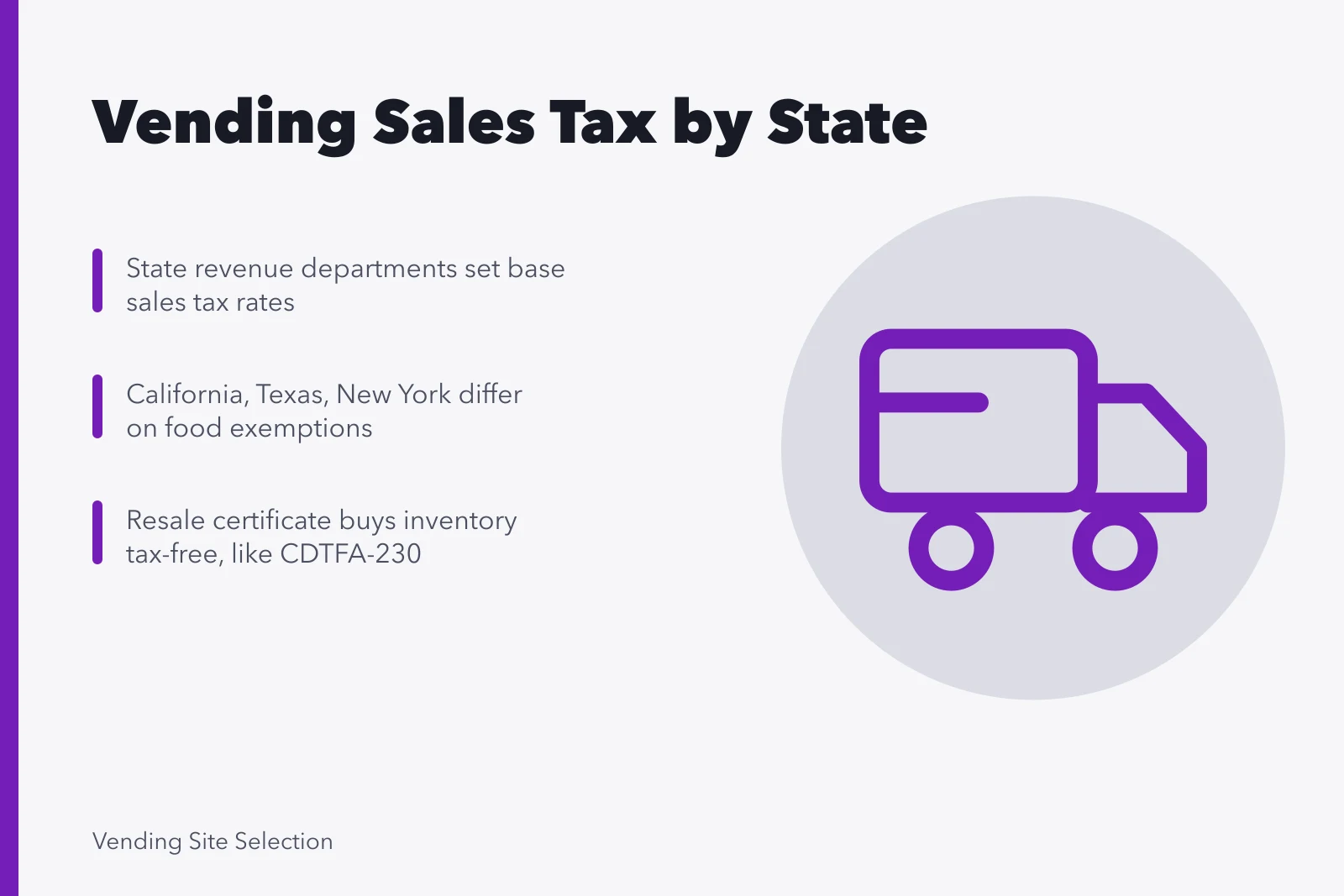
State revenue departments set the base sales tax rate and decide whether vending machine food is exempt or taxable. The rules for the vending machine tax exemption differ from one state to the next. Municipalities often add local sales tax in states that allow it, and they issue vending or food establishment permits. Private location contracts can state who reports the sale, but a private agreement cannot override state tax law. Operators working in Los Angeles, New York, or Chicago should review the vending machine permits in Los Angeles, New York and Chicago article for the municipal layer.
What triggers a sales tax obligation
A taxable retail sale through a machine triggers the obligation to collect and remit state sales tax. Buying inventory wholesale triggers the need for a resale certificate. Selling to a nonprofit or government buyer may require a state exemption certificate from that buyer. If a location owner supplies the machine or shares revenue, the private contract may create a lease arrangement, but the operator who sets prices and fills the machine usually remains the seller. This is where a vending machine lease vs buy decision can affect recordkeeping.
What to submit for exemptions and resale
Use these steps to avoid paying tax twice on the same inventory.
Resale and exemption steps
- Register for a seller's permit online
- Complete a resale certificate for supplier
- Keep permit and exemption forms four years
- Retain point-of-sale records by machine
- Register with the state revenue agency before the first sale. California issues a seller's permit through the California Department of Tax and Fee Administration. Texas issues a permit through the Comptroller using Form AP-201. New York issues a Certificate of Authority through the Department of Taxation and Finance.
- Give your supplier a resale certificate so inventory is bought tax free. California uses CDTFA-230, Texas uses Form 01-339, and New York uses ST-120. The certificate carries your permit or certificate number.
- Collect an exemption certificate when the buyer is a nonprofit, school, or government agency. New York exempt organizations use Form ST-119.1.
- Keep every certificate and return on file for the state's record retention period, typically four years. A certificate you cannot produce in an audit is tax you owe.
Without a resale certificate, state sales tax paid on inventory is a business expense. You still owe tax on the final sale. The IRS explains business expense deductions in Publication 535.
Cashless card sales are taxable just like coin sales at the same state vending machine tax rates. The vending machine cashless payment fees article explains what operators pay. The tax base is the charged price, not the amount after processing.
How long registration and approval take
State seller permits typically issue online in minutes or within one business day. Resale certificates are immediate forms you keep on file. Municipal permits vary: a vending machine permit in a large city may take two to six weeks, especially if a health inspection or zoning review is required. Operators who need a food handler card should check local requirements before placing a machine.
What happens if you skip a step
If you operate without a seller's permit in California, the California Department of Tax and Fee Administration can issue a notice of determination for unpaid tax, add penalties and interest, and revoke your permit. In Texas, the Comptroller can estimate your tax based on purchases and file a lien. In New York, the Department of Taxation and Finance can issue a warrant for unpaid tax and penalties. These are not warnings; they are enforceable collection actions.
Example: California, Texas, and New York compared
California, Texas, New York compared
State base sales tax rate
- California
- 7.25% plus district taxes
- Texas
- 6.25% plus local taxes
- New York
- 4% plus local taxes
Vending machine food treatment
- California
- Most vending machine food is taxable; certain bulk vending machine items are exempt.
- Texas
- Most snack and drink sales through vending machines are taxable; resale certificate recommended for inventory.
- New York
- Vending machine food is taxable unless it is sold through a coin-operated machine at $1.50 or less per item, the threshold for the New York coin-operated vending exemption.
Local district taxes apply on top of the state rate, based on where the machine sits. Combined rates typically run 7.25% to 10.75% in California, 6.25% to 8.25% in Texas, and 7% to 8.875% in New York, where New York City sits at the top of the range.
The vending machine food tax rules differ even for the same packaged snack. These state differences also interact with federal labeling rules. See what OSHA and FDA rules mean for vending machine labeling and placement for packaged food before you stock a new item.
Vending food tax by state
California
- State base rate
- 7.25% plus district
- Vending food
- Most taxable; bulk exempt
- Resale certificate
- CDTFA-230
Texas
- State base rate
- 6.25% plus local
- Vending food
- Most snacks taxable
- Resale certificate
- Texas resale certificate
New York
- State base rate
- 4% plus local
- Vending food
- Taxable unless coin exemption
- Resale certificate
- New York ST-120