Guides
The startup budget for a vending machine business and the ways to finance it in 2027
What a vending machine startup costs in 2027, one-off and recurring, plus the finance routes operators use and the costs first budgets miss.
What to take away
- The 2027 startup budget for a vending machine business starts with a snack and drink pair. New runs about $4,000 to $9,000, or $1,800 to $4,500 refurbished, before vehicle and permits.
- The first fill is cash you have already spent. Two machines holding a week of buffer stock tie up more than most first budgets allow.
- Commission, card fees and product cost scale with sales. Fuel, labor and insurance do not, so a slow site costs money.
- SBA Microloans run to $50,000 and SBA 7(a) loans to $5 million. Equipment leases preserve stock cash at a higher total cost.
- The float, a spare bill validator, machine removal and shrink are four lines new operators leave out.
Two buckets, not one
Write one-off cost and recurring cost in separate columns from the first draft. A loan can cover the first. Only sales cover the second. Confusing them is how an operator ends up with three machines and no money to fill them.
One-off vs recurring costs
One-off
- Machine and delivery
- Purchase or lease
- Payment hardware
- Reader and module
- Opening stock
- First fill
- Vehicle
- Purchase
- Registration and permits
- Registration
- Insurance
- —
- Commission and processing
- —
- Labor and repairs
- —
Recurring
- Machine and delivery
- —
- Payment hardware
- Monthly line fee
- Opening stock
- Replaced each visit
- Vehicle
- Fuel, insurance, upkeep
- Registration and permits
- Some annual
- Insurance
- Liability, host terms
- Commission and processing
- Sales share, card fees
- Labor and repairs
- Wages, parts, irregular
| Category | One-off or recurring | What sits in it |
|---|---|---|
| Machine and delivery | One-off | Purchase or lease deposit, freight, placement, any electrical work the site requires |
| Payment hardware and telemetry | One-off, then recurring | Card reader and connectivity module up front, then a monthly line fee |
| Opening stock | One-off in cash terms, then recurring | The first fill for every machine, replaced each visit |
| Vehicle | Either | Purchase or an existing vehicle, then fuel, insurance and maintenance |
| Registration and permits | One-off, some annual | Business registration, any device permit or decal your county requires |
| Insurance | Recurring | General liability at minimum, and whatever the host's agreement obliges |
| Commission to hosts | Recurring | A share of gross sales, per the signed agreement |
| Card processing | Recurring | A percentage plus a fixed amount per transaction |
| Labor | Recurring | Your own time, priced honestly, or a driver's wage |
| Repairs and parts | Recurring, irregular | Bill validators, coin mechanisms, refrigeration, locks |
What the numbers look like in 2027
These are illustrative ranges for planning, not quotes. Equipment prices and local fees move by market and by month. Confirm every line with a supplier before you commit.
2027 startup cost ranges
- $6,000–$12,000Two-machine start, new
- $3,000–$7,000Two-machine start, refurbished
- $4,000–$12,000Used cargo van
- $2,500–$5,000New drink machine, delivered
| Line | Illustrative range |
|---|---|
| New snack machine, delivered | $2,500 to $4,500 |
| New drink machine, delivered | $2,500 to $5,000 |
| Refurbished pair, delivered | $1,800 to $4,500 |
| Card reader and telemetry, per machine | $200 to $400 |
| First fill, snack plus drink | $350 to $700 per machine |
| Connectivity line fee | $5 to $15 per machine per month |
| General liability, small route | $500 to $1,500 per year |
| Business registration and permits | $50 to $500, by state and city |
| Used cargo van, working | $4,000 to $12,000 |
| Float for a cash machine | $100 to $300 per machine, typical |
| Spare bill validator or coin mechanism | $100 to $300, typical |
| Commission to host | Typically 5% to 25% of gross sales |
| Card processing | Typically 2% to 5% plus a small fixed fee per transaction |
A two-machine start lands near $6,000 to $12,000 new. Refurbished units run $3,000 to $7,000. This is before a vehicle. Add a used cargo van at $4,000 to $12,000 and the realistic all-in figure doubles. The order in which to spend matters as much as the total.
Monthly, a two-machine route carries a connectivity fee, card processing, fuel and insurance. Commission and product cost scale with sales. Fuel, labor and insurance do not fall in a slow month.
The model in named inputs
Build the model from inputs you fill from quotes rather than from averages that would be wrong in your market.
One-off outlay formula
- n = number of machines
- M = delivered cost per machine
- I = value of one full fill
- d = fills held at any time
- n x (M + I x d) + vehicle + permits
Let M be the delivered cost of one machine, including payment hardware. Let n be the number of machines. Let I be the value of one full fill. Let d be the number of fills you hold at any time, counting machine stock and home shelf stock. One-off outlay before any sale is:
n x (M + I x d) + vehicle + registration and permit cost
The second term is the one that surprises people. Stock is cash already spent, and it stays spent until the machine sells it.
Monthly cost, once running, is:
commission (K x gross sales) + card fees + fuel + labor + insurance + parts
Only some of that scales with sales. Commission and card fees do. Fuel, labor and insurance do not.
Getting real numbers into it
Ask for quotes rather than reading averages.
Where to get real quotes
- Machine suppliersdelivered price by model
- Payment processorsfull fee schedule
- Distributorscase price divided by units
- BLS metro wage estimates for drivers
- County licensing and state revenue for permits
- Machine suppliers will quote delivered price by model and condition. Get a refurbished and a new quote for the same specification so you can see what the difference buys.
- Payment processors will provide a full fee schedule if asked directly for the percentage, the fixed per transaction amount, and any monthly minimum. Apply it to your own vend prices, not to an average ticket.
- Distributors will quote case prices, and case price divided by units is the input for cost of goods.
- For a driver's wage in your area, use the metropolitan wage estimates published by the U.S. Bureau of Labor Statistics rather than a national average.
- For permit and registration fees, ask the county licensing office and the state revenue department directly. The U.S. Food and Drug Administration: State Retail and Food Service Codes and Regulations directory identifies which state agency oversees retail food, which is where a machine permit question starts.
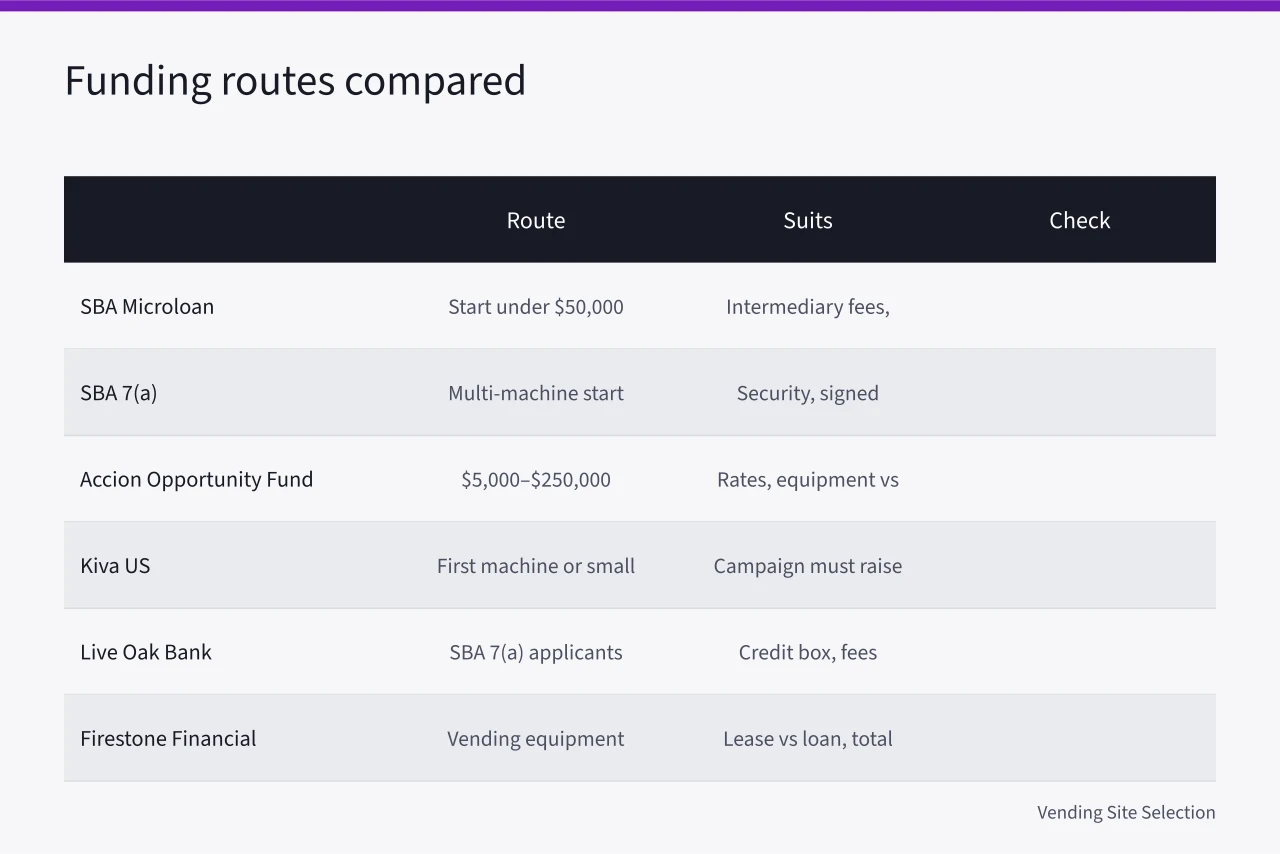
Funding routes for 2027 compared: SBA, Accion, Kiva, Live Oak, Firestone
Funding routes for 2027 compared
Suits
- SBA Microloan (max $50,000)
- A start under $50,000
- SBA 7(a) loan (max $5 million)
- A planned multi machine start
- Accion Opportunity Fund
- Startups and small operators who need $5,000 to $250,000
- Kiva US
- A first machine or a small route, with crowdfunded loans up to $15,000
- Live Oak Bank
- SBA 7(a) applicants who want a national online lender
- Newtek Bank
- SBA 7(a) borrowers who want a smaller loan
- Firestone Financial
- Equipment financing for vending and amusement machines
- Ascentium Capital
- Equipment leases and loans for small business
- Balboa Capital
- Equipment financing for new and used machines
- Personal savings
- A first machine or two
- Bank or credit union term loan
- An operator with trading history
- Equipment lease or finance
- Preserving cash for stock
- Seller financing on a route purchase
- Buying an existing route
- Vendor or distributor credit terms
- Smoothing stock purchases
The thing to check
- SBA Microloan (max $50,000)
- The intermediary's fees and the repayment term
- SBA 7(a) loan (max $5 million)
- What security is required, and whether signed agreements strengthen the application
- Accion Opportunity Fund
- Current rates and whether the lender funds equipment or only working capital
- Kiva US
- The 0% interest and no fee terms are real, but the campaign must raise the loan
- Live Oak Bank
- Whether vending fits its current credit box, and what fees apply
- Newtek Bank
- The rate, guarantee fee and closing costs
- Firestone Financial
- Lease vs loan, total cost over term, and what happens if you move the machine
- Ascentium Capital
- The buyout, the total cost, and any soft cost limits
- Balboa Capital
- The term, the rate factor, and whether used machines qualify
- Personal savings
- Whether you keep enough aside for stock and a repair
- Bank or credit union term loan
- The rate against the SBA option, and any prepayment penalty
- Equipment lease or finance
- The total paid over the term, and what happens if you want to move the machine
- Seller financing on a route purchase
- How much is held back against sites that cancel soon after sale
- Vendor or distributor credit terms
- The terms themselves, and whether they bind you to a supplier
The U.S. Small Business Administration: SBA Business Guide explains the main small business funding paths and what lenders generally ask for. The Internal Revenue Service: Starting a business pages cover how the entity you choose affects your filings. Neither will tell you what a machine costs in your city. Quotes will.
Costs new operators leave out
- The float of coins and small notes a cash machine needs to make change.
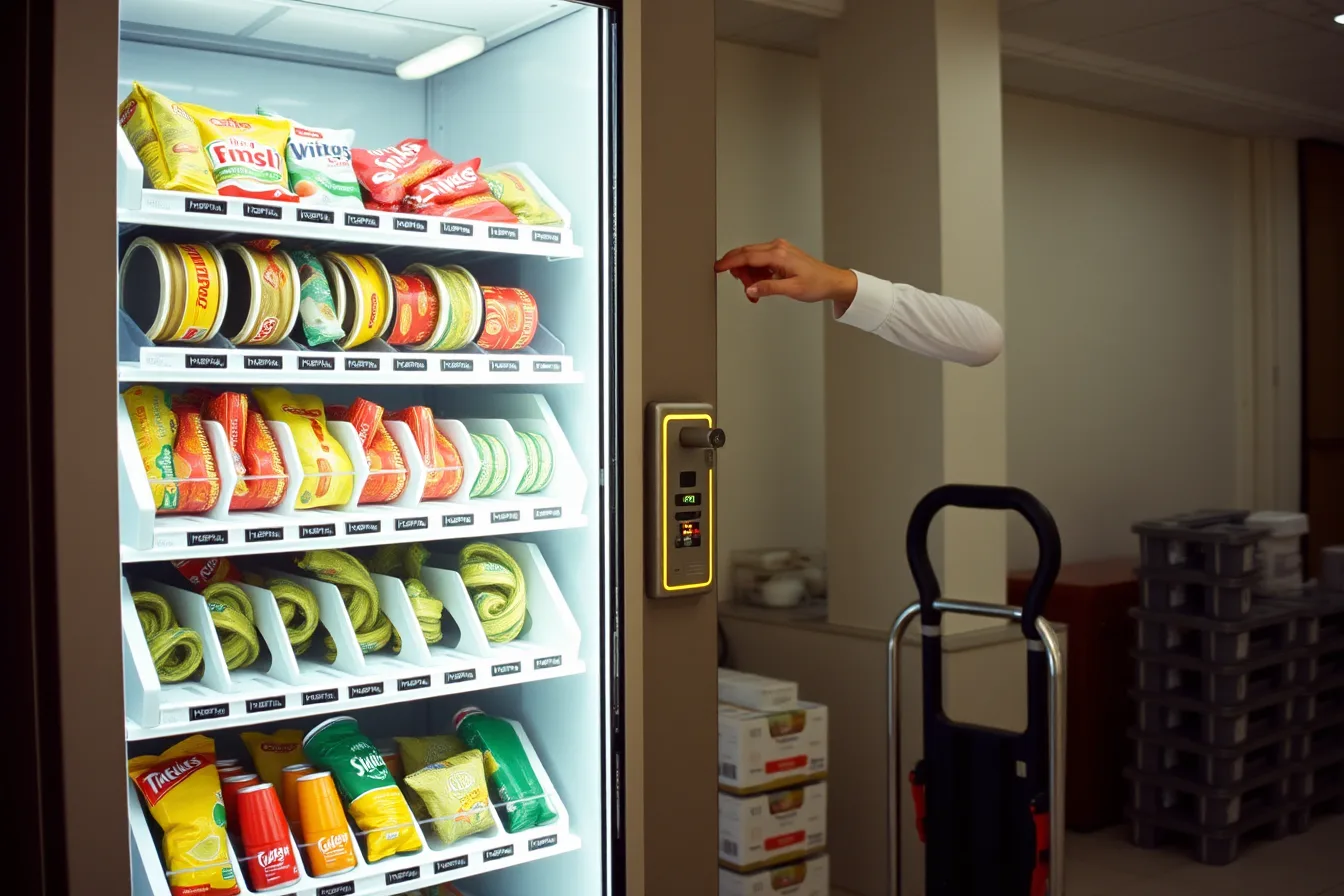
- A spare bill validator or coin mechanism, so a fault does not mean a dead machine for a week.
- The cost of moving a machine when a site cancels, including any lift equipment.
- Shrink: stock that expires, is damaged in the machine, or walks.
- Your own unpaid time in the first months, which is real even when it is not invoiced.
A budget that names these is not more pessimistic than one that omits them. It is a budget rather than a wish.
Costs budgets leave out
- Float of coins and small notes
- Spare bill validator or coin mechanism
- Moving a machine when a site cancels
- Shrinkexpired, damaged or missing stock
- Your own unpaid time in early months
Build it with the written business plan so one set of inputs feeds both. Keep it beside the sourcing decisions that set your cost of goods.
The wider market view explains why the first outlay should follow a signed site. When the route later reaches a new area, expansion costs behave differently again.
Common questions
Is a used machine a false economy?
Not automatically. The question is what parts are available for it and what condition the bill validator and refrigeration are in, because those are the components that fail and the ones that cost most to replace. Ask the seller for the model number and check that parts are still sold before you buy.
How much working capital should sit behind a route?
Enough to refill every machine on the route at least once without new sales coming in, plus one significant repair. That is a rule you can apply to your own numbers rather than a figure to copy.
Can the machine pay for itself before I need more money?
Sometimes, on a strong site. Plan as if it will not. The gap between placing a machine and the first meaningful cash coming back is filled by stock you have already bought. That gap is where undercapitalized routes fail.