Guides
How to think about vending machine expansion
Vending expansion guide: grow in rings rather than leaps, know the capacity of your route in machines per day, and decide when a second area earns a driver.
What to take away
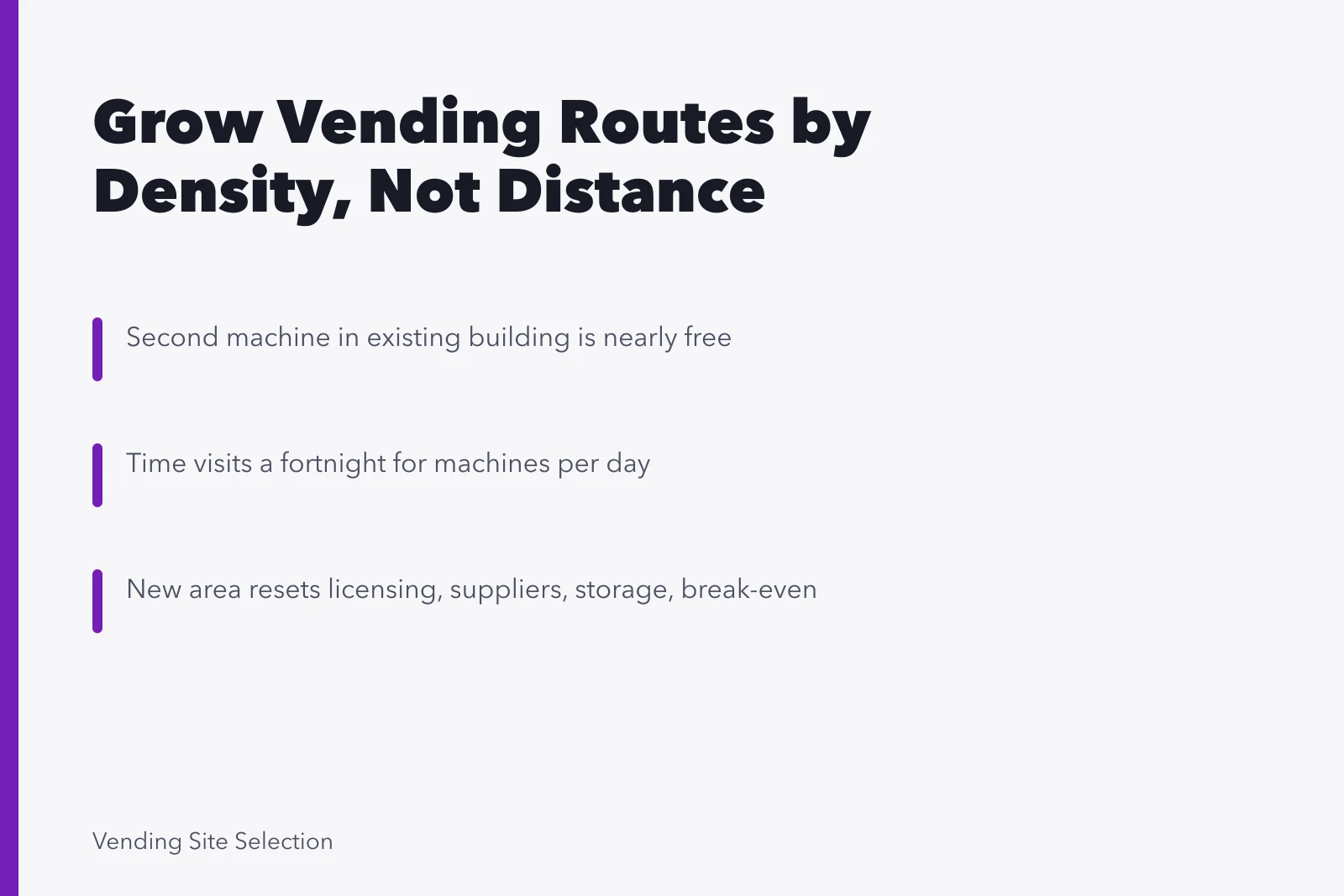
- Expand by density first. A second machine in a building you already serve is worth more than a better site an hour away.
- Know your capacity in machines per day, measured from your own visit times. That number decides everything else.
- A new area is a project with its own licensing, its own suppliers and its own break-even, not a longer version of the route you have.
- The first machine in a new area needs a date by which it must have neighbors.
- Growth that outruns service quality destroys the thing you were selling.
Three kinds of growth, and only one is cheap
Operators talk about growth as one thing. It is three, and they have very different costs.
Three Kinds of Growth
Second machine in existing building
- What it costs to serve
- Minutes on a trip already made
- What it has to cover
- Its own stock and a little handling
New site inside service ring
- What it costs to serve
- One additional stop
- What it has to cover
- The stop, and nothing more
New site outside ring
- What it costs to serve
- A whole journey
- What it has to cover
- The journey, the setup, and time to build a cluster
Adding a machine in a building you already serve is nearly free. The trip is already made, the relationship exists, and the marginal service time is minutes. This is the growth to exhaust before considering anything else.
Adding a machine inside your existing service ring costs a stop. It has to cover that stop and nothing more, which most reasonable sites can do.
Adding a machine outside the ring costs a whole journey, and often a new set of local answers as well. It has to clear a much higher bar, and the mistake operators make is applying the second test to the third case.
Three kinds of growth
What it costs to serve
- Second machine in an existing building
- Minutes on a trip already made
- New site inside your service ring
- One additional stop
- New site outside the ring
- A whole journey, plus local licensing and supply
What it has to cover
- Second machine in an existing building
- Its own stock and a little handling
- New site inside your service ring
- The stop, and nothing more
- New site outside the ring
- The journey, the setup, and the time to build a cluster
Know your capacity before you use it
Capacity is not a feeling. It is a measurement, and most operators have never taken it.
Measure Your Route Capacity
- Time visits for a fortnight
- Record drive time between sites
- Record time inside from parking to leaving
- Record any wait before access
- Divide driving day by average
- Multiply by days worked and service interval
Time your visits for a fortnight: drive time between sites, time inside from parking to leaving, and any wait before access. Divide the driving day you are willing to work by the average, and you have machines per day. Multiply by days worked and by the service interval and you have the size of route one person can hold.
That figure changes every subsequent decision. The next site is affordable if you are below capacity and it is a hiring decision if you are at it. Without the number, the choice gets made on optimism, and the route degrades everywhere at once when the day stops fitting.
Filling the ring properly
Before reaching outward, work the area you already cover.
Ask every existing host whether another machine, or a different type of machine, would be useful. A second machine in a large building often outperforms a new site and costs almost nothing to serve.
Then map the buildings inside the ring you have not approached, sorted by whether people stay in them for hours. Most operators have more prospects inside their existing area than they think, because the list was never built systematically. That is a prospecting exercise rather than an expansion one.
Fixing weak sites is the third form of local growth, and the least glamorous. A machine that fails its own visit test is consuming capacity you could give to a better building.
What a new area actually costs
Entering a new area is a project. Six things reset at the boundary, and only the first is obvious.
What Resets at a New Area
- Drive time
- Licensing and permits
- Supplier coverage
- Storage
- Local product preferences
- Your own time building relationships
Drive time is the visible cost. Licensing and permits reset too, since city and county requirements start again and sometimes state ones do. Supplier coverage can break: a distributor serving your current area may not deliver to the new one, or may set a separate minimum.
Storage becomes a problem once the new area is far enough that carrying stock from home stops working. Local product preferences are real and only discoverable from sales. And your own time goes into building relationships where nobody knows you.
Cost it as a project with a break-even, not as an extension of the current route. Ask what has to be true for it to clear its own costs, and how many machines that implies.
The anchor rule
When a distant site is genuinely worth taking, take it as an anchor rather than as a standalone win.
The Anchor Rule
Is the distant site genuinely worth taking?
Take it as an anchor with a date attached
Leave it alone
An anchor is a first machine in a new area with a date attached: by that date it must have neighbors, or it goes. Writing the date down at the start is what stops a single distant machine becoming a permanent drain on a route that was otherwise dense.
Two or three machines in one new industrial park is a viable second cluster. One machine forty minutes away, serviced for two years because nobody wanted to admit it was a mistake, is the most common shape of a route that has stopped making money.
When expansion means hiring
At capacity, growth stops being a placement question and becomes an employment one.
Costing a First Hire
- Wage estimates by occupation and metro area
- Vehicle
- Insurance
- Cost of your supervising time
- Does the route work when labor is paid?
Model it before committing. Wage estimates by occupation and metropolitan area are published in the U.S. Bureau of Labor Statistics: Occupational Employment and Wage Statistics Tables, which is the right input rather than a national figure. Add vehicle, insurance and the cost of the time you will spend supervising rather than driving.
Then check the harder question: does the route work when the labor is paid? A route that only clears its costs because the owner drives unpaid cannot make this transition, and the honest response is to fix the site mix before hiring rather than after. That arithmetic belongs with your pricing and margin work.
Hiring also brings classification, wage and hour, and record keeping obligations, and they arrive in full on the first day rather than gradually. Settle them before the first pay period.
Compliance resets at the border
The single most avoidable expansion mistake is assuming your current permits travel.
Compliance Questions at the Border
- Ask licensing office about business license or device permit
- Ask county health department about differing requirements
- Ask state revenue department if crossing a state line
- Keep answers dated in your licensing file
Ask the licensing office in the new city or county if a business license or a device permit applies. Ask the county health department if its requirements differ from the ones you meet.
Ask the state revenue department if you cross a state line. Sales tax on vending sales is a state matter, and neighboring states differ.
The U.S. Food and Drug Administration: State Retail and Food Service Codes and Regulations directory names the retail food agency in each state, and the U.S. Small Business Administration: SBA Business Guide covers the general registration steps that may apply again. Keep the answers with your existing licensing file, dated, so it is obvious which area each answer belongs to.
Protecting service while growing
Service quality is the product. A route that spreads faster than it can be served loses sites everywhere, including the good ones you already had.
Guards for Service Quality
- Measure cost per service visit monthly
- Treat a rising figure as an early warning
- Hold to the anchor rule
- Do not take a site you cannot service at the promised interval
Do not take a site you cannot service at the interval you promised, even if the host accepts less. The standard slips quietly and then complaints start.
The practical version of this is that the service routine and the maintenance rhythm both have to survive the new area. If they cannot, the area is not ready to enter.
Other ways to grow that are not new sites
Three options change the size of the business without changing the map.
Different machine types at existing sites: a second machine, a different format, or a change in what the current one holds. This starts with the product decisions rather than with equipment.
Buying an existing route, which converts capital into sites and agreements. The examination to do is on the agreements, their remaining terms, and the seller's service standard, which becomes your reputation on day one.
Raising the return of the route you have, by fixing pricing, commission rates at renewal, and the machines that fail their own visit test. It is the least exciting option and frequently the most profitable one.
Common questions
How far is too far for a single machine?
The distance at which the trip stops being covered by what the machine returns, which depends on your contribution per vend and your service cost rather than on miles. Run it as arithmetic per site: vends multiplied by contribution, against the cost of the journey.
Should I expand into a neighboring state?
Treat it as a new project rather than a longer drive. Licensing, tax treatment and supplier coverage all reset, and the answers take weeks. Where the neighboring area is close and dense, it can be a good move; where it is simply the next thing on the map, it usually is not.
Is buying a route safer than building one?
It is faster and it carries different risks. You inherit agreements that may be near renewal and a service reputation you did not create. Look at how long each site has been in place, when each agreement ends, and how many sites depend on one contact who is leaving.