Guides
The honest guide to vending operators, 2027 edition
Study named vending operators to see how they run routes, price machines and keep sites, then copy the practices that work at your own scale.
What to take away
- The three largest US vending operators are Compass Group's Canteen, Aramark and AVI Foodsystems; each runs a different model you can study.
- Canteen's micro-market format and Coca-Cola's Costa coffee machines show how the big players push cashless, unattended retail.
- Fleet standardization and parts cost decide what a route spends on repairs, and most large operators run one or two machine brands.
- Regional operators like Five Star Food Service and Continental Vending are closer to your scale and easier to copy.
- Every one of them is findable through a machine's fault sticker, a host conversation or a state licensing lookup.
- The list below is US-focused on purpose. It names eight US operators and three outside the US, because US permits and machine stickers are the records a reader here can check.
- Cashless and telemetry sit on most new placements, and micro-markets keep taking share from banks of snack and drink machines.
Why names matter here
An article about vending operators that refuses to name one is useless. You cannot study a practice without knowing who runs it.
The operators below are real, large and public about how they work. Their scale is not yours, but their methods are visible from the front of a machine.
The national operators worth studying in the United States
Canteen, the vending arm of Compass Group North America, is the largest operator in the country. It runs traditional machines, micro-markets and self-checkout kiosks, including the Avanti Markets format. Study Canteen to see how a national account is serviced and how a route is scheduled around a corporate campus.
Aramark, based in Philadelphia, runs vending alongside food service contracts in hospitals, universities and stadiums. Its model is tied to the facility contract, not the machine alone. Study Aramark if you are pitching a building that already buys food service from someone.
AVI Foodsystems, based in Warren, Ohio, is family-owned and runs vending, micro-markets and dining across the Midwest and East. Study AVI to see how a large regional operator still behaves like a local one.
All three compete for contracts a small route cannot win on price. Watch how they keep them instead: service windows, clear reporting and a phone number that reaches a person.
Operators outside the United States
Licensing and contract records are national or provincial, so check the country's own register. Canada is this publication's second market, and the Canadian name here carries the same lesson as the US ones.
| Operator | Market | Format | What to study |
|---|---|---|---|
| Selecta | Europe, headquartered in Switzerland | Vending, coffee and micro-markets | Coffee-led routes run across many countries |
| Costa Express | United Kingdom | Self-serve coffee kiosks in retail sites | Coffee as the whole offer, not an add-on |
| Canteen Canada | Canada, part of Compass Group | Vending and micro-markets | A US operating model run under Canadian rules |
The formats travel. The buying terms and the paperwork do not.
Fleet standardization, parts and payments
Machine brands matter to an operator study for two reasons only: what a standardized fleet costs to keep running, and what parts, readers and software add to the monthly bill.
Crane Merchandising Systems builds the Dixie Narco cold drink line and the National Vendors snack line, the two lines most large US routes standardize on. Parts for those lines are easy to find and most technicians know them.
SandenVendo and Automatic Products cover cold drinks and snacks on other routes. Seaga, based in Freeport, Illinois, sells to smaller operators at a lower entry price. Knowing the brand tells you what parts cost and how long a repair takes.
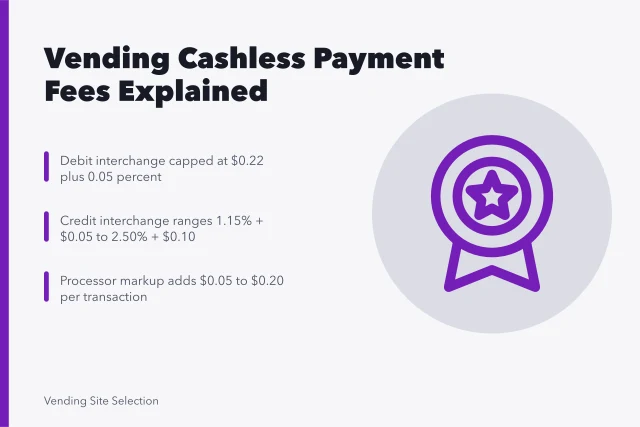
Cashless readers and telemetry usually come from Cantaloupe (the ePort card reader and its Seed software) or Nayax. Micro-market kiosks come from 365 Retail Markets and Avanti Markets. Both tracks carry monthly fees that a small route should price before signing.
Two 2027 shifts sit in this part of the business. Cashless and telemetry now come with most new placements, so a route without them holds no sales data by selection and no par levels. Micro-markets, the unattended self-checkout stores, keep taking share from banks of snack and drink machines at office sites.
Card share depends on the site. A campus or hospital runs high, a plant with a night shift runs lower. At a typical US site with a reader fitted, card sales commonly land between 50 and 70 percent.
Regional operators closer to your scale
| Operator | Base and region | Format | What to study |
|---|---|---|---|
| Five Star Food Service | Chattanooga, serves the Southeast | Vending, micro-markets and coffee | How one route carries three formats |
| Continental Vending | Mid-Atlantic | Vending and office coffee | Service intervals on a dense city route |
| Accent Food Services | Texas | Vending and micro-markets | Filling one large site from one truck |
| Canteen One | National, corporate accounts | Vending for smaller corporate sites | Reporting written for a head office buyer |
| American Food & Vending | Liverpool, New York, serves the Northeast | Vending, micro-markets and dining | How a family-owned route keeps local service |
These are the operators you will meet at a bid. Their route density is closer to yours, so their service intervals and site selection are more useful to copy.
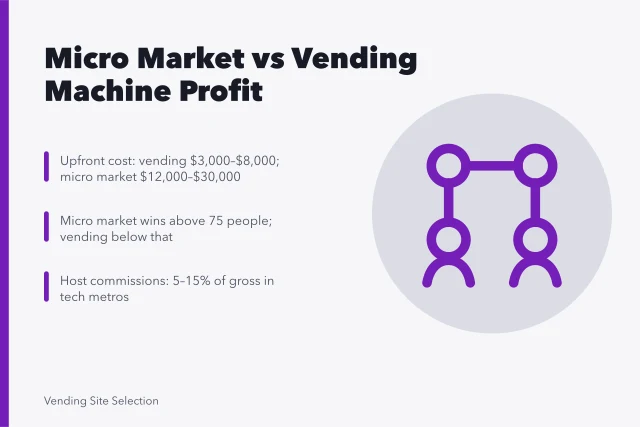
A regional route typically runs a few hundred machines within a couple of hours of its warehouse. Site commissions commonly sit between 5 and 20 percent of gross sales, higher at busy sites.
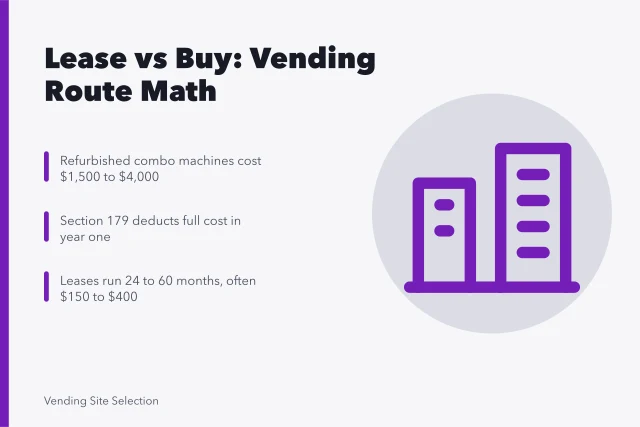
Machine prices vary by brand: a refurbished snack or drink machine typically sells for $1,000 to $3,000, and a new combo unit typically starts near $4,000.
What to look for at the machine
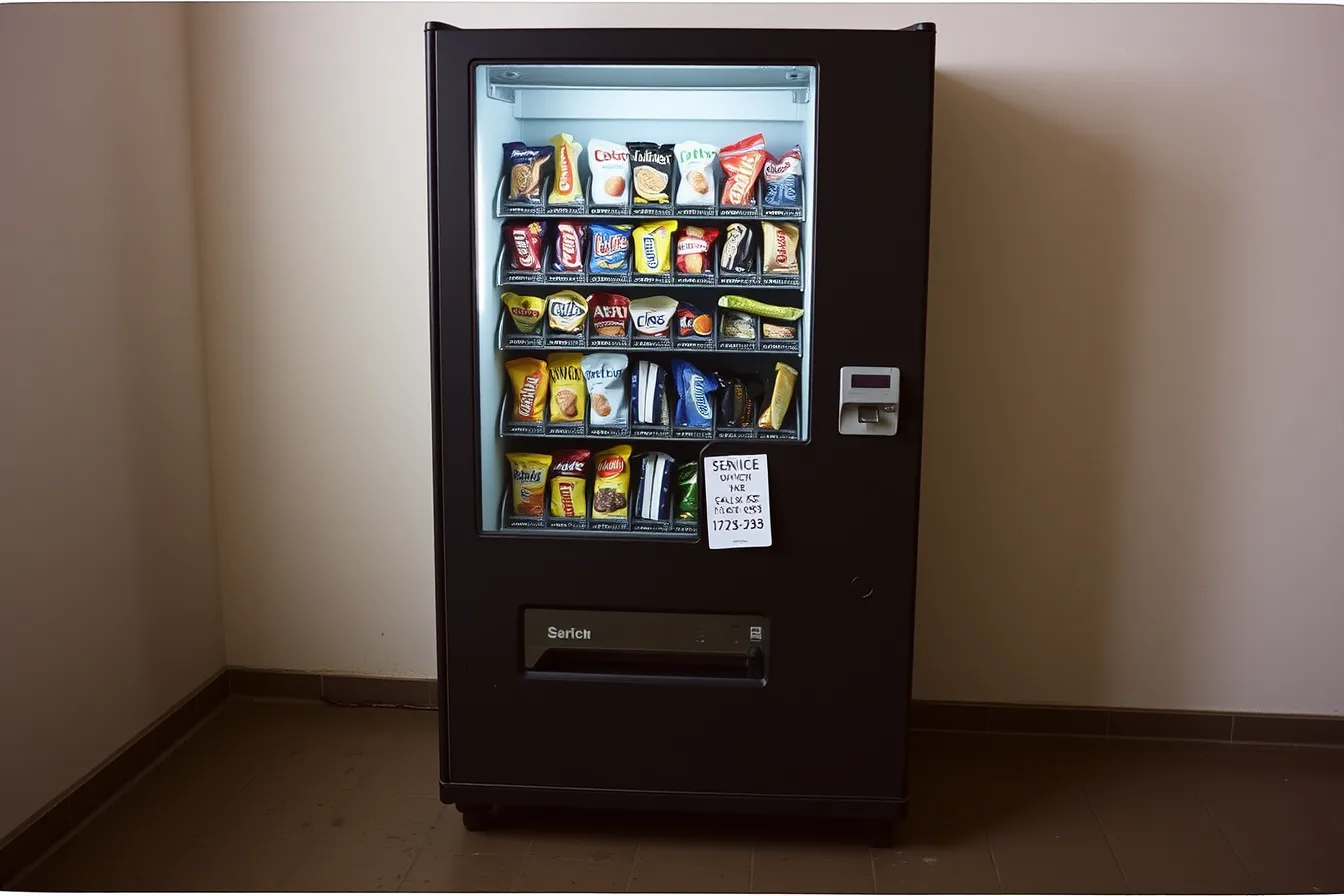
The front of a competitor's machine is a public statement about how the operation is run.
- Is it full at the building's busy hour, or only after a service visit?
- Are the fast selections the ones that are empty, or the slow ones?
- Is the mix chosen for that building, or the same mix you see elsewhere?
- Is the glass clean and the lighting working?
- Are prices legible on every selection?
- Is there a working contact number for faults, and does it look current?
- Is there an out of order note, and how weathered is it?
- Is a card reader fitted, and does it look part of the machine?
- Is the approach clear, or has the site stacked things in front of it?
- Is the machine level, anchored and undamaged?
Take these at two different times. A machine that looks good the morning after a service visit and empty at four in the afternoon is telling you about par levels, not effort.
What to ask a host who has one
Hosts talk, and the questions that get honest answers are specific ones.
- How often does the machine get serviced, and is that what was promised?
- When it breaks, how do you report it and how long does it take?
- Does anyone here complain about it, and about what?
- Do you get a statement, and is it clear?
- Is there anything people ask for that it does not stock?
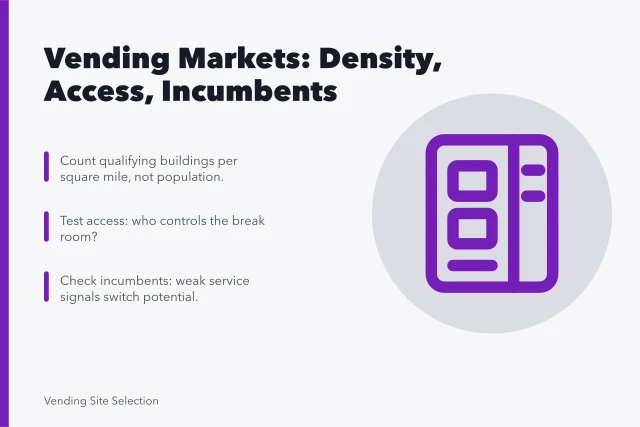
Those five questions also tell you where the incumbent is weak. That is the only useful basis for approaching a building that already has machines.
How the big operators run routes
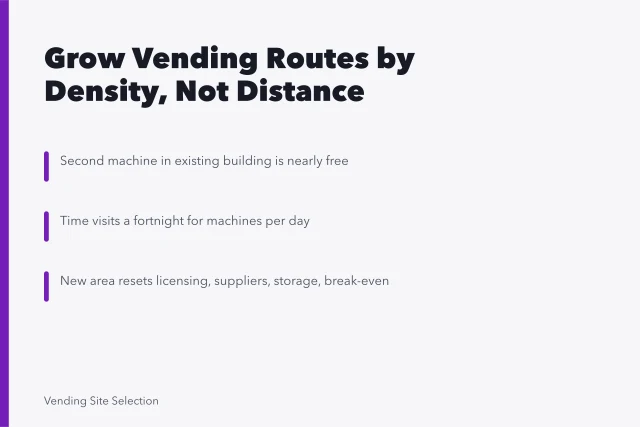
Canteen and Aramark cluster machines in one metro and service them on fixed day routes. Density is the strongest single indicator of a route that makes money. A truck that drives past ten of its own machines on the way to one is losing money on the other nine.
A typical full-line route carries 10 to 12 machines on one truck for a day's service.
Most national operators run a narrow fleet: one or two machine brands, one card reader, one telemetry system. Parts, training and repair calls stay simple. A mixed fleet looks flexible and costs more every month.
They also place a second machine in a site before a first machine somewhere new. That is why they decline sites a small operator would take. Operators who say no to sites they cannot service well are the ones still serving their good sites in five years.
Reading a competitor without copying their mistakes
A large operator's practices are adapted to a large operation, and some do not transfer.
Scale changes the arithmetic on buying terms, machine standardization and unscheduled trip costs.
That comparison belongs with your own route arithmetic, not with what a competitor appears to do.
What does transfer is service discipline. Full at the peak, faults attended quickly, clear statements, honest conversations with hosts. None of it requires scale, and all of it is what keeps sites.
Where to check the numbers yourself
Do not copy a national operator's commission rate or service interval. Work out your own with named variables: stops per day, cost per stop, sales per machine, and the commission rate you can pay before the site stops earning.
For the general business layer, the U.S. Small Business Administration: SBA Business Guide sets out how small businesses are structured, funded and grown. For labor costs when comparing your operation to a larger one, the U.S. Bureau of Labor Statistics: Occupational Employment and Wage Statistics Tables publish estimates by occupation and metropolitan area.
The regulatory position differs by state and shapes how operators work. The U.S. Food and Drug Administration: State Retail and Food Service Codes and Regulations directory names the agency in each state, which is worth checking alongside your own licensing answers.
Industry data comes from NAMA, the National Automatic Merchandising Association, which publishes benchmarks and runs The NAMA Show.
Turning observation into action
Watching competitors is only worth the time if it changes something. Three outputs are reasonable.
A list of buildings with an incumbent whose service is visibly weak, with a note of what is wrong. That is a prospect list, and it beats a list of buildings sorted by size. The approach to those buildings is a service conversation, not a commission offer.
A short list of practices you do not currently follow and could adopt this month. Most are free.
And a note of what people ask for that nobody in your area stocks, which goes straight into your product decisions. If you are still starting out, this observation costs nothing and replaces a great deal of guessing.
Common questions
Should I try to compete with a large operator on commission?
Usually not. Their cost per stop is lower because their machines are denser, so a rate they can sustain may leave you underwater. Compete where scale does not help, which is attentiveness at the individual site.
How do I find out who serves a building?
Look at the machine. Most carry a contact for faults, which identifies the operator. Beyond that, hosts will often say if you ask them plainly, and state licensing records list the permit holder.
Which operators should I study first?
Start with Canteen for national account service and Aramark for contract-led vending. AVI Foodsystems shows a large family-owned model, and Five Star Food Service runs mid-size routes closer to your own.
Is there any value in industry rankings?
Little, for an operator deciding what to do next week. Rankings measure size, and size is not what determines whether your route works. What determines it is density, service and the agreements you hold.
Can I copy a national operator's service schedule?
Only the shape of it. Their intervals are built around dense routes you do not have yet. Set your own from stops per day and the drive time between them, then tighten it as density grows.