Guides
How to find out which licenses a vending machine business needs
Licensing depends on your state, county, city and buildings. Here are the five offices to call, the questions to ask each, and how to record their answers.
What to take away
- No page can list your licenses, because they depend on your state, your county, your city and the buildings you serve.
- Five offices hold the answers. Each one takes a different question.
- Ask for the answer in writing where you can, and record the date and the person where you cannot.
- The two answers that most often change a plan are the food permit position and the sales tax treatment.
Why the honest answer is a phone list
Search for this question and you will find confident lists. They are confident because they are generic, and a licensing question cannot be generic.
State retail food agency call questions
- Are packaged shelf stable snacks regulated?
- What changes if the machine is refrigerated?
- Is permit per machine, site or operator?
- Do I need a commissary or storage?
- What records and inspections apply?
One state licenses machines individually, another licenses the operator, and a third does neither for packaged snacks but does for refrigerated food. Cities add their own layer on top, and a hospital or school district adds a fourth that is contractual, not legal.
So the deliverable here is not a list of licenses. It is a call sheet that gets you your own list in about a week.
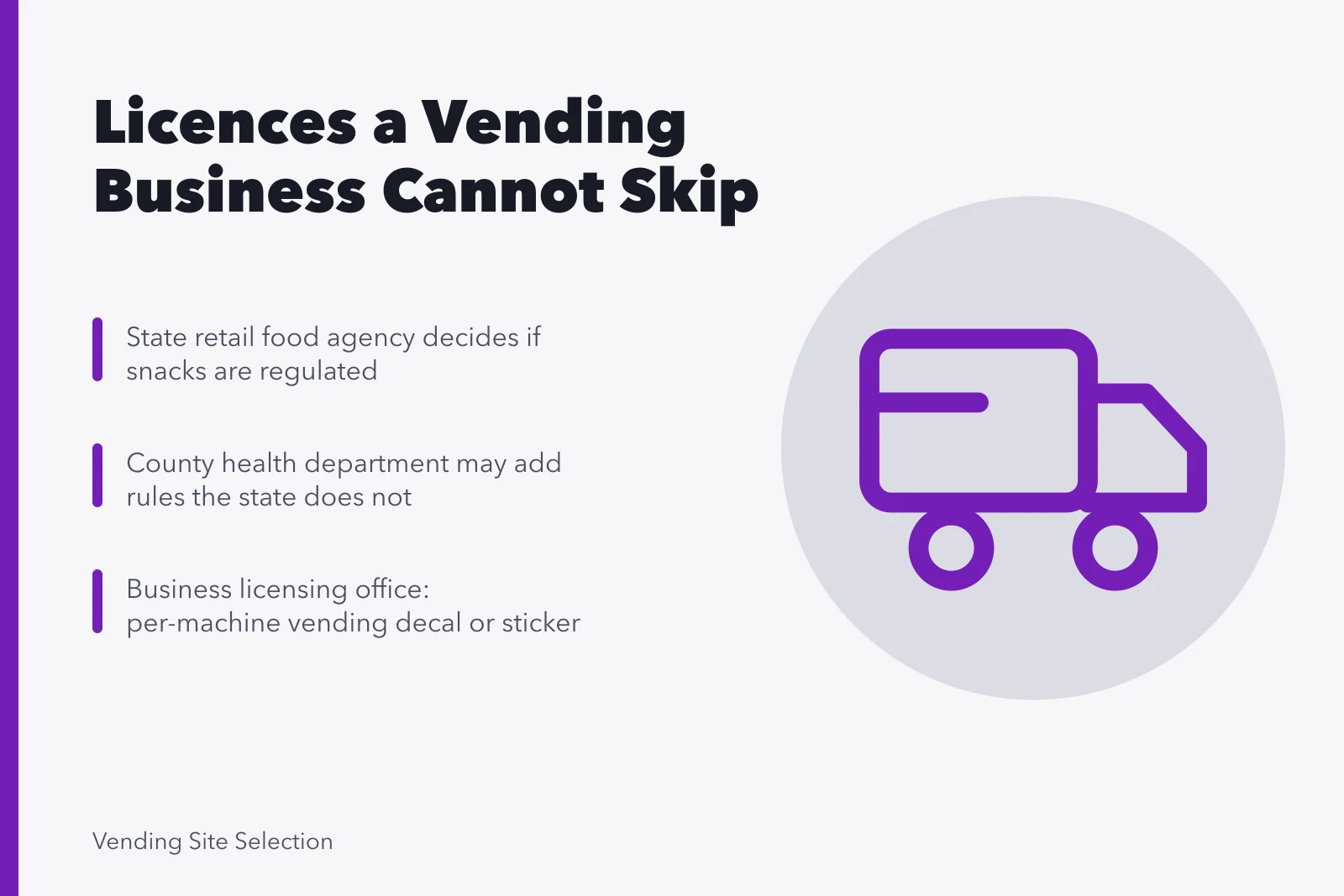
Office one: the state retail food agency
This is usually the first call, because the answer determines whether everything else is simple or not.
Find your agency through the U.S. Food and Drug Administration: State Retail and Food Service Codes and Regulations directory, which lists the responsible body and the code in force by state.
Ask:
- Is a machine vending only packaged, shelf stable snacks and drinks regulated in this state?
- What changes if the machine is refrigerated?
- Is any permit issued per machine, per site or per operator?
- Do I need a commissary or a licensed storage location for stock?
- What records will an inspector want, and what triggers an inspection?
Office two: the county or city health department
In many states, enforcement is delegated locally, and the county answer is the one that actually applies to your machines. Ask the same five questions, and add one: does the county require anything the state does not?
Where the two answers differ, act on the local one and keep a note of both.
Office three: the county or city business licensing office
Ask three things.
- Does an operator based here need a general business license?
- Is there a separate vending device permit, decal or sticker, and is it per machine?
- Does a machine placed in another jurisdiction inside this metropolitan area need anything from that jurisdiction as well?
The last question catches out operators whose route crosses a city line, which most routes eventually do.
Office four: the state revenue department
Sales tax on vending is genuinely variable, and this office is the only reliable source for your state.
Ask whether vending sales are taxable, whether tax is included in the vend price or added at the point of sale, whether any product category is treated differently, what registration is required, and what returns you file and how often. Ask also what records they expect you to keep, because that answer shapes how you record sales from day one.
Office five: the state labor agency, if you hire
The moment someone other than you drives the route, employment obligations arrive. Classification, wage and hour rules, and record keeping all apply, and states add to the federal floor. Start with the federal position and then ask the state agency what else applies where you operate.
What is not a license but behaves like one
Two obligations attach to the machine rather than to the business, and they apply regardless of what any office tells you about permits.
Accessibility first: a machine's approach and operable parts at a public accommodation must meet U.S. Department of Justice: 2010 ADA Standards for Accessible Design.
U.S. Department of Justice: ADA Guide for Small Businesses explains in plainer terms what small businesses in existing facilities must do about barriers. Agree its exact position and clear approach with the host in writing.
The host's own rules are the second. Hospitals, schools, secure sites and government buildings can require background checks, insurance certificates naming them, product restrictions, and specific service hours. None of that is a license and all of it can stop you working. Ask before you sign, not after.
Recording what you are told
Build one file and keep it. For each office: who you spoke to, the date, the question, the answer, and any reference number or document they sent. Where an answer is available on the agency's own site, save the page rather than a summary of it.
That file does three jobs. It tells you what to renew and when. It answers a host who asks whether you are licensed. And it is what you produce if an inspector asks a question you answered eighteen months ago.
Set a date to re-ask everything once a year, and re-ask immediately whenever you add a machine type or product category or take a site in a new jurisdiction. The full map of which layer decides what is set out in the licensing and compliance framework.
Sequencing it with everything else
Licensing runs in parallel with prospecting, not after it. A host asks at the first meeting whether you are licensed.
Saying who you asked and what they said beats a vague yes. Put that in your material when approaching new locations, because a facilities manager is asked to put your equipment in their building.
If you are still at the beginning, fold the call sheet above into the launch sequence during the weeks you are prospecting. Answers sometimes take a fortnight to arrive, and one of them may change what machine you buy.
Common questions
Can I start with one machine and sort the licensing out later?
That is a gamble whose size you cannot know until you have asked, which is the argument for asking first. The calls are free and most are answered the same week. Where a permit is required and not held, the consequence is decided by the agency rather than by how small you are.
Does it matter whether I am a sole proprietor or a company?
It affects your registration and your filings rather than your food or device permits. It also affects what hosts will sign, since many prefer to contract with a registered entity that carries insurance. Ask the licensing office what they register and ask a host what they need to see.
What if an office gives me an unclear answer?
Ask them to point you to the section of the code or the page on their site that says it, and save that. An unclear verbal answer with nothing behind it is not a compliance position, and the person who gave it will not remember the call.