Guides
Reading vending machine suppliers with a sceptical eye
Vending machine suppliers assessed by a 15-point review method covering fill rate, date codes, parts availability and terms, rather than a list of names.
What to take away
- This page names no suppliers, and the reason is given below rather than buried.
- A supplier is judged on what arrives, not on what the catalog says. Fill rate, date codes and delivery reliability decide your machine's performance.
- Machine suppliers and product distributors are different relationships with different failure modes. Assess them separately.
- Run the same fifteen checks on every candidate and the shortlist writes itself.
Why there is no list of company names here
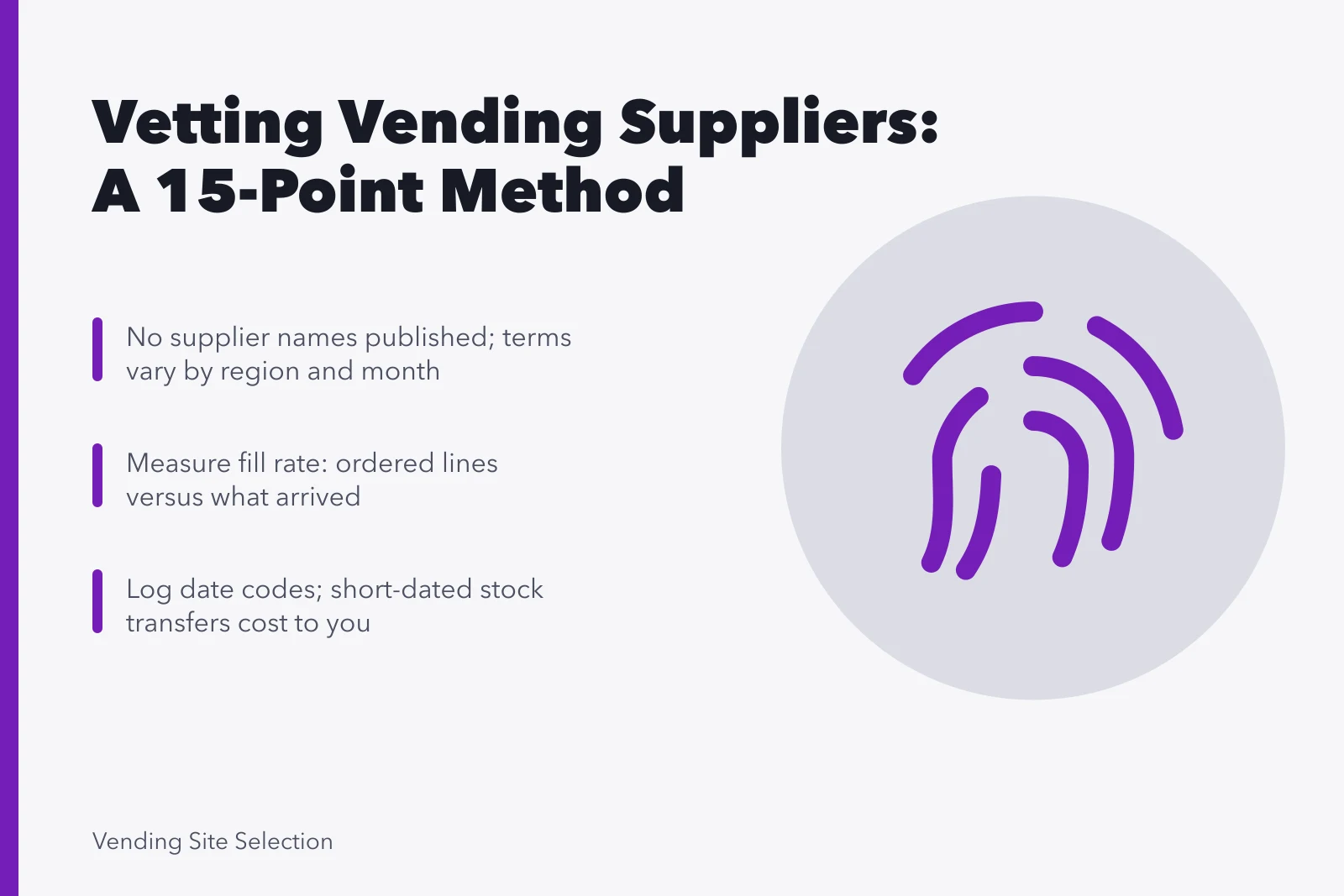
A ranked supplier list would be the easiest thing to publish and the least useful thing to read. Terms, coverage and service quality vary by region and by month.
A distributor that excels in one metropolitan area may not deliver to yours at all. Attaching commentary to real company names would make claims about identifiable businesses nobody here has verified.
So this is a method instead. It is more work than reading a list and it produces an answer that is actually about your route.
Build the candidate list first
Four sources, in the order that produces the fewest dead ends.
Four sources for candidates
- Ask other operators who they left and why
- Ask host locations who delivers to their kitchen
- Check trade association directories and regional grocers
- Start from your machine manufacturer, work to dealers
- Ask other operators in your area who they buy from and, more usefully, who they left and why.
- Ask the host locations you serve who delivers to their kitchen or cafeteria. Foodservice distributors already coming to a building may be an option.
- Look at trade association member directories and regional wholesale grocers rather than search results.
- For machines and parts, start from the manufacturer of the equipment you already own and work outward to authorized dealers and refurbishers.
Aim for a handful of real candidates. Fifteen names you cannot evaluate is worse than four you can.
The fifteen checks
Run these on every candidate. The first eight apply to product distributors, the next four to machine and parts suppliers, and the last three to both.
- Fill rate on ordered lines. Order for a month and record what was ordered against what arrived. This single measurement separates suppliers more sharply than price does.
- Date codes on arrival. Log the code on each delivery. Consistently short dated stock is a cost transferred to you.
- Delivered cost per usable unit. Take the full invoice, including delivery and any minimum order penalty, and divide by units you can actually sell.
- Minimum order value, against one week of your route's real consumption.
- Delivery window reliability. Promised against actual, kept as a simple log.
- Range coverage. List what you actually buy and check how much of it one supplier can cover, because a second supplier means a second minimum.
- How substitutions are handled when a line is out, and whether you are told before or after the truck arrives.
- Credit terms and what happens to them if you miss a payment.
- For machinesparts availability for that model, and for how many years. A cheap machine with no bill validator parts is a liability.
- For machineswhether the unit is new, refurbished or as is, and what that word means in their contract rather than in general.
- For machineswhat warranty exists, who performs the work, and whether the machine has to be shipped for service.
- For machineswhat the delivery includes. Placement inside a building, up a step, through a narrow door, is not always part of the price.
- Who answers the phone when something is wrong, and how quickly.
- Whether the supplier sells to your competitors in the same buildings, which is normal but worth knowing.
- What ending the relationship looks likenotice, returns, and any stock you are left holding.
Scoring without pretending to be precise
Do not build an elaborate weighted model. Score each candidate on each check as acceptable, marginal or disqualifying, and treat any disqualifying result as final regardless of price.
Scoring with veto checks
Can the supplier supply parts for a machine you own?
keep as a candidate for that machine
disqualify for that machine, whatever else they do well
Two checks deserve veto power: a supplier who cannot supply parts for a machine you own is not a supplier for that machine, whatever else they do well.
A distributor with a poor fill rate costs you sales at every machine, every cycle. No case discount repairs that. Slot the survivors into your stock control and ordering routine and see how they behave in practice.
Trial before commitment
Run a real trial rather than a sample order. Order the way you would normally order, for at least a month, and keep the log. A supplier's first delivery is always their best one.
What to watch in a trial
- What happens when you call with a problem
- What happens when a line is out of stock
- Whether the invoice matches what was ordered
- Keep invoices and delivery notes as evidence
During the trial, watch three things that never appear in a quote: what happens when you call with a problem, what happens when a line is out of stock, and whether the invoice matches what was ordered. Those three predict the relationship better than the price sheet.
Keep the invoices and the delivery notes. Purchase records are part of what the Internal Revenue Service: What kind of records should I keep? guidance expects a business to retain, and they are also the only evidence you will have in a dispute.
Two things a supplier cannot settle for you
A supplier will tell you what a machine can do, but not what your site requires.
Where a machine stands in a place of public accommodation, the installation must meet the access requirements set out in the U.S. Department of Justice: 2010 ADA Standards for Accessible Design. That is your responsibility and the host's, not the seller's.
A supplier will not tell you if the product you buy is allowed in your machine under local food rules. The state or county health department gives that answer. The U.S. Food and Drug Administration: State Retail and Food Service Codes and Regulations directory names the agency to ask.
Before you order, check it, and check the licensing position for your operation at the same time.
The wider sourcing framework explains how these supplier decisions feed the planogram, and if you are placing a first machine the supplier choice can wait until the site is signed. It becomes urgent again when you move into an area your current distributor does not cover.
Common questions
Should I use one supplier or several?
One primary supplier is simpler and usually cheaper per unit. A second, even a small one, is insurance against a missed delivery emptying every machine at once. Most routes settle on a main supplier and a fallback they use often enough to stay a customer.
Is buying machines from an auction or a private seller a mistake?
Not necessarily, but the risk moves to you entirely. Ask for the model number, check that parts are still available, and assume the bill validator and refrigeration will need attention. Price the machine as purchase plus expected repairs, not as the hammer price.
How do I tell a refurbished machine from a repainted one?
Ask what was actually replaced and get it in writing. A genuine refurbishment lists components. A repaint describes the finish. If the seller cannot say which parts are new, treat the machine as used and price it that way.